Key takeaways
- Color temperature: Stay at 2700K or below for any fixture you use after dark. Anything at 3000K and up pushes more short-wavelength light into your eyes, which is the wrong message to send your body clock at 9pm. Warm white is not just a style preference — it’s the sleep-friendly choice.
- Dimming quality: A bulb that only dims to 20% before flickering or dropping out is nearly useless in the evening. Look for genuinely dimmable drivers, confirm your dimmer is LED-compatible, and test the low end first. Deep, smooth dimming is the single most valuable feature here.
- CRI (color rendering): 90+ CRI bulbs render skin, wood, and food far more naturally than budget 80 CRI models. In a dining room this matters aesthetically, but it also reduces the low-grade visual strain that makes people reach for brighter settings than they need.
- Filament versus frosted, and glare: Clear filament bulbs look gorgeous but expose bright points of light. If your chandelier aims bulbs downward at seated eye level, frosted glass or a lower-lumen bulb will be kinder to your eyes across a long dinner.
- Lumens and quantity: Multiply per-bulb lumens by socket count before you buy. Six 600-lumen bulbs is 3,600 lumens overhead — plenty for a kitchen, far too much for a relaxed evening unless you can dim it. Buying multipacks also means every bulb ages at the same rate, so your fixture stays visually consistent.
What's inside
Most people shop for chandelier bulbs the way they shop for batteries — grab whatever fits the socket and move on. But a chandelier usually hangs in a dining room, entryway, or bedroom: the exact spaces where you wind down at the end of the day. As someone who spends their working hours helping people protect their circadian rhythm, I’d argue the six little candelabra bulbs over your table have more influence on your evening than your mattress does. Light is the strongest signal your body has for deciding whether it’s time to be alert or time to start producing melatonin.
This guide looks at chandelier bulbs through that lens. Below you’ll find the specs that actually matter for evening comfort — color temperature, dimming behavior, color rendering, and glare control — plus honest notes on five sets of E12 candelabra bulbs worth installing in 2026, including where an old-fashioned incandescent still earns its place.
As an Amazon Associate we earn from qualifying purchases.




🛒 Best Price Today on Amazon
Prime members get fast, free shipping on everything above, plus member-only deals. New members get a 30-day free trial — cancel anytime.
How to Choose a/an Chandelier Light Bulbs (2026)
- Color temperature: Stay at 2700K or below for any fixture you use after dark. Anything at 3000K and up pushes more short-wavelength light into your eyes, which is the wrong message to send your body clock at 9pm. Warm white is not just a style preference — it’s the sleep-friendly choice.
- Dimming quality: A bulb that only dims to 20% before flickering or dropping out is nearly useless in the evening. Look for genuinely dimmable drivers, confirm your dimmer is LED-compatible, and test the low end first. Deep, smooth dimming is the single most valuable feature here.
- CRI (color rendering): 90+ CRI bulbs render skin, wood, and food far more naturally than budget 80 CRI models. In a dining room this matters aesthetically, but it also reduces the low-grade visual strain that makes people reach for brighter settings than they need.
- Filament versus frosted, and glare: Clear filament bulbs look gorgeous but expose bright points of light. If your chandelier aims bulbs downward at seated eye level, frosted glass or a lower-lumen bulb will be kinder to your eyes across a long dinner.
- Lumens and quantity: Multiply per-bulb lumens by socket count before you buy. Six 600-lumen bulbs is 3,600 lumens overhead — plenty for a kitchen, far too much for a relaxed evening unless you can dim it. Buying multipacks also means every bulb ages at the same rate, so your fixture stays visually consistent.
The Best Chandelier Light Bulbs (2026)s Reviewed
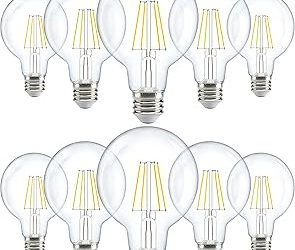
12-Pack Dimmable E12 LED Candelabra Bulbs, 2700K, 450 Lumens
A sensible default for most chandeliers: 4W of draw, 450 lumens, true 2700K, and clear filament glass in the classic B11 shape. The twelve-pack means you can re-lamp an entire fixture in one pass, which keeps the color and brightness perfectly matched — a small detail that makes a big visual difference overhead.
Hizashi 90+ CRI LED Candelabra Bulb, 4W 450LM Flame Tip CA10
My pick for dining rooms and bedrooms. The 90+ CRI makes food and faces look genuinely appealing rather than washed out, and the flame-tip CA10 profile softens the filament’s visual punch. UL listing and reliable low-end dimming round out a bulb I’d happily install in a room I intend to relax in.
GvvooHome E12 Candelabra Bulbs, 400LM, 90+ CRI, 12 Pack
At 400 lumens these are the dimmest LEDs in the roundup, which I mean as a compliment — in a six- or eight-arm fixture, that lower output plus 90+ CRI gives you a warm, unhurried evening glow without needing to crank the dimmer down. Excellent value for bedroom chandeliers and hallway sconces.
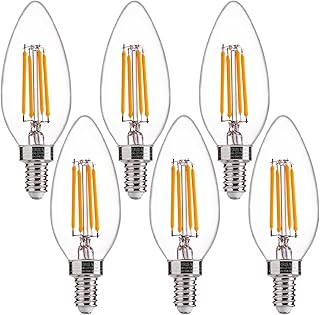
60W Equivalent LED Filament Candelabra Bulbs, Clear B11, 6 Pack
The right choice when a chandelier is doing real work — an entryway, a stairwell, or a kitchen island where you need genuine brightness. The six-pack suits smaller fixtures, and the 2700K output keeps things warm even at higher lumen levels. Pair with a good dimmer so you can pull it back at night.
60W Candelabra Incandescent Bulbs, E12 B10 Clear, 600 Lumen, 12-Pack
Incandescents aren’t efficient, but they dim to a genuinely amber, candlelike glow that most LEDs can’t replicate, and they never flicker. If you have a temperamental old dimmer or a formal dining room used mainly in the evening, these are still the most sleep-friendly light in the group.
Frequently Asked Questions
Does warm white light really help me sleep better?
Warm light won’t put you to sleep, but bright cool light in the evening can delay melatonin release and push your body clock later. Keeping overhead fixtures at 2700K and dimming them after dark removes an obstacle to falling asleep on time.
Why do my LED chandelier bulbs flicker when dimmed?
Almost always a dimmer mismatch. Older leading-edge dimmers were designed for incandescent loads and struggle with the low wattage of LEDs. Swap in an LED-rated dimmer, or make sure your total connected load meets the dimmer’s minimum.
Should I choose clear filament or frosted bulbs?
Clear filament for upward-facing or shaded fixtures where the sparkle is a feature. Frosted for anything pointing down into a room, since exposed filaments at eye level create glare that tires your eyes over a long evening.
Can I mix wattages or color temperatures in one fixture?
Try not to. Even a 200K difference reads as an obvious mismatch when bulbs sit side by side, and uneven brightness makes a chandelier look broken rather than intentional. Re-lamp the whole fixture at once.
Final Thoughts
For most homes, the Hizashi 90+ CRI flame-tip set is the one I’d install first — warm, high-fidelity light with dimming that holds together at the low end. The GvvooHome 400-lumen twelve-pack is the better call for bedrooms and any fixture with lots of sockets, and if your dining room is strictly an evening space with an aging dimmer, the 60W B10 incandescents still deliver the warmest, calmest light on this list.