Key takeaways
- Color temperature: Stay at or below 3000K for evening use. Warm light carries less short-wavelength energy, which is the portion of the spectrum most closely tied to melatonin suppression. Lamps offering multiple color modes let you run neutral white for daytime tasks and switch to warm for wind-down.
- Dimming range, not just dimming: Three-step dimming is workable, but stepless dimming is better — the lowest setting on a continuous dial is usually far dimmer than the lowest of three presets, which matters in the final twenty minutes before lights out.
- Shade opacity and beam direction: A fabric or opaque drum shade pushes light down onto the page and keeps the bulb out of your line of sight. Fully exposed bulbs and translucent glass shades create glare and disturb a sleeping partner.
- Height relative to your mattress: Aim for the bottom of the shade to sit roughly at shoulder height when you’re propped up reading. Lamps in the 14″–16″ range suit low platform beds; 20″–25″ models are better matched to taller frames and thicker mattresses.
- Controls and charging: Touch bases and rotary knobs are easier to operate half-asleep than inline cord switches. Built-in USB-A and USB-C ports — and ideally a pass-through AC outlet — reduce cable clutter and keep chargers off the floor.
What's inside
Most bedroom lighting is designed for the wrong task. Overhead fixtures flood a room with bright, cool light that tells your brain it’s still midday, while the average decorative lamp scatters glare across the page instead of onto it. The result is a familiar nightly compromise: you either read in light that’s too harsh and stimulating, or you squint through something so dim your eyes fatigue after ten pages. Neither serves the goal, which is a gentle handoff between wakefulness and sleep.
From a sleep-wellness perspective, the ideal bedside lamp does three things well: it delivers warm, low-blue light in the 2700K–3000K range, it dims low enough that you can taper brightness as bedtime approaches, and it aims light downward onto your book rather than into your partner’s eyes. This guide evaluates six current nightstand lamps against those criteria, along with the practical details that matter at 11 p.m. — touch controls you can find in the dark, USB-C for the phone that lives beside you, and a footprint that doesn’t crowd a small table.
As an Amazon Associate we earn from qualifying purchases.


🛒 Best Price Today on Amazon
Prime members get fast, free shipping on everything above, plus member-only deals. New members get a 30-day free trial — cancel anytime.
How to Choose a Nightstand Reading Lamp (2026)
- Color temperature: Stay at or below 3000K for evening use. Warm light carries less short-wavelength energy, which is the portion of the spectrum most closely tied to melatonin suppression. Lamps offering multiple color modes let you run neutral white for daytime tasks and switch to warm for wind-down.
- Dimming range, not just dimming: Three-step dimming is workable, but stepless dimming is better — the lowest setting on a continuous dial is usually far dimmer than the lowest of three presets, which matters in the final twenty minutes before lights out.
- Shade opacity and beam direction: A fabric or opaque drum shade pushes light down onto the page and keeps the bulb out of your line of sight. Fully exposed bulbs and translucent glass shades create glare and disturb a sleeping partner.
- Height relative to your mattress: Aim for the bottom of the shade to sit roughly at shoulder height when you’re propped up reading. Lamps in the 14″–16″ range suit low platform beds; 20″–25″ models are better matched to taller frames and thicker mattresses.
- Controls and charging: Touch bases and rotary knobs are easier to operate half-asleep than inline cord switches. Built-in USB-A and USB-C ports — and ideally a pass-through AC outlet — reduce cable clutter and keep chargers off the floor.
The Best Nightstand Reading Lamps (2026) Reviewed
Touch Bedside Lamp with AC Outlet and USB A+C
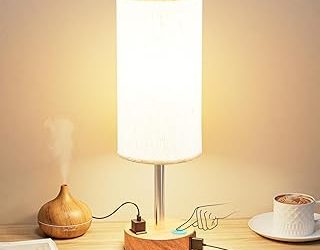
This is the most complete nightstand solution here: high-sensitivity touch dimming across three levels, dual USB ports, and a pass-through AC outlet that effectively turns the lamp into a bedside power hub. The warm wooden finish and eye-care LED bulb suit evening reading well, and the touch base is genuinely responsive rather than requiring a firm tap.
25″ Stepless Dimmable Minimalist Bedside Lamp
The standout pick for anyone with a tall bed frame or a low nightstand, and the only model here with truly stepless dimming — you can dial output down to a whisper rather than jumping between fixed levels. Its 9W 3000K bulb and slim profile make it a strong fit for modern bedrooms where a bulky shade would dominate.
Bedside Table Lamp with 3-Way Dimming and Wood-Grain Base
At 14 inches, this compact lamp is built for crowded nightstands and smaller rooms without sacrificing features: touch dimming, USB-A and USB-C, an AC outlet, and a fabric shade that controls glare properly. A sensible choice for guest rooms and dorms where you want capability in a small footprint.
BOHON LED Desk Lamp with Auto-Dimming Induction
The most technical option, with a flexible gooseneck, three color modes, and intelligent induction dimming that adjusts to ambient conditions. The articulating neck lets you aim light precisely at the page — ideal if you share a bed and need to keep spill light contained.
ONEWISH Industrial Fully Dimmable Table Lamp
A design-forward pick that doesn’t compromise on sleep hygiene: full dimming paired with an included 2700K bulb, which is the warmest color temperature in this roundup and the closest to candlelight. Best suited to bedrooms where the lamp needs to look intentional as well as function well.
Frequently Asked Questions
What brightness should a reading lamp be?
Roughly 400–800 lumens at the brightest setting is ample for reading print at close range. What matters more is the bottom of the range — you want the option to drop well below 100 lumens in the last stretch before sleep.
Is warm light actually better for sleep?
Yes, though intensity matters as much as color. Warm light at 2700K contains less blue wavelength energy than daylight-balanced bulbs, but a very bright warm lamp will still be stimulating. Combine warm color with low output for the best result.
Do I need a smart lamp?
Not for reading. A reliable dimmer and a warm bulb accomplish the sleep-relevant work; app control and scheduling are conveniences rather than requirements, and they add a screen to a routine that benefits from fewer screens.
Should the lamp have a USB-C port?
If your phone or e-reader charges beside the bed, yes — it consolidates cables and removes the temptation to reach for a floor-level charger. Look for lamps with both USB-A and USB-C to cover older accessories.
Final Thoughts
For most bedrooms, the Touch Bedside Lamp with AC Outlet and USB A+C offers the best overall balance of warm light, easy dimming, and bedside charging. Choose the 25″ Stepless Dimmable Bedside Lamp if you want the finest control over low-end brightness or have a taller bed, and the 14″ Wood-Grain Bedside Lamp if nightstand space is tight and you still want full functionality.