Key takeaways
- Lumens, matched to volume not ego: A single-bay garage of roughly 250 square feet is well served by 15,000–20,000 lumens. A deep two- or three-bay space with a workbench justifies 30,000 and up. Overshooting creates glare on concrete floors, which is fatiguing rather than helpful, and makes the late-evening circadian hit considerably harder.
- Color temperature and when you work: 6500K is the standard here and it’s genuinely superior for color discrimination and fine detail — reading torque specs, spotting a coolant weep. Just recognize that this is the most melatonin-suppressive part of the visible spectrum. If your garage sessions routinely run past 9 p.m., pair the fixture with a smart plug or dimmer so you’re not blasting daylight into your retinas an hour before bed.
- Panel count and articulation: Six-panel and 6+1 designs let you aim light where the work happens instead of straight down. Three-panel units are more compact and suit low or awkward ceilings, garage door openers, and shallow fixtures. Angle the outer panels slightly downward and outward — never level with your eye line at standing height.
- Physical clearance before you click buy: Measure socket-to-obstruction distance. Deformable bulbs fold slim for installation then expand, sometimes to eight or nine inches across. Confirm the wings won’t foul a door track, joist, or storage shelf.
- Thermal design and driver quality: Aluminum housings with visible fin structures shed heat, and heat is what kills LED output over time. In unconditioned garages that swing from freezing to 100°F, passive cooling is the single best predictor of whether you’ll still be happy in year four.
What's inside
Most people shopping for garage ceiling lighting are solving a visibility problem: the single yellowish bulb overhead throws more shadow than light, and every oil change turns into a game of feel-around-and-hope. But there’s a second variable almost nobody accounts for, and as someone who spends their working life studying how light shapes human physiology, I’d argue it matters just as much. A 6500K daylight panel pumping out 30,000 lumens is, biologically speaking, a small sunrise. Fire that up at 11 p.m. to finish a project, then head straight to bed, and you’ve just told your suprachiasmatic nucleus that morning has arrived. Melatonin onset gets pushed back. Sleep latency stretches. You lie there wondering why you’re wired.
None of that is an argument against bright garage lighting — it’s an argument for choosing it deliberately. Below I’ve assembled the deformable LED garage bulbs worth your money in 2026, evaluated on the usual criteria (output, beam coverage, heat management, fitment in a standard E26 socket) plus one the other roundups skip: how well each one fits into a household that also needs to sleep. You’ll find guidance on lumen matching, panel geometry, timing your usage, and the small habits that let you have surgical-grade brightness in your workspace without paying for it at 2 a.m.
As an Amazon Associate we earn from qualifying purchases.


🛒 Best Price Today on Amazon
Prime members get fast, free shipping on everything above, plus member-only deals. New members get a 30-day free trial — cancel anytime.
How to Choose a Light Bulbs For Garage Ceiling (2026)
- Lumens, matched to volume not ego: A single-bay garage of roughly 250 square feet is well served by 15,000–20,000 lumens. A deep two- or three-bay space with a workbench justifies 30,000 and up. Overshooting creates glare on concrete floors, which is fatiguing rather than helpful, and makes the late-evening circadian hit considerably harder.
- Color temperature and when you work: 6500K is the standard here and it’s genuinely superior for color discrimination and fine detail — reading torque specs, spotting a coolant weep. Just recognize that this is the most melatonin-suppressive part of the visible spectrum. If your garage sessions routinely run past 9 p.m., pair the fixture with a smart plug or dimmer so you’re not blasting daylight into your retinas an hour before bed.
- Panel count and articulation: Six-panel and 6+1 designs let you aim light where the work happens instead of straight down. Three-panel units are more compact and suit low or awkward ceilings, garage door openers, and shallow fixtures. Angle the outer panels slightly downward and outward — never level with your eye line at standing height.
- Physical clearance before you click buy: Measure socket-to-obstruction distance. Deformable bulbs fold slim for installation then expand, sometimes to eight or nine inches across. Confirm the wings won’t foul a door track, joist, or storage shelf.
- Thermal design and driver quality: Aluminum housings with visible fin structures shed heat, and heat is what kills LED output over time. In unconditioned garages that swing from freezing to 100°F, passive cooling is the single best predictor of whether you’ll still be happy in year four.
The Best Light Bulbs For Garage Ceiling (2026)s Reviewed
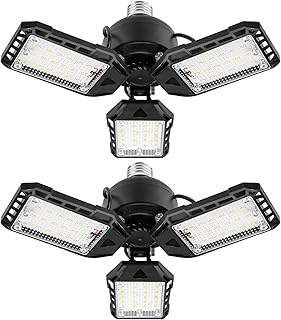
32000LM 6-Panel Garage Lights, 2-Pack
The output leader here, and the right call for oversized or dark-walled garages where you genuinely need to flood the space. Because 32,000 lumens of 6500K is a substantial biological signal, I’d install these on a switched circuit you can dim or a plug-in timer if the garage adjoins bedrooms.
TANBABY 30000LM Deformable Ceiling Light
The 6+1 configuration is the most versatile geometry on this list — six adjustable wings plus a downward center panel that eliminates the dead spot directly beneath the socket. Solid heat sinking and even diffusion make this my default recommendation for a two-bay space.
20000LM LED Garage Ceiling Lights, 2-Pack
For most single-bay garages this is the sensible output tier, delivering plenty of working light without the harsh specular glare that larger units can throw off epoxy or sealed concrete. Also the easiest of the group to live with during evening use.
200W Garage Light Bulbs, 6-Pack
Buying in a six-pack is how you get genuinely uniform coverage across a long garage or shop, since three or four moderate sources always beat one blinding one. Distributed lighting also lets you illuminate only the zone you’re working in — a small change that meaningfully reduces total evening light exposure.
AUDLES 200W 20000LM Shop Lights
A well-executed 6+1 unit with confident build quality and a satisfyingly firm detent on each panel hinge, so your aim stays put. A dependable pick for barns, basements, and workshops where you’ll be adjusting the beam pattern seasonally.
Frequently Asked Questions
Will working in a brightly lit garage at night actually affect my sleep?
Yes, measurably. Short-wavelength-rich light at 6500K suppresses melatonin secretion and delays circadian phase, with effects documented at intensities far below what these fixtures produce. The practical fix is a buffer: finish under bright light, then spend the final 45–60 minutes before bed under warm, dim household lighting.
Should I choose a warmer bulb instead?
Only if your garage doubles as a living or hobby space. For genuine mechanical and detail work, 6500K provides the contrast rendering you need, and downgrading to 3000K trades away real safety and accuracy. Better to keep daylight output and control when you use it.
Can these be installed in an enclosed or covered fixture?
Generally no. Deformable panels need to expand and require open air to dissipate heat; enclosing them traps thermal load and shortens lifespan considerably. Bare porcelain sockets and open-cage fixtures are ideal.
How many bulbs does a standard two-car garage need?
Two units in the 20,000–30,000 lumen range, spaced roughly a third of the way in from each end wall, handles most two-car garages cleanly. Adding a third near the workbench beats increasing brightness overhead.
Final Thoughts
For most readers the TANBABY 30000LM deformable light is the balanced choice — thoughtful panel geometry, ample output, sound thermal engineering. Step up to the 32000LM 6-panel set if your space is genuinely cavernous, or go with the 200W six-pack if you’d rather distribute several moderate sources and gain the ability to light just one zone at a time. Whichever you choose, put it on a dimmer or a timer, and treat the last hour before bed as a low-light hour. Your workspace and your sleep architecture can both win here.