Key takeaways
- Match PSI to the surface, not your ego: Roughly 1500–2000 PSI handles cars, patio furniture, and painted siding; 2000–3000 PSI covers fences, decks, and most concrete; above 3000 PSI is for stubborn driveway staining and heavy prep work. Excess pressure etches wood, strips paint, and destroys mortar.
- Read GPM before PSI: Pressure breaks the grime loose, but water volume carries it away. A machine at 2.6 GPM will finish a driveway in a fraction of the time of one at 1.76 GPM, even at similar pressure. Cleaning Units (PSI × GPM) is the honest comparison metric.
- Treat inflated PSI claims with suspicion: Any 120V corded unit is limited by the roughly 1800 watts your household outlet supplies. Listings advertising 5000 PSI are typically quoting an unloaded peak or an internal figure that bears little resemblance to what reaches the nozzle. Judge those models on usability and value, not the number on the box.
- Consider noise as a real spec: Gas engines run in the 85–95 dB range — protective-equipment territory, and genuinely disruptive to anyone napping or working nearby. Induction-motor electrics run markedly quieter and are the better choice for townhomes, early mornings, and households with small children or shift workers.
- Look at the ergonomics you’ll actually feel: Onboard soap tanks, generous hose length, a hose reel, and a steel wand reduce the bending, dragging, and repositioning that leaves you wrecked. Weight matters too — a machine you dread wheeling out is a machine you won’t use.
What's inside
Ask anyone who has spent a Saturday scrubbing a deck by hand, and they’ll describe the same aftermath: aching shoulders, a sunburned neck, and a body too wired and sore to settle down that night. As someone who spends most of my working hours helping people protect their rest, I’ve come to see outdoor maintenance as a sleep issue in disguise. The wrong pressure washer turns a two-hour job into a six-hour ordeal, and physical overexertion late in the day is one of the more reliable ways to sabotage your own recovery. The right one gets the driveway done before dinner and leaves your evening intact.
The trouble is that pressure washer shopping has become an arms race of numbers. Listings shout 5000 PSI at you as though more is automatically better, while quietly saying nothing about flow rate, motor type, or how loud the machine will be at seven in the morning while your neighbors are still asleep. This guide sorts the meaningful specs from the marketing noise, then walks through the models worth your attention in 2026 — including where the headline figures deserve a healthy dose of skepticism.
As an Amazon Associate we earn from qualifying purchases.




🛒 Best Price Today on Amazon
Prime members get fast, free shipping on everything above, plus member-only deals. New members get a 30-day free trial — cancel anytime.
How to Choose a Pressure Washer Best Psi (2026)
- Match PSI to the surface, not your ego: Roughly 1500–2000 PSI handles cars, patio furniture, and painted siding; 2000–3000 PSI covers fences, decks, and most concrete; above 3000 PSI is for stubborn driveway staining and heavy prep work. Excess pressure etches wood, strips paint, and destroys mortar.
- Read GPM before PSI: Pressure breaks the grime loose, but water volume carries it away. A machine at 2.6 GPM will finish a driveway in a fraction of the time of one at 1.76 GPM, even at similar pressure. Cleaning Units (PSI × GPM) is the honest comparison metric.
- Treat inflated PSI claims with suspicion: Any 120V corded unit is limited by the roughly 1800 watts your household outlet supplies. Listings advertising 5000 PSI are typically quoting an unloaded peak or an internal figure that bears little resemblance to what reaches the nozzle. Judge those models on usability and value, not the number on the box.
- Consider noise as a real spec: Gas engines run in the 85–95 dB range — protective-equipment territory, and genuinely disruptive to anyone napping or working nearby. Induction-motor electrics run markedly quieter and are the better choice for townhomes, early mornings, and households with small children or shift workers.
- Look at the ergonomics you’ll actually feel: Onboard soap tanks, generous hose length, a hose reel, and a steel wand reduce the bending, dragging, and repositioning that leaves you wrecked. Weight matters too — a machine you dread wheeling out is a machine you won’t use.
The Best Pressure Washer Best Psi (2026)s Reviewed
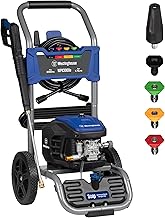
Westinghouse WPX3000e Electric
This is my default recommendation for most homeowners: a genuine 3000 max PSI from an induction motor, which means quieter operation, less vibration, and a far longer service life than the universal motors in budget units. At 1.76 GPM it isn’t the fastest on wide concrete, but for siding, fences, and driveways it hits the sweet spot between capability and civility.
Westinghouse WPX3400 Gas
The 3400 PSI and 2.6 GPM pairing here is what actually shortens a big job — nearly 50% more water moving through the wand than the electric models, with no cord to manage. Reserve it for large properties and accept the tradeoff: it’s loud, needs fuel and oil, and is a poor neighbor before nine in the morning.
Westinghouse ePX3500 Electric
A well-sorted 2500 PSI compact with anti-tipping geometry that keeps it upright when you tug the hose from an awkward angle — a small feature that spares you a lot of walking back. The pro-style steel wand and five-nozzle set make it more versatile than its footprint suggests.
Westinghouse ePX3100v Electric
At 2100 PSI with a detachable foam cannon and a carry handle instead of a cart, this is the sensible pick for car care, patio sets, and apartment balconies. It’s the gentlest of the group on delicate finishes, which is precisely why it’s the one I’d hand to a first-time user.
Adjustable 5000 PSI Electric (2026)
Ignore the 2500–5000 PSI badge; the meaningful feature is the variable pressure dial, which lets you dial back for teak furniture and open up for concrete without swapping nozzles. GFCI protection and a detergent tank are welcome, and as a low-cost secondary machine it earns its place.
Frequently Asked Questions
Is more PSI always better?
No. Pressure above what a surface can tolerate causes permanent damage — furring on cedar, stripped paint, pitted composite decking. Buy for your hardest job, then use the widest nozzle that gets the work done.
Are 5000 PSI electric models legitimate?
Not at that figure. Household current physically caps what a corded pump can produce, so expect real-world output well under half the advertised number. Several are still perfectly serviceable machines — just not five-thousand-PSI machines.
Electric or gas for a typical suburban lot?
Electric, in most cases. It’s quieter, starts instantly, needs no maintenance beyond winterizing, and 2500–3000 PSI covers the overwhelming majority of residential cleaning.
Does this really affect sleep?
Indirectly but meaningfully. Heavy physical strain and loud noise exposure in the late afternoon elevate arousal well into the evening, and the resulting soreness fragments sleep. Finishing earlier with less effort is the practical fix.
Final Thoughts
For most households, the Westinghouse WPX3000e is the buy — quiet, durable, and powerful enough for nearly everything a home throws at it. Choose the WPX3400 if you have serious acreage and can live with the noise, or the ePX3100v if cars and patio furniture are the whole of your list and you’d rather not own a machine that intimidates you.