Key takeaways
- Cut power at the breaker, not just the wall switch, and let bulbs cool fully — cold liquid on a hot bulb can shatter it.
- Remove bulbs and any fabric or paper shades entirely. Drip-dry formulas are meant to run off hard surfaces; fabric will wick and stain.
- Lay a drop cloth or plastic sheeting over the table and floor beneath, extending at least two feet past the fixture’s widest point, then put a folded towel on top to absorb runoff.
- Bag or cover the socket cups with small plastic sandwich bags secured with a twist tie so liquid never enters the wiring.
What's inside
Most people think of a chandelier as decoration. In a bedroom, dining room, or hallway you pass through at midnight, it is also a piece of sleep equipment. Crystal is a lens: when it is clear, it scatters light into broad, soft, low-glare pools. When it is coated in months of dust, oil vapor, and skin cells, that same fixture stops refracting and starts diffusing — the beam turns flat and hazy, and you compensate by turning the dimmer up. Brighter evening light in the 20–200 lux range is exactly the input that delays melatonin release and pushes your body clock later. Cleaning your crystals is, unglamorously, a way of getting to sleep on time.
There is a second reason I raise this with clients. A multi-arm fixture is a horizontal dust shelf suspended over your breathing zone, and every time forced-air heating kicks on, some of that load falls. Sleeping under a dusty chandelier means eight hours of low-grade nasal irritation and congestion, which fragments sleep even when you never fully wake. Below, I’ll walk through the method I actually recommend — the no-wipe drip-dry approach that professional fixture cleaners use — plus how to protect the finish, what to do about fabric shades and floors, and how often this needs to happen. Our recommended products are grouped first.
As an Amazon Associate we earn from qualifying purchases.



🛒 Best Price Today on Amazon
Prime members get fast, free shipping on everything above, plus member-only deals. New members get a 30-day free trial — cancel anytime.
Why the No-Wipe, Drip-Dry Method Wins
The traditional method — cotton gloves, a bowl of vinegar water, one prism at a time — is thorough and miserable, and it is where most chandelier damage originates. Every prism you unhook is a prism you may rehang crooked, and every pin you bend is a permanent sag in the tier. Drip-dry cleaners are formulated to be sprayed on generously and left entirely alone: the solvent lifts soil, then carries it off the bottom edge of each crystal as it evaporates, taking the grime with it. No contact, no handling, no reassembly. A dedicated formula such as Sparkle Plenty Chandelier Cleaner Drip Dry Spray or the Chandelier Cleaner Spray 32 oz No-Wipe is built around that evaporation curve; household glass cleaner is not, and will streak or leave residue rings as it dries unevenly on curved facets.
Check What Your Fixture Is Actually Made Of
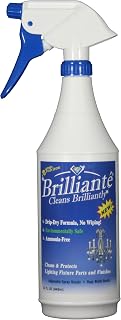
Before anything gets wet, identify your material. Leaded crystal and standard glass are both robust. Acrylic prisms — common on budget and rental fixtures — craze and cloud permanently when hit with ammonia or acetone, so an ammonia-free formula is non-negotiable; the BRILLIANTÉ Crystal Chandelier Cleaner line is explicitly ammonia-free and safe on acrylic as well as crystal. Antique fixtures deserve extra caution: gilded, painted, or gold-leafed arms, plus any silk-wrapped wiring, should be shielded from spray rather than saturated. If your prisms are strung on brass pins that have already tarnished green, treat that as a signal to consult a restorer instead of soaking the frame.
Prep the Room, Not Just the Fixture
- Cut power at the breaker, not just the wall switch, and let bulbs cool fully — cold liquid on a hot bulb can shatter it.
- Remove bulbs and any fabric or paper shades entirely. Drip-dry formulas are meant to run off hard surfaces; fabric will wick and stain.
- Lay a drop cloth or plastic sheeting over the table and floor beneath, extending at least two feet past the fixture’s widest point, then put a folded towel on top to absorb runoff.
- Bag or cover the socket cups with small plastic sandwich bags secured with a twist tie so liquid never enters the wiring.
Spray Technique: Generous, Top-Down, Then Walk Away
Timid spraying is the most common mistake. You need enough liquid that it visibly sheets off the lowest crystals, because the runoff is the cleaning mechanism. Work from the top tier downward in overlapping passes, rotating around the fixture so every face gets hit, and keep going until the drips running off are clear rather than gray. For high foyer fixtures, a long-throw sprayer that reaches up to 25 feet lets you clean from the ground and skip the ladder entirely — genuinely the safest option for a two-story entry. Heavily soiled kitchen-adjacent fixtures with cooking film may need a second application; a stronger-cutting formula like the Jaxry Professional Crystal Chandelier Cleaner handles greasy dust better than a light-duty spray. Then leave it. Do not blot, do not buff. Touching a drying prism is what creates streaks.
Build a Realistic Schedule
For a bedroom or nursery fixture, or any home with allergy sufferers, plan on a full drip-dry treatment every three to four months, with a dry microfiber duster pass every few weeks in between. Dining and living room fixtures can stretch to twice a year. Kitchens with an open plan need quarterly attention regardless, because aerosolized cooking oil binds dust into a film that only gets harder to remove. Buying a gallon refill rather than repeat spray bottles makes a quarterly habit considerably cheaper to sustain.
Tips
- Clean in the morning with windows open — you want airflow and hours of drying time before you need the light on.
- Photograph the fixture from three angles before you start, so you have a reference if a prism does get knocked loose.
- Wipe bulbs separately with a dry cloth while they’re out; a filmed bulb costs you real lumens.
- After cleaning, re-check your dimmer setting. A clean fixture reads noticeably brighter, and you can usually dial evening light down a notch or two — which is the sleep benefit you came for.
Frequently Asked Questions
Can I just use vinegar and water instead?
You can, but it must be wiped, which means handling every prism. Vinegar also dries with visible mineral streaking if your tap water is hard, and it can dull metal finishes over time. The cost of a dedicated formula is low relative to the labor it saves.
Will the spray damage my hardwood floor or dining table?
Runoff is mostly water and alcohol, so brief contact is rarely dramatic — but pooled liquid on wood will leave a mark. Sheeting plus an absorbent towel underneath eliminates the risk entirely, and it takes two minutes to set up.
How do I know when the crystals are truly clean?
Turn the fixture on after it dries and look for rainbow scatter on the nearby walls and ceiling. Clean crystal throws distinct colored fragments of light; dirty crystal produces only a general glow. That scatter pattern is your test.
Is a dusty chandelier really affecting my sleep?
Indirectly but measurably. It pushes you toward brighter evening lighting, and it adds particulate to the air directly above your bed. Neither effect is dramatic alone, and both are cheap to remove.
Conclusion
Treat your chandelier as part of your lighting hygiene rather than an ornament you dust when guests are coming. Cut the power, protect the surfaces below, spray an ammonia-free drip-dry formula generously from the top down, and leave it strictly alone to evaporate — that is the whole method, and it takes about twenty minutes for a fixture that hasn’t been touched in a year. Do it quarterly, then turn your evening lights down to match the recovered brightness, and you’ll have improved both your rooms and your sleep for the price of a bottle of cleaner.