Key takeaways
- Simplicity is Speed
- Includes Harness and Batteries
- 5 Year Warranty
The best avalanche beacons for most backcountry users in 2026 are 3-antenna digital beacons with 60-70 meter search range, intuitive direction and distance display, and a dedicated group-check mode — the Mammut Barryvox S2, BCA Tracker S, Arva Neo BT Pro, and Ortovox Diract Voice lead this group because they balance fast fine-search accuracy, long battery life, and simple interfaces under stress.
Our top picks
 BCA Backcountry Access Tracker S Avalanche Beacon
- Simplicity is Speed
- Includes Harness and Batteries
- 5 Year Warranty
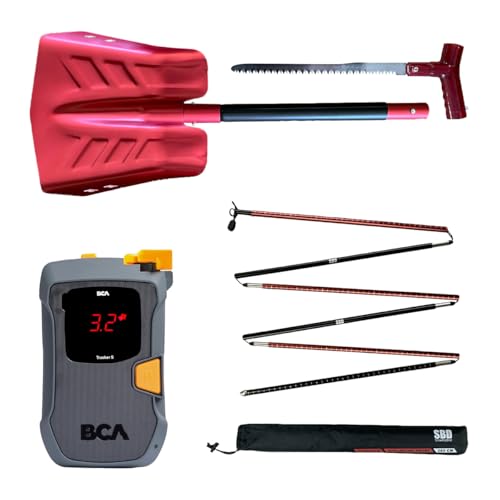 SnowBigDeal Avalanche Rescue Bundle
- Complete Avalanche Rescue Kit
- Trusted BCA Tracker S Beacon
- SnowBigDeal 260cm Aluminum Probe
 Bundle Backcountry Access BCA Tracker 3 Avalanche
- ✅ Avalanche Beacon - This avalanche gear package…
- ✅ Avalanche Probe - After locating the backcountry…
- ✅ Tracker Avalanche Beacons & transceivers are must…
| Product | Key specs | |
|---|---|---|
| BCA Backcountry Access Tracker S Avalanche Beacon | Simplicity is Speed Includes Harness and Batteries 5 Year Warranty | Check price |
| SnowBigDeal Avalanche Rescue Bundle | Complete Avalanche Rescue Kit Trusted BCA Tracker S Beacon SnowBigDeal 260cm Aluminum Probe | Check price |
| Bundle Backcountry Access BCA Tracker 3 Avalanche | ✅ Avalanche Beacon - This avalanche gear package… ✅ Avalanche Probe - After locating the backcountry… ✅ Tracker Avalanche Beacons & transceivers are must… | Check price |
 BCA Tracker 3 Avalanche Transceiver Beacon BCA Tracker 3 Avalanche Transceiver Beacon | 3-Antenna Digital Transceiver Multiple Burial Indicator Auto Revert Mode | Check price |
As an Amazon Associate we earn from qualifying purchases at no extra cost to you.
How to Choose an Avalanche Beacon in 2026
An avalanche beacon does not prevent an avalanche. It reduces search time after a burial, when every minute cuts survival odds. All modern beacons transmit on 457 kHz and are compatible with each other, so your decision comes down to how quickly and reliably you can find a signal, how clearly the beacon guides you, and how well it prevents user error during a high-stress search.
Six criteria matter more than marketing names:
- Search range and strip width: Determines how wide your search pattern can be. Most quality beacons list 60-70m maximum range and a 60m search strip width. In practice, usable range is 10-15m less due to burial orientation and interference.
- Antenna performance: All recommended 2026 models use 3 antennas. Three antennas eliminate signal spikes and dead zones during the fine search and give accurate distance and direction even when the transmitting beacon is vertical or angled.
- Interface simplicity: Look for a clear distance number, direction arrow, and automatic switch from coarse to fine search. Fewer buttons and no hidden menus reduce mistakes with gloves on.
- Battery life and type: AAA alkaline or lithium batteries usually deliver 250 to 400 hours in transmit. Rechargeable lithium packs offer USB-C convenience but require stricter cold-weather management.
- Group-check and multiple-burial handling: Group-check mode lets you verify every member is transmitting at the trailhead without cycling through search. Mark/flag functions help isolate signals when more than one person is buried.
- Harness and carry system: A harness-ready design keeps the beacon under your outer layer, close to your body, antenna away from metal and electronics. The beacon should ride with the display facing inward and stay secure during skinning and riding.
Head-to-Head: Top Beacons by Spec
These four models represent the current market standard for recreational and advanced backcountry users. All are 3-antenna digital beacons with 457 kHz compatibility and usually $300–$600 depending on features and bundle.
| Model | Max. Search Range | Search Strip Width | Battery Type | Transmit Battery Life | Weight (with batteries) | Key Feature |
|---|---|---|---|---|---|---|
| Mammut Barryvox S2 | 70 m | 70 m | 3x AAA alkaline | 300 hours | 210 g | Smart search guidance, large display, auto antenna switch |
| BCA Tracker S | 60 m | 50 m | 3x AAA alkaline | 250+ hours | 165 g | Most intuitive single-button operation, real-time display |
| Arva Neo BT Pro | 60 m | 60 m | 3x AAA alkaline / lithium | 350 hours (alkaline) | 190 g | Bluetooth for updates and training, group-check, analog mode |
| Ortovox Diract Voice | 50 m | 50 m | Rechargeable Li-ion (USB-C) | 250 hours | 210 g incl. battery | Voice navigation prompts for each search phase |
| Black Diamond Guide BT (Pieps platform) | 60 m | 60 m | 3x AAA alkaline | 400 hours | 210 g | Circular range with mark function, Bluetooth diagnostics |
Numbers are manufacturer specs for 2026 firmware. Usable range in snow is typically 10 to 20 percent lower. Cold reduces battery output significantly — alkaline capacity can drop 30 to 50 percent at -10°C / 14°F, which is why most guides carry spare AAA batteries inside a warm chest pocket.
Antenna and Signal Processing Differences That Actually Matter
All five beacons above solve the classic spike problem of older 2-antenna units. Differences show up in processor speed and interference handling:
- Mammut Barryvox S2 and Black Diamond Guide BT use intelligent signal processing that automatically selects the best transmitting antenna and filters out overlapping signals. This helps in multiple-burial scenarios where signals compete.
- BCA Tracker S prioritizes raw distance and direction stability with minimal processing lag. It shows real-time distance without smoothing, which some users find faster in the coarse search but requires more practice to follow cleanly.
- Arva Neo BT Pro adds an analog mode for advanced users who want to hear the raw 457 kHz tone for deep burials, useful when digital processing struggles beyond 50 meters.
- Ortovox Diract Voice trades a slightly shorter maximum range for voice instructions that talk you through coarse, fine, and pinpoint search. For users who train infrequently, audible prompts reduce the chance of skipping a step.
Electronic interference is the equalizer. Smartphones, heated gloves, airbag packs, and two-way radios can cut range by half if placed within 20 cm / 8 inches of the beacon. Keep the beacon at least 20 cm from electronics in transmit and 50 cm in search, and always turn off phone airplane-mode-off search interference sources during a search.
Interface and Ease of Use Under Stress
In a real search you are wearing gloves, breathing hard, and managing adrenaline. Interface design outweighs extra features:
- Easiest to learn: BCA Tracker S and Ortovox Diract Voice. Tracker S has one large switch — off / transmit / search — with no menus. Diract Voice replaces screen-reading with spoken commands like “run down” and “probe here.”
- Most information: Mammut Barryvox S2. Large screen shows direction, distance to 0.1m in fine search, number of buried signals, and battery status. It auto-reverts to transmit after 4 minutes of motionlessness if a second avalanche hits the searcher.
- Most configurable: Arva Neo BT Pro and Black Diamond Guide BT. Bluetooth connection to Arva or Pieps apps lets you update firmware, adjust auto-revert timing, and run training modes without extra hardware.
Auto-revert to transmit is now standard and non-negotiable. If you are caught in a secondary slide while searching, the beacon must switch back to transmit so others can find you. All beacons listed have motion-sensor auto-revert; confirm it is enabled before you leave the trailhead.
Which Beacon Fits Your Situation
Use this decision matrix to match your typical group and experience level to the right feature set, rather than buying the most expensive option by default.
| Your Situation | Priority Features | Best Fit in 2026 |
|---|---|---|
| Beginner or occasional tourer, 1-3 tours per season, often with a guide | Minimal buttons, voice or arrow guidance, forgiving fine search | Ortovox Diract Voice or BCA Tracker S |
| Regular recreational group, mixed experience, friends and family | Group-check mode, clear multiple-burial marking, fast processor | Arva Neo BT Pro or Mammut Barryvox S2 |
| Advanced / professional, frequent tours, deep snowpack days | 70m range, analog mode, Bluetooth diagnostics, long battery life | Mammut Barryvox S2 or Black Diamond Guide BT |
| Weight-conscious ski mountaineer or splitboarder | Lightest body, simple harness, AAA availability on long trips | BCA Tracker S (165g) or Arva Neo BT Pro |
| Cold-weather or expedition use (-20°C and below) | Alkaline cold performance, easy field battery swap, no charging dependency | Mammut Barryvox S2, BCA Tracker S, or Black Diamond Guide BT with lithium AAA |
Group-Check, Multiple Burials, and Harness Design
Group-check should be a dedicated mode, not just switching briefly to search at the parking lot. In group-check, the beacon reduces its transmit range to about 1 meter so you have to approach each person to confirm their signal — this catches a beacon that is off, in a pack, or suffering interference. Arva, Mammut, and Pieps/Black Diamond platforms all include this; BCA achieves the same with its close-proximity search.
For multiple burials, all modern beacons allow you to mark a found signal so the beacon ignores it and guides you to the next strongest signal. Expect reliable marking for 3 to 4 signals. Beyond that, no digital beacon is fast — shovel and probe strategy and using multiple searchers matter more than processor speed.
Harness-ready means more than an included pouch. Check that the harness holds the beacon centrally on your chest, under at least one insulating layer, with the tether attached. The pouch should have a secure zip or buckle you can operate with gloves but that will not open if you tumble. All listed beacons ship with a harness. Avoid carrying a beacon in a pants pocket, backpack, or airbag vest pocket where body shielding and distance from interference are compromised.
Battery, Maintenance, and What Wears First
Battery management is the most common failure point, not electronics. Practice these non-negotiable habits:
- Start every tour above 70 percent. Most beacons warn at 20 percent but search performance degrades earlier.
- Use only the battery type recommended by the manufacturer for that model. Do not mix alkaline and lithium or old and new cells. For rechargeable Diract Voice, charge to 100 percent the night before and carry a small USB power bank for multi-day trips.
- Remove batteries for summer storage to prevent corrosion.
- Update firmware annually via Bluetooth or USB. Updates often improve search algorithms and auto-revert logic.
- What wears first is not the beacon but the harness elastic, zipper, and battery door contacts. Check elastic tension, clean contacts with a dry cloth, and replace a stretched harness — a loose beacon swings during a slide and can be torn away.
Store beacons away from magnets, TVs, and laptops. A simple function test before each season at a beacon checker station or by pairing two beacons at 20 meters confirms transmit and search distance has not degraded.
Beyond the Beacon
A beacon alone does not make you safe. In 2026, every recognized avalanche center still lists the essential trio as beacon, 240 cm or longer probe, and sturdy metal shovel. Add an avalanche airbag pack only after those three are dialed and you have practiced single and double-burial scenarios at least twice per season. Search strip width is irrelevant if probing and strategic shoveling are slow — most recoveries finish within 2 meters after the fine search, where probe and shovel speed decides the outcome.
If you are buying your first beacon or replacing a unit older than 7 to 8 years, choose the interface you understand fastest, not the longest spec sheet. A 60-meter beacon you can operate without hesitation will outperform a 70-meter beacon you hesitate to switch.
FAQ
Can I use any beacon with any other beacon?
Yes. All avalanche beacons sold today transmit and search on 457 kHz and are interoperable across brands. Features like marking and group-check work within the searching beacon; they do not require the buried beacon to be the same brand.
How long do avalanche beacons last?
Manufacturers generally recommend retirement after 7 to 10 years, even if the beacon still turns on. Antenna tuning, processor accuracy, and plastic housing integrity degrade, and newer firmware may no longer be supported.
Do I need a beacon with Bluetooth or voice?
No, but both help specific users. Bluetooth simplifies firmware updates and self-checks without visiting a shop. Voice guidance helps infrequent users follow the correct search sequence. If you train monthly, a standard arrow-and-distance display is often faster.