Key takeaways
- Strong cross-bar steel frame
- Supports up to 300 lb
- Max height: 6 ft
The best camping cot for adults is the one whose rated capacity, sleeping length, packed dimensions, and mattress height match your body size and campsite—not simply the cot with the largest surface.
For most adults, a sturdy folding cot with a 300–600 lb capacity, a sleeping surface at least 6 inches longer than their height, and a mattress height between 16 and 20 inches offers the best balance of support and convenience. Smaller campers may prefer a lightweight backpacking cot, while larger adults, side sleepers, and anyone sharing a cot with a child should look at oversized or bunk-style designs.
Our top picks
 Coleman Trailhead II Large Folding Cot with
- Strong cross-bar steel frame
- Supports up to 300 lb
- Max height: 6 ft
 ARAER Camping Cot for Adults
- 【HEAVY DUTY & STABLE】Unique square high strength 25mm…
- 【DETACHABLE MATTRESS FOR FLEXIBLE COMFORT】 Use the included…
- 【Compact & Portable】 Super easy to set up…
 ABORON Camping Cot for Adults
- Cot for Sleeping with Detachable Soft Pad: The…
- Quick Open & Easy Fold: No tools needed—opens…
- Premium 1200D Fabric: Double-layer Oxford resists wear and…
| Product | Key specs | |
|---|---|---|
| Coleman Trailhead II Large Folding Cot with | Strong cross-bar steel frame Supports up to 300 lb Max height: 6 ft | Check price |
| ARAER Camping Cot for Adults | 【HEAVY DUTY & STABLE】Unique square high strength 25mm… 【DETACHABLE MATTRESS FOR FLEXIBLE COMFORT】 Use the included… 【Compact & Portable】 Super easy to set up… | Check price |
| ABORON Camping Cot for Adults | Cot for Sleeping with Detachable Soft Pad: The… Quick Open & Easy Fold: No tools needed—opens… Premium 1200D Fabric: Double-layer Oxford resists wear and… | Check price |
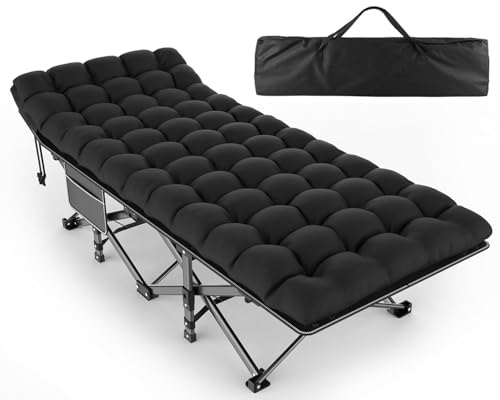 ZENPETIO Camping Cot for Adults ZENPETIO Camping Cot for Adults | Unrivaled Outdoor Comfort & Durability: Experience the ultimate… Superior Stability & 500 LBS Capacity: Rest confidently… Effortless 10-Second Setup: Maximize your adventure time with… | Check price |
As an Amazon Associate we earn from qualifying purchases at no extra cost to you.
Best camping cots for adults by situation
- Best for most car campers: a full-size steel folding cot with a 300–600 lb capacity and a 16–20 inch sleeping height.
- Best for tall or broad adults: an oversized cot such as the TETON Sports Outfitter XXL, provided its packed length and weight fit your vehicle.
- Best for couples, children, or limited tent floor space: the Disc-O-Bed XL, which can be configured as two cots or stacked as a bunk.
- Best for backpacking: a compact aluminum-frame cot such as the Helinox Cot One Convertible, where low packed weight matters more than maximum width.
- Best for a tent-and-bed combination: the Kamp-Rite Oversize Tent Cot, which raises you off wet ground while supplying an integrated shelter.
- Best for occasional guests or simple car camping: the Coleman Pack-Away Cot, especially when an attached side table and uncomplicated folding design are useful.
Head-to-head comparison of adult camping cots
| Cot type or example | Typical capacity | Approx. sleeping size | Approx. packed weight | Mattress height | Best use |
|---|---|---|---|---|---|
| Lightweight aluminum cot, such as Helinox Cot One Convertible | Approximately 320 lb | About 6 ft 3 in long and 2 ft wide | About 5–7 lb | About 4–5 in | Backpacking and compact tents |
| Standard folding steel cot, such as Coleman Pack-Away | Approximately 300–325 lb | About 6 ft 6 in long and 2 ft 6 in wide | About 20–25 lb | About 17 in | Car camping and guest use |
| Oversized folding cot, such as TETON Sports Outfitter XXL | Approximately 600 lb | About 7 ft long and 3 ft wide | About 25–35 lb | About 4–6 in | Tall, broad, or heavier adults |
| Stackable bunk cot, such as Disc-O-Bed XL | Approximately 500 lb per cot, depending on configuration | About 6 ft 6 in long and 2 ft 9 in wide | Often 60 lb or more as a complete set | About 9–18 in depending on bunk position | Families, children, and shared tent space |
| Integrated tent cot, such as Kamp-Rite Oversize Tent Cot | Often around 300–350 lb | Roughly 6 ft 6 in to 7 ft long and 3 ft wide | Often 30–40 lb | About 11–12 in | Uneven, damp, or insect-prone ground |
These figures are useful planning ranges rather than substitutes for the current manufacturer specification. Capacity can change by model revision, and some ratings apply to evenly distributed weight rather than concentrated loads. A foam pad, sleeping bag, and occupant all count toward the practical load placed on the frame.
How body size changes the right cot
For adults under 5 ft 10 in
A sleeping length of 6 ft 3 in is usually sufficient, leaving several inches for a pillow and some movement. A 24–26 inch wide cot is adequate for many back sleepers. If you sleep on your side or turn frequently, look for at least 28 inches of usable width rather than relying on the advertised frame width, which may include rails.
For tall adults
Choose a cot at least 6–8 inches longer than your height. Someone who is 6 ft 3 in should look for a sleeping surface near 7 ft rather than a nominal 6 ft 6 in cot. Check the diagonal space too: end bars can reduce usable length and become uncomfortable if your feet press against them.
For broad or heavier adults
Prioritize both width and capacity. A 600 lb rating does not make a narrow cot comfortable. An oversized cot around 36 inches wide usually feels more stable for larger sleepers than a standard 25-inch model. Avoid sitting heavily on one edge, because folding frames handle distributed lying weight better than concentrated side loads.
For people with back or knee discomfort
A sleeping height of 17–20 inches is generally easier to sit down on and stand up from than a low backpacking cot. The cot itself is not a mattress: a thin fabric bed can create pressure at the hips and shoulders. Add a 2–4 inch self-inflating pad or closed-cell foam pad, while checking that the combined height does not make the tent roof uncomfortably low.
Frame materials: lightness versus stability
| Frame or bed material | Advantages | Trade-offs |
|---|---|---|
| Powder-coated steel | High stiffness, lower cost, good resistance to flexing | Heavy; scratched areas can eventually rust if stored damp |
| Aluminum tubing | Much lighter and easier to carry, with good corrosion resistance | Usually costs more and may feel less rigid under a heavy sleeper |
| Polyester or nylon bed fabric | Dries quickly, folds compactly, and needs no inflated air chamber | Can sag, stretch, or abrade against rough ground over time |
| Quilted or padded cot surface | More comfortable without a separate pad | Bulkier, slower to dry, and not a replacement for a thick mattress |
| Steel or aluminum spring bars | Creates tension and reduces fabric sag | Increases setup force and adds parts that can bend or fatigue |
Steel is usually the sensible choice for car camping, hunting cabins, and guest use. Aluminum makes more sense when the cot must be carried any distance. Fabric tension matters as much as the metal: a lightweight cot with a well-supported, tightly tensioned deck can feel more stable than a heavier cot with a loose center panel.
Measure the tent before buying
Do not measure only the floor area. A cot needs clearance around its legs, and the sleeping pad may extend beyond the frame. In a 10-by-12-foot tent, a 36-inch-wide cot placed along one 12-foot wall leaves approximately 8 feet of width, but door clearance, vestibule space, and other equipment may reduce the usable area considerably.
Allow at least 18 inches beside the cot for changing clothes and reaching a bag. About 24 inches is more comfortable, especially near the door. Two standard 25-inch cots placed side by side need at least 50 inches before adding a walkway; two oversized 36-inch cots require 72 inches. Measure the tent’s interior at cot height because sloped walls can make a full-size cot unusable even when the floor dimensions look generous.
Also measure the vehicle, storage closet, and doorway. A packed cot weighing 30 pounds may be manageable in a car but awkward on stairs. A bunk-cot system weighing over 60 pounds is best carried by two people. Before buying, check the packed length against the narrowest doorway or hatch opening; a package around 40 inches long can be more difficult to maneuver than its weight suggests.
Setup comfort and durability details that matter
Traditional X-frame cots are quick to unfold but may require considerable force to attach the final crossbar. That force is normal, but keep fingers away from hinge points and never stand on the frame while opening it. Lever-lock and tension-bar designs can feel more secure once assembled, though they usually take longer on the first setup.
Practice at home before a nighttime arrival. Confirm that every leg locks fully, the fabric is centered, and the cot does not rock on a flat floor. Outdoors, use a footprint or groundsheet under the legs to prevent sinking into soft soil. Do not place sharp stones under the bed, and do not drag a loaded cot, which can twist the joints.
The fabric deck often shows wear before the metal frame. Inspect stitching, corner sleeves, hinge rivets, and plastic feet at the start of each season. Let the cot dry completely before storage, especially if it was exposed to condensation. A cot rated for a high static load can still fail early if repeatedly overloaded by jumping, kneeling on one edge, or being folded while wet.
Which adult camping cot should you choose?
- Choose a lightweight aluminum cot if you carry gear more than a few hundred yards and can accept a narrower, lower sleeping surface.
- Choose a standard steel cot if you drive to camp, want a raised bed, and need the best value without an oversized packed load.
- Choose an oversized cot if width, length, or weight capacity is your main concern and your tent and vehicle have room for it.
- Choose a bunk cot if two sleepers must share a tent footprint, but plan for its heavier carry weight and more complicated assembly.
- Choose an integrated tent cot when ground moisture, insects, or uneven terrain are bigger problems than packed size.
For 2026, a realistic budget is usually about $60–$120 for a basic steel cot, $120–$250 for a sturdier oversized or padded model, and roughly $250–$350 or more for a premium lightweight aluminum cot or specialized tent-cot system. The best value is not the lowest price: it is the cot that fits your body, tent, transport method, and sleeping pad without forcing compromises you will notice every night.