Key takeaways
- Measure the opening before anything else: Record the width and height of the clear sash opening, not the frame or the trim. Casement units need a minimum height (typically 22–24 inches) and a maximum width around 15 inches; if your numbers fall outside that envelope, a portable unit with a vertical vent kit is your answer, not a compromise.
- Prioritize seal quality over raw cooling power: An unsealed 2-inch gap around a vent panel undoes a surprising fraction of a unit’s output and lets street noise pour straight in. Look for kits with layered foam edging, waterproof backing, and a drawstring or zip closure rather than adhesive tape alone.
- Judge noise by its texture, not just decibels: A steady 48 dB hum is far less disruptive to sleep architecture than a 44 dB unit that cycles on and off with a mechanical clunk. Inverter compressors modulate rather than slam between full-on and off, which is why they consistently outperform fixed-speed units in the bedroom.
- Match BTUs to the room, then subtract: Oversizing is the most common mistake I see. An overpowered unit cools fast, satisfies the thermostat, and shuts off before it has pulled meaningful moisture from the air—leaving you cold, clammy, and awake. Aim for roughly 20 BTU per square foot and adjust for sun exposure.
- Check for a sleep or Follow Me mode: Core body temperature naturally falls overnight and rises before waking. A unit that can ramp its setpoint gradually, or read temperature at the remote beside your bed rather than at the chassis, tracks that curve far more closely than a fixed thermostat.
What's inside
Vertical sliding windows—the tall, narrow casement and slider styles common in apartments, basements, and mid-century homes—are the blind spot of the cooling aisle. Nearly every standard window unit is engineered for a wide, short opening, so buyers with a narrow vertical sash end up with a box that won’t sit level, a gap they’ve stuffed with towels, and a bedroom that never quite drops below 75°F. As someone who spends most days talking with people about why they can’t stay asleep, I can tell you that gap matters more than the BTU number on the label: a poorly sealed window is a noise leak and a humidity leak, and both of those fragment sleep long before you consciously notice the heat.
This guide covers the two legitimate routes for a vertical sliding window in 2026—a purpose-built casement unit that mounts into the tall opening, or a portable unit paired with a genuine vertical-orientation vent kit—plus the U-shaped saddle units worth considering if your window turns out to be a wide slider rather than a true crank-out casement. I’ve evaluated each pick on seal integrity, measured noise character at night, and how well it handles the pre-dawn temperature dip, when most people wake without knowing why.
As an Amazon Associate we earn from qualifying purchases.




🛒 Best Price Today on Amazon
Prime members get fast, free shipping on everything above, plus member-only deals. New members get a 30-day free trial — cancel anytime.
How to Choose a/an Air Conditioner For Vertical Sliding Window (2026)
- Measure the opening before anything else: Record the width and height of the clear sash opening, not the frame or the trim. Casement units need a minimum height (typically 22–24 inches) and a maximum width around 15 inches; if your numbers fall outside that envelope, a portable unit with a vertical vent kit is your answer, not a compromise.
- Prioritize seal quality over raw cooling power: An unsealed 2-inch gap around a vent panel undoes a surprising fraction of a unit’s output and lets street noise pour straight in. Look for kits with layered foam edging, waterproof backing, and a drawstring or zip closure rather than adhesive tape alone.
- Judge noise by its texture, not just decibels: A steady 48 dB hum is far less disruptive to sleep architecture than a 44 dB unit that cycles on and off with a mechanical clunk. Inverter compressors modulate rather than slam between full-on and off, which is why they consistently outperform fixed-speed units in the bedroom.
- Match BTUs to the room, then subtract: Oversizing is the most common mistake I see. An overpowered unit cools fast, satisfies the thermostat, and shuts off before it has pulled meaningful moisture from the air—leaving you cold, clammy, and awake. Aim for roughly 20 BTU per square foot and adjust for sun exposure.
- Check for a sleep or Follow Me mode: Core body temperature naturally falls overnight and rises before waking. A unit that can ramp its setpoint gradually, or read temperature at the remote beside your bed rather than at the chassis, tracks that curve far more closely than a fixed thermostat.
The Best Air Conditioner For Vertical Sliding Window (2026)s Reviewed
Perfect Aire 10,000 BTU Casement Window Air Conditioner
This is the only unit here purpose-built for a tall, narrow opening, and at 23.5 inches high by 14.75 inches wide it drops into most crank-out and vertical slider frames without shims or improvisation. The Follow Me remote is the standout sleep feature—it reads the temperature at your nightstand instead of across the room, which prevents the slow overcooling that wakes people at 4 a.m.
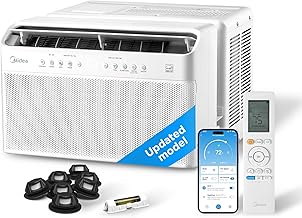
Midea 12,000 BTU U Shaped Window Air Conditioner
If your “vertical” window turns out to be a wide horizontal slider, this saddle-style unit is the quietest mainstream option available, largely because the sash closes between the compressor and your bedroom. The inverter compressor holds a genuinely flat temperature curve overnight rather than cycling, and 550 square feet of coverage handles an open-plan bedroom without straining.
Midea 8,000 BTU U Shaped Smart Inverter Window Air Conditioner
The right-sized sibling for a typical 300–350 square foot bedroom, and my usual recommendation for anyone who has been fighting clamminess from an oversized unit. It keeps the open-window flexibility and near-silent operation of the larger model while running long, gentle cycles that actually dehumidify.
LOVIGA Portable AC Window Kit, 10×40–64″
The most robust vertical vent kit I’ve tested, with genuine waterproof backing and full-perimeter sealing that holds up through a season of rain rather than sagging by August. The 40-to-64-inch adjustment range covers the majority of tall sashes, and the sealing quality is good enough to keep exterior noise from negating your portable unit’s quiet mode.
Portable AC Window Vent Kit, 5.9″ with 16.9–62.1″ Panel
A leaner, lower-cost panel that works in either vertical or horizontal orientation and installs in under ten minutes with no coupler required. Sealing is a step below the LOVIGA in wet weather, but for a rental where you need something reversible and unobtrusive, it’s the pragmatic pick.
Frequently Asked Questions
Can I use a standard window air conditioner in a vertical sliding window?
No. Standard units are wider than they are tall and rely on the sash pressing down on the chassis for support. In a vertical opening they sit unsupported and cannot be sealed safely—use a casement-specific unit or a portable with a vertical vent kit instead.
Is a portable unit with a vent kit noisier than a window unit?
Generally yes, because the compressor sits inside the room rather than outside the sash. If nighttime quiet is your priority and your window geometry allows it, a casement or U-shaped unit will outperform any portable.
What temperature should I set for sleep?
Most adults sleep best between 65 and 68°F, though the more important factor is stability. A unit that holds within a degree or two beats one that swings four degrees each cycle, even at a nominally ideal setpoint.
Do I still need a dehumidifier?
Usually not, if your unit is correctly sized. Right-sized air conditioners run longer cycles and remove substantial moisture as a byproduct; a separate dehumidifier is mainly worth it in basements or if your AC is oversized for the room.
Final Thoughts
For a true tall, narrow opening, the Perfect Aire 10,000 BTU casement unit remains the cleanest solution, and its Follow Me remote gives it a real edge for bedroom use. If your window is a wide slider, the Midea 8,000 BTU U-Shaped inverter is the better sleep choice for typical bedrooms, with the 12,000 BTU version reserved for larger open spaces—and if you’re pairing a portable unit with a vertical sash, spend the extra few dollars on the LOVIGA kit and seal it properly the first time.