Key takeaways
- Tooth count matched to the task: 32–40 teeth rip and break down stock quickly; 60–80 teeth handle furniture-grade crosscuts; 100–120 teeth are for melamine, veneer, and trim where surface quality outranks speed. Higher is not automatically better — too many teeth in thick hardwood traps heat and burns the cut.
- Kerf and saw compatibility: Thin-kerf blades (roughly 3/32″) reduce load on 15-amp motors and sliding saws, which means less deflection and a quieter, smoother pass. Full kerf (1/8″) is stiffer and more forgiving on heavy-duty, high-torque saws.
- Grind geometry: ATB (alternate top bevel) gives clean crosscuts in solid wood. TCG (triple-chip grind) resists chipping in aluminum, laminate, and composites. Hook angle matters too: a neutral or slightly negative hook keeps a miter saw from grabbing and climbing the workpiece.
- Arbor and plate quality: Confirm a 5/8″ (16mm) arbor for standard North American miter saws. Then look at the plate — laser-cut expansion slots, tensioning, and anti-vibration cuts are what keep a blade running true and audibly calmer rather than howling.
- Carbide grade and resharpenability: Micrograin carbide holds an edge far longer than budget brazing, and a blade with substantial tooth mass can be resharpened several times, making a $60 disc cheaper per cut than three $20 replacements.
What's inside
Anyone who has built a bed frame or a nightstand knows the moment: the miter cuts look fine on the saw, but once the pieces come together the joint shows a hairline gap, and the end grain has a fuzzy, torn edge that no amount of sanding fully cures. The culprit is almost never the saw. It’s the blade that shipped with it — usually a 24- to 40-tooth general-purpose disc designed to move fast through framing lumber, not to leave a glue-ready face on hardwood or a chip-free edge on veneered plywood.
Swapping that blade is the cheapest meaningful upgrade in a home shop, and it pays off twice over on bedroom furniture, where surfaces sit at eye level and vibration-free cuts mean less noise bleeding through the house on a Sunday afternoon. Below are ten 10-inch miter saw blades worth considering in 2026, spanning ultra-fine crosscut discs, thin-kerf sliding-saw specialists, non-ferrous options, and multi-packs that cover a whole project from rough cut to final trim.
As an Amazon Associate we earn from qualifying purchases.



🛒 Best Price Today on Amazon
Prime members get fast, free shipping on everything above, plus member-only deals. New members get a 30-day free trial — cancel anytime.
How to Choose a/an 10 Miter Saw Blade (2026)
- Tooth count matched to the task: 32–40 teeth rip and break down stock quickly; 60–80 teeth handle furniture-grade crosscuts; 100–120 teeth are for melamine, veneer, and trim where surface quality outranks speed. Higher is not automatically better — too many teeth in thick hardwood traps heat and burns the cut.
- Kerf and saw compatibility: Thin-kerf blades (roughly 3/32″) reduce load on 15-amp motors and sliding saws, which means less deflection and a quieter, smoother pass. Full kerf (1/8″) is stiffer and more forgiving on heavy-duty, high-torque saws.
- Grind geometry: ATB (alternate top bevel) gives clean crosscuts in solid wood. TCG (triple-chip grind) resists chipping in aluminum, laminate, and composites. Hook angle matters too: a neutral or slightly negative hook keeps a miter saw from grabbing and climbing the workpiece.
- Arbor and plate quality: Confirm a 5/8″ (16mm) arbor for standard North American miter saws. Then look at the plate — laser-cut expansion slots, tensioning, and anti-vibration cuts are what keep a blade running true and audibly calmer rather than howling.
- Carbide grade and resharpenability: Micrograin carbide holds an edge far longer than budget brazing, and a blade with substantial tooth mass can be resharpened several times, making a $60 disc cheaper per cut than three $20 replacements.
The Best 10 Miter Saw Blade (2026)s Reviewed
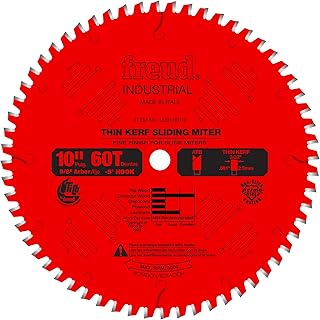
Freud LU91R010 10″ Thin Kerf Sliding Compound Blade
Purpose-built for sliding saws, this thin-kerf 60-tooth blade uses a negative hook angle that stops the blade from self-feeding as the head travels forward — the single biggest cause of chip-out on slide cuts. It leaves an edge clean enough to glue straight off the saw, and the vibration-damping plate noticeably drops the pitch of the cut.
WEN BL1080 10-Inch 80-Tooth Carbide-Tipped
The value standout: carbide-tipped, ultra-fine 80-tooth geometry at a price most shops can justify keeping as a dedicated finish blade. It won’t hold an edge as long as premium industrial discs, but for a weekend furniture builder cutting poplar, pine, and prefinished plywood, the surface quality is well beyond fair.
US1080-MTR 10″ 80T USA-Made Miter Blade
Tooth geometry here is optimized specifically for crosscuts and miters rather than being a compromise table-saw design, and the 1/8″ kerf plate stays rigid in dense hardwoods like white oak and maple. A strong pick if you want a single do-everything blade for a compound miter saw and value resharpenable carbide.
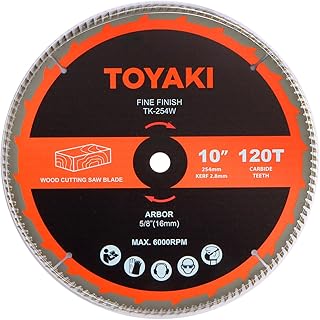
10-Inch 120-Tooth Fine-Finish Professional Blade
With 120 teeth on a 5/8″ arbor, this is a trim and molding specialist: crown, baseboard, picture frames, and anything veneered where a torn edge is unfixable. Feed slowly and keep it out of thick stock, and it delivers a near-polished face.
10-Inch TCG Aluminum-Working 120-Tooth Blade
The triple-chip grind is the right answer for non-ferrous metal, acrylic, and laminate — flat raker teeth take the shock while beveled teeth clear the chip, so nothing chips or grabs. Essential if your furniture work includes aluminum bed rails, T-track, or plastic edging.
Frequently Asked Questions
How many teeth do I actually need for furniture work?
An 80-tooth blade is the sweet spot for most bedroom and living-room projects. Reserve 120-tooth blades for veneer and trim, and keep a 32- to 40-tooth blade for breaking down construction lumber.
Can I use a table saw blade in my miter saw?
Sometimes, but check the hook angle. Positive-hook rip blades can climb aggressively in a miter saw and are genuinely unsafe on sliding models. Choose a blade with a neutral or negative hook.
Is a thin-kerf blade worth it?
On a sliding saw or any 15-amp motor, yes — less material removed means less strain, less deflection, and a quieter cut. On heavy stationary saws, full kerf offers more stability.
How do I know when the blade is dull?
Watch for burning, increased feed pressure, a rougher cut face, and a change in sound. A quality carbide blade can usually be resharpened two or three times before replacement.
Final Thoughts
For most home furniture builders, the Freud LU91R010 is the smartest single purchase — its negative hook and thin kerf are exactly what a sliding compound saw wants. The WEN BL1080 is the best budget finish blade, and the 3-pack combining 32T, 60T, and 80T blades is the most practical starting point if you’re outfitting a shop from scratch and want the right tooth count ready for every stage of a build.