Key takeaways
- Drawer mechanism: Ball bearing slides are the single biggest upgrade over friction runners. They glide instead of grinding, which means less noise, less force, and no jarring slam at the end of travel — worth prioritising above almost every other feature.
- Gauge and frame rigidity: Press the side panel of any steel chest. If it flexes and drums, that panel will amplify every rattle inside it. Welded or reinforced frames stay acoustically dead under load.
- Castors versus portability: Rolling chests suit fixed workshops; larger wheels handle expansion joints and cracked concrete without the clatter small hard castors produce. Portable box-style chests suit tenants, shared garages, and anyone carrying tools to the job.
- Locking and separation: A central lock protects blades and power tools from curious children — a real safety consideration in family homes, not a luxury. Detachable top boxes let you separate frequently used items from the heavy stuff below.
- Drawer liners and dividers: Bare steel drawers turn every socket into a percussion instrument. Budget for foam or rubber liners from day one; they cost little and eliminate the loose-metal noise almost entirely.
What's inside
Most buyers shop for a tool chest thinking only about capacity, and I understand the instinct — you count your wrenches, you count the drawers, you buy. But I spend my working life studying what wrecks people’s rest, and garages are quietly one of the worst offenders in the modern home. A drawer that shrieks on dry metal runners at 11 p.m., a stack of loose sockets rattling every time the door closes, a pile of tools that guarantees a twenty-minute hunt before any Saturday project can begin: these are low-grade stressors, and low-grade stressors follow you indoors. Households where the garage shares a wall with a bedroom or nursery feel it most acutely.
This guide looks at metal tool chests through that lens — build quality, drawer mechanics, roll quality, and the kind of orderliness that lets you close the door and genuinely stop thinking about the job. Everything here is steel-bodied, lockable where it matters, and chosen because it either runs quietly or contains noise well. Below you’ll find the current picks, a short buying framework, individual assessments of the top five, and answers to the questions readers send me most often.
As an Amazon Associate we earn from qualifying purchases.


🛒 Best Price Today on Amazon
Prime members get fast, free shipping on everything above, plus member-only deals. New members get a 30-day free trial — cancel anytime.
How to Choose a Metal Tool Chest (2026)
- Drawer mechanism: Ball bearing slides are the single biggest upgrade over friction runners. They glide instead of grinding, which means less noise, less force, and no jarring slam at the end of travel — worth prioritising above almost every other feature.
- Gauge and frame rigidity: Press the side panel of any steel chest. If it flexes and drums, that panel will amplify every rattle inside it. Welded or reinforced frames stay acoustically dead under load.
- Castors versus portability: Rolling chests suit fixed workshops; larger wheels handle expansion joints and cracked concrete without the clatter small hard castors produce. Portable box-style chests suit tenants, shared garages, and anyone carrying tools to the job.
- Locking and separation: A central lock protects blades and power tools from curious children — a real safety consideration in family homes, not a luxury. Detachable top boxes let you separate frequently used items from the heavy stuff below.
- Drawer liners and dividers: Bare steel drawers turn every socket into a percussion instrument. Budget for foam or rubber liners from day one; they cost little and eliminate the loose-metal noise almost entirely.
The Best Metal Tool Chests (2026) Reviewed
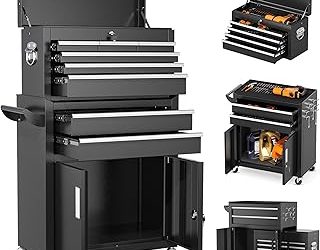
13-Drawer Double Door Rolling Tool Chest
The most complete storage solution here, pairing thirteen drawers with a double-door cabinet that swallows bulky items no drawer will take. The 2-in-1 detachable design and locking build make it the strongest choice for a serious home workshop that needs everything behind one key.
Workington 26″ 9-Drawer Tool Chest (4016)
My pick for quiet operation: nine drawers on ball bearing slides, all running smoothly enough that late-evening use won’t carry through a shared wall. The industrial-grade steel body feels genuinely professional and resists the panel drumming that plagues thinner chests.
LDHTHOPI 8-Drawer Rolling Tool Chest
Arrives assembled, which spares you an afternoon and a great deal of frustration, and the detachable top box plus locking sliding drawers cover the essentials properly. The red finish and generous wheels make it a practical mid-size workhorse for a repair room or garage.
5-Drawer Rolling Tool Chest (Green)
Heavy-duty steel with locking wheels — an underrated detail, since a chest that creeps across the floor is a chest that eventually bangs into something. The security system and detachable top box give it a sensible balance of capacity and control.
Workington 20″ 4-Drawer Tool Chest (4004)
Compact, portable, and built with the same ball bearing slides as its larger sibling, making it ideal for apartments, sheds, or anyone who needs tools organised without surrendering floor space. It’s the least intrusive option here, physically and acoustically.
Frequently Asked Questions
Does a tool chest really affect sleep quality?
Indirectly, yes. Sudden mechanical noise from an attached garage can fragment light sleep, and unfinished, disorganised projects are a common source of the bedtime rumination that delays sleep onset. Containment helps both.
How do I stop drawers rattling?
Line every drawer with closed-cell foam or rubber matting and keep tools spaced rather than stacked. This absorbs vibration at the source and is far more effective than shimming the chest itself.
Should I choose rolling or portable?
Roll if the chest lives permanently in one space and you value capacity. Choose a portable steel box like the 24″ or Workington 4004 if you move between locations or share the garage.
Is a lock necessary?
If children, teenagers, or visitors have access to the space, treat it as essential. Locking also stops drawers from opening in transit, which prevents both damage and noise.
Final Thoughts
For most homes, the Workington 26″ 9-Drawer chest offers the best combination of smooth, quiet drawer action and professional build integrity. If you need maximum capacity behind a single lock, the 13-Drawer Double Door rolling chest is the clear choice, while the compact Workington 4004 handles smaller spaces without compromising on mechanism quality. Any of the three will leave you with a tidier workshop and one less thing turning over in your mind at midnight.