Key takeaways
- Duty cycle over peak numbers: A two-stage pump running at 50–60% duty cycle refills faster and cycles less often than a single-stage unit chasing the same CFM. Fewer cycles means fewer noise events per hour — the metric that actually determines whether anyone upstairs notices.
- Decibel rating in context: Standard cast-iron compressors sit near 85–90 dB; purpose-built quiet models land in the 65–75 dB range. That gap is roughly the difference between a passing motorcycle and a running dishwasher, and it matters enormously if the unit shares a slab with a bedroom.
- Vibration isolation from day one: Structure-borne sound is the real culprit in home installations. Budget for rubber isolation pads or a spring mount, and specify a flexible braided hose for the first two feet of the discharge line rather than rigid pipe.
- Power supply reality check: Most 80-gallon units want 230V, and several require three-phase service that residential panels simply do not carry. Confirm your available voltage and phase before shopping, not after delivery.
- Automatic tank drainage: Condensate left in a tank corrodes it from the inside. An auto-drain system removes the daily chore and, just as usefully, eliminates the temptation to drain the tank late at night with the compressor still under pressure.
What's inside
Anyone who has ever been jolted awake by a single-stage pump kicking on at 6 a.m. understands the problem: an 80-gallon compressor is a household appliance as much as a shop tool. It shares walls, floor joists, and ductwork with bedrooms, and the low-frequency thrum it produces travels through structure far more efficiently than it travels through air. Buyers tend to shop on horsepower and CFM alone, then discover that the machine they chose vibrates the guest room ceiling every time the tank refills.
This guide approaches 80-gallon compressors the way a sleep-wellness consultant would evaluate any piece of equipment installed in a living space — weighing duty cycle, decibel output, vibration transfer, and drain automation alongside raw output. Below you’ll find the models worth considering in 2026, followed by a practical selection framework and answers to the questions that come up most often when a compressor moves into a home workshop.
As an Amazon Associate we earn from qualifying purchases.




🛒 Best Price Today on Amazon
Prime members get fast, free shipping on everything above, plus member-only deals. New members get a 30-day free trial — cancel anytime.
How to Choose a/an 80 Gallon Air Compressor (2026)
- Duty cycle over peak numbers: A two-stage pump running at 50–60% duty cycle refills faster and cycles less often than a single-stage unit chasing the same CFM. Fewer cycles means fewer noise events per hour — the metric that actually determines whether anyone upstairs notices.
- Decibel rating in context: Standard cast-iron compressors sit near 85–90 dB; purpose-built quiet models land in the 65–75 dB range. That gap is roughly the difference between a passing motorcycle and a running dishwasher, and it matters enormously if the unit shares a slab with a bedroom.
- Vibration isolation from day one: Structure-borne sound is the real culprit in home installations. Budget for rubber isolation pads or a spring mount, and specify a flexible braided hose for the first two feet of the discharge line rather than rigid pipe.
- Power supply reality check: Most 80-gallon units want 230V, and several require three-phase service that residential panels simply do not carry. Confirm your available voltage and phase before shopping, not after delivery.
- Automatic tank drainage: Condensate left in a tank corrodes it from the inside. An auto-drain system removes the daily chore and, just as usefully, eliminates the temptation to drain the tank late at night with the compressor still under pressure.
The Best 80 Gallon Air Compressor (2026)s Reviewed
Industrial Plus Silent 7.5HP 80 Gal
The strongest choice for anyone whose shop shares a wall with a bedroom: 31 CFM output paired with genuinely reduced noise emissions, a pressure-lubricated pump, and an automatic drain. Assembled in the USA with a two-stage vertical layout, it delivers professional airflow without the acoustic penalty most units in this class carry.
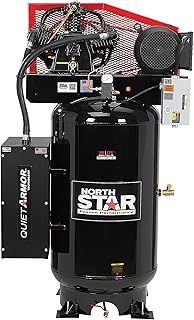
NorthStar 7.5 HP, 26 CFM Quiet Armor
NorthStar’s Quiet Armor enclosure meaningfully lowers perceived noise while keeping service points genuinely accessible — a rare combination, since sound shrouds usually make oil changes miserable. A sensible pick for demanding pneumatic tool use in a stationary residential workshop.
EMAX 80 Gal 7.5HP, 26 CFM Two-Stage
A 200 PSI maximum and splash-lubricated industrial pump make this the durability play, and the higher pressure ceiling means longer intervals between cycles. Note the manual tank drain alongside the auto-drain feature, and plan on isolation pads, as the exposed pump is not acoustically shrouded.
VEVOR 80 Gallon Oil-Free, 6.5HP 15.5 SCFM
The most home-friendly power requirement of the group — 220V single-phase — plus oil-free operation that eliminates lubricant maintenance entirely. Output is the most modest here at 15.5 SCFM, so match it to sanders and impact tools rather than continuous-demand spray work.
Campbell Hausfeld 80-Gallon Vertical, 5 HP
A dependable, straightforward vertical unit at 140 PSI that covers general workshop air without complexity. As a single-stage 5 HP machine it cycles more frequently than the two-stage options, which is the trade-off you accept for the lower entry cost.
Frequently Asked Questions
How loud is an 80-gallon compressor in a home?
Conventional models produce 85–90 dB at close range, loud enough to be clearly audible two rooms away. Quiet-designated units typically measure 65–75 dB, which most households find tolerable during daytime hours.
Can I run one on standard household wiring?
No. These units need a dedicated 230V circuit, and models specified as three-phase require service most homes lack. Verify voltage and phase before purchasing.
Will a compressor in the garage disturb sleep upstairs?
It can, through structure-borne vibration rather than airborne noise. Isolation pads, a flexible discharge connection, and avoiding overnight operation resolve nearly all complaints.
Is two-stage worth the premium?
For sustained tool use, yes. Higher pressure and better efficiency mean fewer refill cycles, less heat, and a longer pump life.
Final Thoughts
For a compressor living close to sleeping quarters, the Industrial Plus Silent 7.5HP is the clear recommendation, with the NorthStar Quiet Armor a close second for its balance of low noise and easy servicing. If you need single-phase power and minimal maintenance, the VEVOR oil-free 6.5HP is the practical answer.