Key takeaways
- Recovery rate over raw PSI: A 6-gallon tank empties fast. Look at SCFM at 90 PSI — 2.6 is fine for one brad nailer, while 4.0 lets you run two framing guns without the pump screaming continuously.
- Cycling behavior, not just decibels: Manufacturers quote a single sound figure, but what wakes a household is the on-off pattern. Units with larger effective reserves cycle less often, which reads as calmer to a sleeping brain even at similar peak volume.
- Vibration isolation: Rubber feet matter more in apartments than in garages. Structure-borne vibration travels through joists and can be felt in a bed two rooms away. Plan to add a dense mat regardless of what ships in the box.
- Oil-free maintenance: For occasional furniture and trim work, an oil-free pump removes a maintenance ritual you will otherwise forget. Slightly louder, considerably more forgiving.
- Included accessories: A 10-piece kit with hose, couplers, and blow gun saves a second order. If a brad nailer is bundled, that is usually the better value for indoor furniture assembly.
What's inside
Most people shopping for a 6-gallon pancake compressor are not building houses for a living. They are assembling a platform bed at 9 p.m., tacking trim behind a headboard, or re-stapling webbing under a sofa that has been sagging for two years. And that is exactly where the trouble starts: a tool rated for open-air framing crews behaves very differently inside a 1,100-square-foot apartment with a sleeping toddler down the hall. I spend my working life on sleep environments — acoustics, vibration transfer, circadian timing — and compressors are one of the most underestimated disruptors I encounter in home projects.
This guide looks at 6-gallon compressors through that lens without losing sight of the basics. Tank capacity, recovery speed, and duty cycle still decide whether your nailer stalls mid-board. But I have also weighed how loudly each unit cycles, how much of that energy travels through subflooring into adjacent bedrooms, and how predictable the motor’s restart pattern is — because an intermittent 90-decibel burst is far more likely to fragment someone’s sleep than steady ambient noise. Below are the six units worth your attention in 2026, plus a short framework for choosing between them.
As an Amazon Associate we earn from qualifying purchases.


🛒 Best Price Today on Amazon
Prime members get fast, free shipping on everything above, plus member-only deals. New members get a 30-day free trial — cancel anytime.
How to Choose a/an 6-Gallon Air Compressor (2026)
- Recovery rate over raw PSI: A 6-gallon tank empties fast. Look at SCFM at 90 PSI — 2.6 is fine for one brad nailer, while 4.0 lets you run two framing guns without the pump screaming continuously.
- Cycling behavior, not just decibels: Manufacturers quote a single sound figure, but what wakes a household is the on-off pattern. Units with larger effective reserves cycle less often, which reads as calmer to a sleeping brain even at similar peak volume.
- Vibration isolation: Rubber feet matter more in apartments than in garages. Structure-borne vibration travels through joists and can be felt in a bed two rooms away. Plan to add a dense mat regardless of what ships in the box.
- Oil-free maintenance: For occasional furniture and trim work, an oil-free pump removes a maintenance ritual you will otherwise forget. Slightly louder, considerably more forgiving.
- Included accessories: A 10-piece kit with hose, couplers, and blow gun saves a second order. If a brad nailer is bundled, that is usually the better value for indoor furniture assembly.
The Best 6-Gallon Air Compressor (2026)s Reviewed
DEWALT DWFP55126 Pancake, 165 PSI
The most refined cycling character in this group — the pump engages with less startle than its rivals, and its high-efficiency motor restarts reliably in cold rooms, which matters if your workspace is an unheated garage adjoining a bedroom. At 2.6 SCFM @ 90 PSI it comfortably feeds a single finish or brad nailer through a full afternoon of furniture work.
Metabo HPT EC914S, 200 PSI
With 4 CFM and a 200 PSI ceiling, this is the one to buy if two people are working at once or you are driving framing and roofing nailers back to back. The tradeoff is honest: more air means more motor, so reserve this for daytime hours and put it on a dense mat if you are above a finished ceiling.
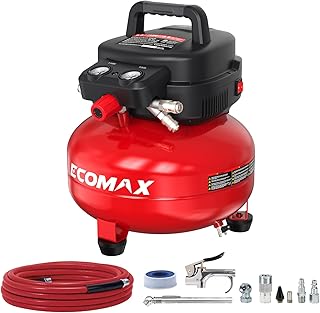
ECOMAX 6-Gallon 150 PSI with 10-Piece Kit
The best entry point for someone whose projects are bookshelves, bed frames, and upholstery repair rather than jobsite work. The bundled hose and couplers are genuinely usable, and the modest 150 PSI pump draws less current — a small advantage on older apartment circuits already carrying a bedroom air purifier or white-noise machine.
CRAFTSMAN 6-Gallon Pancake with 18GA Brad Nailer
The included 18-gauge brad nailer is well matched to trim, drawer boxes, and back panels, making this the most complete out-of-the-box setup for home improvement. Performance mirrors the DEWALT on paper at 2.6 SCFM, though it runs a touch coarser and benefits noticeably from isolation pads.
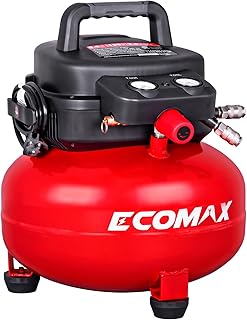
ECOMAX 6-Gallon Red, 1.5HP with Dual Couplers
Dual quick couplers let two tools stay connected, which cuts down on the fumbling that turns a 20-minute job into an hour of noise. The 3.6 CFM @ 40 PSI rating suits inflation, blow-off, and light nailing around cars and furniture alike.
Frequently Asked Questions
How late is too late to run a compressor at home?
As a rule, stop at least 90 minutes before anyone in the household intends to sleep. Sudden noise during the wind-down period elevates arousal even if no one fully wakes, and that cost shows up the next morning.
Will earplugs solve the problem?
They protect the operator, not the sleeper in the next room. Low-frequency vibration passes through walls and foam alike, so isolation at the source — a rubber mat, a concrete slab, a closed door — does more than anything worn.
Is 6 gallons enough for furniture projects?
Comfortably, yes. Brad nailers, staplers, and finish nailers draw small volumes per shot, and a 6-gallon tank at 150 PSI holds enough for dozens of fasteners before the pump wakes up.
Does oil-free mean louder?
Generally by a few decibels, yes, because there is less damping in the pump. The maintenance savings are usually worth it for intermittent home use.
Final Thoughts
For most people furnishing and repairing a home, the DEWALT DWFP55126 is the balanced choice — quiet-cycling, cold-start dependable, and sized correctly for indoor work. Choose the Metabo HPT EC914S if you need real airflow for two tools and can confine the noise to daylight hours, and the ECOMAX 6-Gallon with 10-piece kit if you want everything you need for weekend furniture projects without overbuying.