Key takeaways
- Fitment before features: Bed length and model year matter more than any spec sheet. A 6’6″ system will not adapt to a 5’7″ bed, and generation changes — Super Duty 2017-current, F-150 2015-current — mark real dimensional breaks.
- Load rating and deck strength: Look for systems rated to carry a loaded ATV or a full pallet on the deck surface. If you plan to sleep, kneel, or stack firewood up top, the deck must flex less than a quarter inch under weight.
- Noise behavior: Ask how the drawers seal and whether the deck floats on rubber isolators. Metal-on-metal contact turns a gravel road into a percussion section, and that’s the single most common complaint from people who camp in their trucks.
- Installation commitment: No-drill, slide-in trays preserve resale value and move to your next truck. Drop-in deck systems need more setup time and often use existing bed anchor points — better long-term, less flexible short-term.
- Weather sealing and drainage: Powder-coated aluminum resists corrosion well; sealed polymer drawers with drain paths handle standing water. Anything that traps moisture against tools will cost you more in rust than the system saved you.
Anyone who has spent a night in a truck bed knows the difference between a good setup and a bad one is measured in hours of sleep. Gear slides, a socket wrench works its way under your hip, and every bump in the wind sets loose tools rattling against sheet metal. As someone who studies rest environments for a living, I’ve come to see the truck bed the same way I see a bedroom: a space whose noise, surface, and clutter levels decide whether you wake up restored or wrecked. Most drivers don’t organize their bed because they love tidiness — they do it because chaos back there follows them into the cab, the campsite, and the next morning.
This guide looks at truck bed storage through that lens. We’ll cover what separates a genuinely quiet, load-bearing system from a plastic bin with ambitions, how platform height affects whether you can sleep or sit up on top of it, and which models hold their tolerances after two winters of salt. Below you’ll find our current picks for full-size, heavy-duty, and mid-size trucks, plus a shorter answer for people who want organization without permanent hardware.
Our top picks


As an Amazon Associate we earn from qualifying purchases at no extra cost to you. Ratings are shown as listed on Amazon.
🛒 Best Price Today on Amazon
Prime members get fast, free shipping on everything above, plus member-only deals. New members get a 30-day free trial — cancel anytime.
How to Choose a Truck Bed Storage System (2026)
- Fitment before features: Bed length and model year matter more than any spec sheet. A 6’6″ system will not adapt to a 5’7″ bed, and generation changes — Super Duty 2017-current, F-150 2015-current — mark real dimensional breaks.
- Load rating and deck strength: Look for systems rated to carry a loaded ATV or a full pallet on the deck surface. If you plan to sleep, kneel, or stack firewood up top, the deck must flex less than a quarter inch under weight.
- Noise behavior: Ask how the drawers seal and whether the deck floats on rubber isolators. Metal-on-metal contact turns a gravel road into a percussion section, and that’s the single most common complaint from people who camp in their trucks.
- Installation commitment: No-drill, slide-in trays preserve resale value and move to your next truck. Drop-in deck systems need more setup time and often use existing bed anchor points — better long-term, less flexible short-term.
- Weather sealing and drainage: Powder-coated aluminum resists corrosion well; sealed polymer drawers with drain paths handle standing water. Anything that traps moisture against tools will cost you more in rust than the system saved you.
The Best Truck Bed Storage System (2026)s Reviewed
DECKED System for Ford F-150 (2015-current, 6’6″)
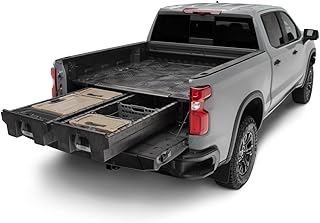
This is the benchmark for full-size trucks: two full-length weatherproof drawers under a deck rated for serious cargo, with an isolated surface that stays impressively quiet on rough roads. If you sleep in the bed with a topper, the flat deck height is close to ideal for a pad and bag.
DECKED System for Ford Super Duty (2017-current, 6’9″)
Same architecture scaled for the longer heavy-duty bed, which means a genuinely large lower storage volume for recovery gear, chains, and tools. Worth the install effort if the truck is a working vehicle you also camp out of on weekends.
DECKED System for Silverado & Sierra 2500/3500 (2020-current, 6’6″)
Built for the newer GM heavy-duty beds, this version keeps the drawers tracking smoothly even when loaded past what most people expect. The included accessories cover most tie-down and divider needs out of the box.
S2 Series Aluminum Slide-Out Organizer (Full Size, 5’7″)
Two aluminum trays that slide toward the tailgate, requiring no drilling and taking under an hour to set up. It’s the smart pick if you want reachable organization and full bed depth above it rather than a fixed platform.
S1 Series Aluminum Organizer Tray (Mid-Size)
Sized for Tacoma, Ranger, Colorado, Canyon, and Frontier beds, this roller-mounted tray solves the mid-size problem of gear migrating to the bulkhead. Non-foldable and single-tier, so treat it as an access solution, not a full platform.
Frequently Asked Questions
Can I sleep on top of a truck bed storage system?
On deck-style systems, yes — the surface is flat and rated for far more than body weight. Add a two- to three-inch closed-cell or self-inflating pad; the deck offers zero give, and your shoulders and hips will notice by 3 a.m. without one.
Do these systems require drilling?
The aluminum slide-out trays install without drilling. Deck systems typically mount using existing bed hardware and stake pockets, though installation steps vary by truck, so read the model-specific instructions before starting.
How much bed space do I lose?
Deck systems raise your usable floor several inches, which reduces vertical clearance under a topper or tonneau. Slide-out trays sit low and preserve most of the bed’s depth.
What if I want organization without a permanent install?
For SUVs and lighter-duty use, a removable two-tier option like the Tru-Convenience Cargo Shelf Organizer separates groceries, tools, and camping supplies without any mounting hardware, and lifts out when you need the space back.
Final Thoughts
For most full-size owners, the DECKED System for the F-150 remains the most complete answer — quiet, weather-sealed, and strong enough to double as a sleeping platform. Heavy-duty drivers should step up to the Super Duty version for its extra drawer volume, while mid-size and no-drill buyers will get more practical value from the S2 Series aluminum slide-out trays.