Key takeaways
- Read the load rating as a shared budget: Add both sleepers’ weights, your mattress (a queen hybrid often runs 100–140 lbs), plus bedding, then aim for a frame rated at roughly double that figure. Ratings are typically measured under static, evenly distributed conditions — real beds get dynamic loads.
- Count legs and check the center rail: For a queen, nine or more legs with a dedicated center support beam is the threshold where sag stops being a concern. Frames with four or six legs concentrate stress at the middle of the side rails, which is exactly where two people sleep.
- Prioritize noise engineering, not just strength: Look for rubber or felt washers at bolt points, interlocking slats rather than loose ones, and non-slip pads. Squeak comes from metal-on-metal micro-movement, so a frame can be immensely strong and still be a poor sleep surface.
- Match slat spacing to your mattress warranty: Most foam and hybrid manufacturers require slats no more than 3 inches apart. Wider gaps void coverage and create visible dips between supports, which heavier sleepers feel almost immediately.
- Decide on height before you decide on style: An 18-inch frame buys serious under-bed storage and easier entry and exit for anyone with knee or hip discomfort; 12 to 14 inches suits thick mattresses where total stack height would otherwise get unwieldy.
Combined body weight is the variable most bed frame listings quietly ignore. A frame rated for a single sleeper can technically hold two adults and still fail at the joints — the failure mode is rarely a dramatic collapse but a slow surrender: center-rail sag, bolts working loose, and a metallic creak that arrives every time one partner rolls over. From a sleep-quality standpoint, that last part matters more than most buyers expect. Micro-arousals from noise and motion transfer fragment deep sleep even when neither person fully wakes, and the cumulative cost shows up as morning grogginess that no mattress upgrade will fix.
This guide focuses specifically on frames engineered for two heavier sleepers: load ratings you can actually trust, leg counts and center support that keep the mattress plane flat, and construction details that stop noise before it starts. Below you’ll find current picks spanning steel platforms with 3,500 lb capacities, quieter hybrid designs with wooden headboards, and a solid pine option for people who prefer wood over metal. Each recommendation is followed by a buying framework and answers to the questions we hear most from couples sizing up a replacement.
Our top picks



As an Amazon Associate we earn from qualifying purchases at no extra cost to you. Ratings are shown as listed on Amazon.
🛒 Best Price Today on Amazon
Prime members get fast, free shipping on everything above, plus member-only deals. New members get a 30-day free trial — cancel anytime.
How to Choose a Bed Frame For Heavy Couples (2026)
- Read the load rating as a shared budget: Add both sleepers’ weights, your mattress (a queen hybrid often runs 100–140 lbs), plus bedding, then aim for a frame rated at roughly double that figure. Ratings are typically measured under static, evenly distributed conditions — real beds get dynamic loads.
- Count legs and check the center rail: For a queen, nine or more legs with a dedicated center support beam is the threshold where sag stops being a concern. Frames with four or six legs concentrate stress at the middle of the side rails, which is exactly where two people sleep.
- Prioritize noise engineering, not just strength: Look for rubber or felt washers at bolt points, interlocking slats rather than loose ones, and non-slip pads. Squeak comes from metal-on-metal micro-movement, so a frame can be immensely strong and still be a poor sleep surface.
- Match slat spacing to your mattress warranty: Most foam and hybrid manufacturers require slats no more than 3 inches apart. Wider gaps void coverage and create visible dips between supports, which heavier sleepers feel almost immediately.
- Decide on height before you decide on style: An 18-inch frame buys serious under-bed storage and easier entry and exit for anyone with knee or hip discomfort; 12 to 14 inches suits thick mattresses where total stack height would otherwise get unwieldy.
The Best Bed Frame For Heavy Couples (2026)s Reviewed
ROIL 18 Inch Queen Bed Frame
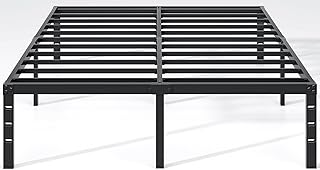
The 3,500 lb rating, four mattress baffles, and rounded corners make this the most complete package here for two heavier sleepers who also want serious storage — 16.4 inches of clearance is enough for bins rather than just shallow boxes. The headboard holes mean you aren’t locked out of adding a headboard later, which is a common regret with tall platform frames.
VIPSHOW 18 Inch Queen Bed Frame
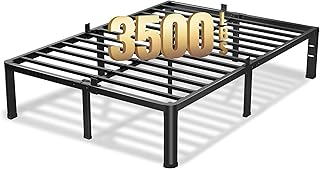
Functionally very close to the ROIL, with the same 3,500 lb capacity plus rubber covers at contact points and four mattress stoppers — the detail that keeps a heavy hybrid from creeping toward the footboard over months of use. A strong pick if you want a headboard-free, storage-first frame with real noise control built in.
SHA CERLIN 14 Inch Metal Platform Bed
This is the choice for couples who want the strength of a steel platform without the utilitarian look, pairing a metal chassis with wooden headboard and footboard panels in black oak. The non-slip, noise-suppressed construction is well executed, and 14 inches strikes a sensible balance when you’re already running a thick mattress.
NEW JETO 14 Inch Metal Bed Frame
A straightforward heavy-duty foundation that gets the fundamentals right: dense leg placement, genuine under-bed clearance, and an assembly process most couples finish in under half an hour without tools beyond what’s included. Best suited to buyers who already own a headboard or don’t want one.
Mellow Naturalista Classic 12 Inch Solid Wood Platform
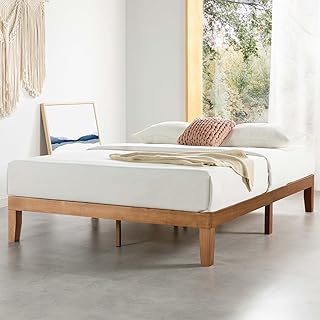
Solid pine construction gives this frame a quieter, deader feel underfoot than steel, which some sleepers strongly prefer — wood dampens vibration instead of transmitting it. Confirm the stated capacity against your combined load, and treat it as the aesthetic-first option rather than the maximum-strength one.
Frequently Asked Questions
Is a queen frame enough for two heavier adults, or should we size up?
Capacity isn’t the issue — a well-built queen frame handles two heavy sleepers fine. The constraint is width: a queen gives each person about 30 inches, and broader-shouldered couples often sleep noticeably better on a king simply because reduced contact means less motion transfer.
Do we still need a box spring with these frames?
No. Every frame here is a platform design with integrated slat support, and adding a box spring would raise the surface awkwardly while doing nothing for durability. Foam, latex, and hybrid mattresses all sit directly on the slats as intended.
Why do metal frames start squeaking after a few months?
Bolts loosen as the frame settles and the metal contracts and expands with room temperature. Re-torquing every connection at the three-month mark eliminates the vast majority of complaints; frames that ship with rubber washers at the joints tend to need this far less often.
Does frame height actually affect sleep quality?
Indirectly, and it’s underrated. A surface height that lets your feet rest flat with knees at roughly 90 degrees makes getting in and out easier, which matters for anyone whose sleep is already interrupted by nighttime bathroom trips — less struggle means a faster return to sleep.
Final Thoughts
For most heavier couples, the ROIL 18 Inch is the frame to beat: the 3,500 lb rating, mattress baffles, and generous storage clearance cover nearly every practical concern, with the VIPSHOW 18 Inch as an equally capable alternative if its rubber-covered hardware and pricing line up better on the day you buy. If you want the same structural confidence in something that looks like furniture rather than a foundation, the SHA CERLIN 14 Inch with its wooden headboard and footboard is the pick — and the one least likely to be the thing you replace next.