Key takeaways
- Weight rating per bunk, not total: Look for a stated capacity for the upper berth specifically. Aim for at least 250 lb up top and 400 lb below if two adults will share the lower bunk — and remember your mattress counts toward that number.
- Lateral rigidity over raw thickness: Sway is what wakes people. Full-height corner posts, cross-bracing at the footwall, and steel-on-steel bolted joints resist racking far better than a heavier frame held together by cam locks.
- Slat gap and mattress depth: Slats spaced under 3 inches apart support hybrid and pocket-coil mattresses without sagging. Check the distance from slat to guardrail top — you want 5 inches of rail showing above your mattress, which usually caps upper-bunk mattresses around 8 inches.
- Vertical clearance and airflow: Measure floor-to-ceiling and subtract. You want roughly 30 inches of sitting height on the top bunk and a foot of ceiling clearance, otherwise heat pools around your head and disrupts the core temperature drop sleep depends on.
- Egress design: Stairs with a handrail beat a vertical ladder for anyone who wakes to use the bathroom, has a stiff back, or takes sleep medication. If you choose a ladder, insist on flat, wide treads rather than round rungs.
Most bunk beds are engineered around a nine-year-old’s body and a nine-year-old’s sleep. Adults bring a different set of demands: more mass, longer limbs, thicker mattresses, and a nervous system that registers every creak and micro-sway as a reason to surface out of deep sleep. That’s the real problem with buying a bunk bed past a certain age — the frame may hold your weight on paper while still sabotaging your sleep architecture through lateral flex, headroom that forces a hunched entry, or slats spaced for a five-inch foam pad rather than a proper hybrid mattress.
This guide approaches bunk beds the way a sleep clinician would approach any sleep surface: stability first, then thermal and postural comfort, then the logistics of actually living with the thing. I’ve focused on models that adults, roommates, guest-room hosts, and multigenerational households can realistically use nightly — evaluating steel gauge and joinery, guardrail geometry, ladder or stair safety for a groggy 3 a.m. descent, and how each frame handles the deeper mattresses adults tend to want. Below you’ll find the standouts for 2026, followed by a buying framework and answers to the questions I hear most often.
Our top picks



As an Amazon Associate we earn from qualifying purchases at no extra cost to you. Ratings are shown as listed on Amazon.
🛒 Best Price Today on Amazon
Prime members get fast, free shipping on everything above, plus member-only deals. New members get a 30-day free trial — cancel anytime.
How to Choose a Bunk Bed For Adults (2026)
- Weight rating per bunk, not total: Look for a stated capacity for the upper berth specifically. Aim for at least 250 lb up top and 400 lb below if two adults will share the lower bunk — and remember your mattress counts toward that number.
- Lateral rigidity over raw thickness: Sway is what wakes people. Full-height corner posts, cross-bracing at the footwall, and steel-on-steel bolted joints resist racking far better than a heavier frame held together by cam locks.
- Slat gap and mattress depth: Slats spaced under 3 inches apart support hybrid and pocket-coil mattresses without sagging. Check the distance from slat to guardrail top — you want 5 inches of rail showing above your mattress, which usually caps upper-bunk mattresses around 8 inches.
- Vertical clearance and airflow: Measure floor-to-ceiling and subtract. You want roughly 30 inches of sitting height on the top bunk and a foot of ceiling clearance, otherwise heat pools around your head and disrupts the core temperature drop sleep depends on.
- Egress design: Stairs with a handrail beat a vertical ladder for anyone who wakes to use the bathroom, has a stiff back, or takes sleep medication. If you choose a ladder, insist on flat, wide treads rather than round rungs.
The Best Bunk Beds For Adults (2026) Reviewed
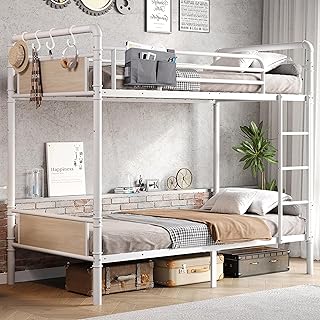
Jocoevol Metal Bunk Bed Twin Over Twin (Vintage Brown)
This is the frame I point adults toward first: heavy-gauge steel, full-length guardrails, and a bolted industrial structure that stays notably quiet under an adult’s shifting weight. The vintage brown finish reads as furniture rather than dormitory hardware, and the low-profile slat platform leaves usable headroom for taller sleepers up top.
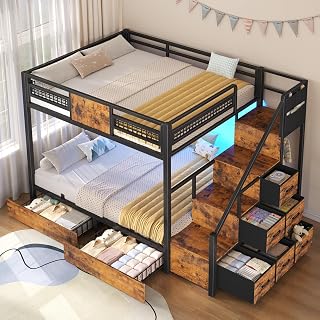
Full Over Full Bunk Bed with Stairs, Storage Drawers and LED Lights
Full-over-full is the honest configuration for adult bodies, and the built-in staircase removes the single biggest nighttime risk factor in bunk sleeping. The eight drawers and hanging area make this a genuine studio-apartment solution, while the LED strip gives you low-level wayfinding light that won’t spike cortisol like an overhead fixture.
Harper & Bright Designs Convertible Twin Over Full
Solid wood construction dampens vibration better than most tubular steel at this price, and the twin-over-full layout gives a taller adult the wider lower berth. Its best feature is reversibility: separate it into two standalone daybeds later and you’ve protected your investment.
Merax Wood Convertible Bunk Bed with Drawers
A clean, low-visual-weight white frame with two deep drawers and reassuringly thick posts — a good fit for guest rooms where you want the bed to disappear into the décor. The detachable design and flat-tread ladder make it one of the more adult-friendly wood options.
Harper & Bright Designs Twin Over Twin with Trundle
Three sleepers, one footprint: the roll-out trundle and three drawers make this the pragmatic pick for hosting or shared housing. Note that the trundle sits low, so it’s better suited to occasional guests than to a nightly adult sleeper with mobility limitations.
Frequently Asked Questions
Are bunk beds safe for adults to sleep in nightly?
Yes, provided the frame is rated for adult weight, anchored or braced against sway, and fitted with guardrails that clear your mattress by about 5 inches. Assemble it on level flooring and re-torque the bolts every few months.
Does the top or bottom bunk sleep better?
The bottom bunk is generally cooler, easier to exit, and less prone to motion transfer from the frame. The top bunk feels more private and blocks light better, but it traps heat — a breathable mattress protector and a small circulating fan solve most of that.
What mattress thickness should I use?
Keep the upper bunk to 6–8 inches so the guardrail still functions, and choose a firmer foam or thin hybrid rather than a plush pillow-top. The lower bunk can take up to 10–12 inches depending on your frame’s clearance.
Will a bunk bed feel cramped for a tall adult?
Standard twin and full lengths are 75 inches, which is tight above roughly 6 feet. Look for twin XL or full XL options, or prioritize a frame with generous vertical clearance so you can sit up comfortably.
Final Thoughts
If you want one recommendation that suits most adults, the Jocoevol Metal Twin Over Twin delivers the rigidity and quiet that protect deep sleep. Choose the Full Over Full with Stairs and Storage if you need adult-scale width plus safe nighttime egress, or the Harper & Bright Convertible Twin Over Full if you’d rather buy wood once and split it into two daybeds down the road.