Key takeaways
- Tall sleepers roughly 6 ft 2 in and above, whose knee height is high enough that a 30 inch bed feels natural.
- People who need storage and prefer bins under the bed over a dresser. An 18 inch frame leaves around 16 to 17 inches of clear space under the slats on many designs, enough for standard lidded storage totes that are 12 to 15 inches tall.
- Thin mattress owners. With a 6 to 8 inch foam mattress, an 18 inch frame finishes at a conventional 24 to 26 inches.
- Anyone who dislikes bending low to make the bed or to get up in the morning, provided the height still lets feet touch the floor when seated.
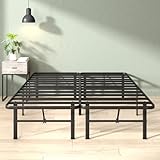
An 18 inch queen bed frame is the right height if you want maximum under-bed storage or you are tall, but with a typical 10 to 14 inch mattress it puts the sleeping surface at 28 to 32 inches, which is several inches higher than most adults find comfortable to sit on. For average height sleepers, a 14 inch frame usually lands closer to knee height, and 10 to 12 inch frames suit thick mattresses or shorter sleepers. Here is how to work out which frame height actually fits your body, your mattress and what you plan to store underneath.
Our top picks


As an Amazon Associate we earn from qualifying purchases at no extra cost to you. Ratings are shown as listed on Amazon.
The Number That Matters: Finished Bed Height
Frame height alone tells you little. What you feel is the finished height, frame plus mattress (and any topper). A widely used comfort guideline is that, sitting on the edge, your feet should rest flat on the floor with knees at roughly a 90 degree angle. That usually means the top of the mattress sits close to the height of the back of your knee, often somewhere between about 19 and 25 inches for most adults.
| Frame height | + 8 in mattress | + 10 in mattress | + 12 in mattress | + 14 in mattress |
|---|---|---|---|---|
| 10 in | 18 in | 20 in | 22 in | 24 in |
| 12 in | 20 in | 22 in | 24 in | 26 in |
| 14 in | 22 in | 24 in | 26 in | 28 in |
| 18 in | 26 in | 28 in | 30 in | 32 in |
To find your own target, stand barefoot and measure from the floor to the crease behind your knee. Add one or two inches if you prefer to perch slightly, as many people with knee or hip stiffness do because getting up from a higher bed takes less effort. Subtract your mattress thickness from that number and you have your ideal frame height.
Who an 18 Inch Frame Suits
- Tall sleepers roughly 6 ft 2 in and above, whose knee height is high enough that a 30 inch bed feels natural.
- People who need storage and prefer bins under the bed over a dresser. An 18 inch frame leaves around 16 to 17 inches of clear space under the slats on many designs, enough for standard lidded storage totes that are 12 to 15 inches tall.
- Thin mattress owners. With a 6 to 8 inch foam mattress, an 18 inch frame finishes at a conventional 24 to 26 inches.
- Anyone who dislikes bending low to make the bed or to get up in the morning, provided the height still lets feet touch the floor when seated.
Who Should Choose 14, 12 or 10 Inches Instead
| Your situation | Better frame height | Why |
|---|---|---|
| Average height, 12–14 in mattress | 14 in | Finishes at 26–28 in; still leaves about 12–13 in for flat storage |
| Shorter sleepers, under about 5 ft 4 in | 10–12 in | Keeps feet on the floor when sitting |
| Thick hybrid or pillow-top mattress, 14–16 in | 10–12 in | Avoids a 32 in-plus bed that needs a hop to climb in |
| Young children or anyone at risk of falls | 10 in or lower | Shorter drop if they roll out |
| Robot vacuum under the bed | Any, if clearance exceeds vacuum height | Most robot vacuums need about 3.5–4 in of space |
| Low ceilings or a minimalist look | 10–12 in | Visually lighter in a small room |
Platform Frames vs Frames That Need a Box Spring
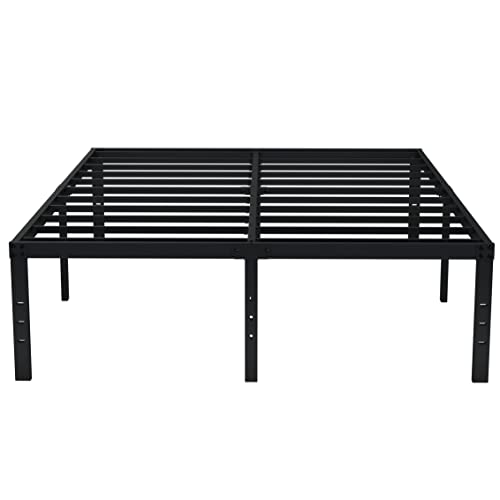
Most 14 and 18 inch frames sold today are metal platform frames: a steel perimeter with legs and either a steel grid or wood slats that support the mattress directly, with no box spring needed. Adding a box spring to an 18 inch frame raises the bed another 5 to 9 inches, which is almost always too tall. If you plan to keep a box spring, a low-profile 7 to 9 inch frame is a better pairing.
For foam and hybrid mattresses, check the maximum slat gap the mattress warranty allows. Many manufacturers specify gaps of no more than about 3 inches; some steel grid platforms are spaced wider and need a bunkie board or a sheet of plywood on top.
Sizes Across the Range
Frame heights are offered across the main mattress sizes. The footprint follows the mattress size, plus an inch or two for the frame itself.
| Size | Mattress dimensions | Minimum room comfortable fit | Typical 18 in metal platform price |
|---|---|---|---|
| Twin | 38 x 75 in | 7 x 10 ft | $60–$120 |
| Full | 54 x 75 in | 9 x 10 ft | $70–$140 |
| Queen | 60 x 80 in | 10 x 10 ft | $80–$170 |
| King | 76 x 80 in | 12 x 12 ft | $100–$220 |
The room sizes assume roughly 24 to 30 inches of walking space on the sides and foot of the bed. Upholstered and wooden 18 inch platform frames exist too but cost noticeably more, often $250 to $700 for a queen, and usually sit lower because of their side rails.
Construction Details That Separate Good Frames From Bad
- Center support legs. A queen frame should have legs along the center rail, not just at the corners. Taller legs are more prone to wobble, so look for at least six to nine legs on an 18 inch queen.
- Weight rating. Steel platform frames often list ratings in the high hundreds to over a thousand pounds. Ratings assume weight spread evenly, so treat them as a ceiling, not a target.
- Rubber or plastic foot caps. These protect floors and reduce squeak. Felt pads are a cheap addition on hardwood.
- Bolted vs tool-free joints. Tool-free hinged frames assemble in minutes but can loosen and squeak; bolted joints are slower to build and easier to retighten.
- Mattress retainers. Raised tabs at the corners or a lip around the edge stop the mattress from sliding on a bare steel frame.
Assembly and Moving Realities
Most metal 14 and 18 inch platform frames ship in a compact box under about 50 pounds, often folded so the box is narrow enough to carry upstairs by one person. Assembly usually takes 15 to 45 minutes. Taller frames are slightly harder to square up on carpet, so assemble in place and check that all legs touch the floor before tightening the last bolts.
Quick Decision Rule
Measure your knee height, subtract your mattress thickness, and round to the nearest frame option. If the answer is around 18 and you want storage, the 18 inch frame is a strong choice. If the answer is 14 or less, the extra height of an 18 inch frame will make the bed feel like a perch rather than a place to sit.