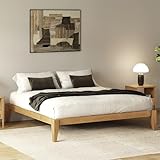
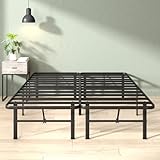
Key takeaways
- Slat system: Horizontal wood or metal slats run across the side rails. The mattress sits directly on them.
- Solid platform: A sheet of plywood, MDF with veneer, or upholstered deck creates an unbroken surface. Often has drilled ventilation holes to reduce moisture buildup.
- Adjustable deck: A hinged metal platform with no slats at all, designed to raise head and foot sections.
A bed frame that doesn’t need a box spring supports your mattress directly with closely spaced slats, a solid platform, or an adjustable base, so you can place any foam, latex, or hybrid mattress right on the frame without a 9-inch foundation underneath.
If you are searching for a bed frame that doesn’t require box spring support, you are looking for the same thing: a frame engineered to prevent mattress sag, protect your warranty, and lower your overall bed height by 7 to 9 inches. Understanding slat spacing and support rails is what determines whether a frame actually qualifies.
Our top picks


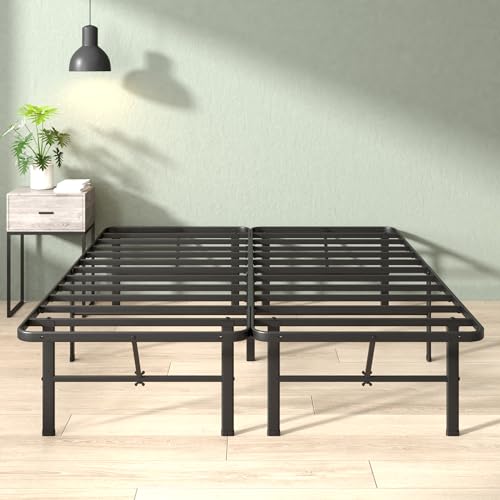

As an Amazon Associate we earn from qualifying purchases at no extra cost to you. Ratings are shown as listed on Amazon.
How a Frame Replaces a Box Spring
A traditional box spring (more accurately called a foundation today) has two jobs: to raise the mattress and to provide a flat, semi-rigid surface. Modern mattresses do not need the springs inside a box spring for shock absorption. What they do need is continuous, even support so the foam or coils do not dip between gaps.
Frames that eliminate the box spring do this in one of three ways:
- Slat system: Horizontal wood or metal slats run across the side rails. The mattress sits directly on them.
- Solid platform: A sheet of plywood, MDF with veneer, or upholstered deck creates an unbroken surface. Often has drilled ventilation holes to reduce moisture buildup.
- Adjustable deck: A hinged metal platform with no slats at all, designed to raise head and foot sections.
All three count as a bed frame that doesn’t need a box spring as long as they meet the spacing and center support rules below.
The Slat-Spacing Rule That Protects Your Mattress
This is the single most important spec to check before you buy. Mattress warranties are often voided if slats are too far apart.
| Mattress Type | Maximum Slat Gap to Keep Warranty Valid | Ideal Gap for Long-Term Durability | What Happens if Gap Is Too Wide |
|---|---|---|---|
| Memory foam, latex, or all-foam | Under 3 inches | 1.5 to 2.5 inches | Foam compresses and sags between slats, causing body impressions within months |
| Hybrid (foam + pocketed coils) | Under 3 inches | 2 to 3 inches | Coils tilt, edge support weakens, foam top layer dips |
| Traditional innerspring (open coil / Bonnell) | Under 5 inches | 3 to 4 inches | Coils can bow through wide gaps and snag fabric |
Always measure gap distance, not slat count. Two frames can both advertise “14 slats” but have very different gaps depending on whether they are queen or king width. For a standard queen (60 inches wide), you need at least 14-16 slats that are 2.5 to 3.5 inches wide to stay under that 3-inch threshold. For a king (76 inches wide), look for 16-20 slats.
Center Support Is Non-Negotiable
For any size queen or larger, a frame that doesn’t need a box spring must have a center rail with at least one vertical support leg reaching the floor. Without it, slats bow under the combined weight of two sleepers and a 80 to 120-pound hybrid mattress. Metal frames with a center rail and adjustable foot glides handle this best, while all-wood platform frames should use a solid center beam, not just two extra slats.
Which Frame Types Qualify (and Which Don’t)
1. Platform Frame
The most common bed frame that doesn’t require a box spring. The mattress sits in a recessed ledge or directly on top of the slat deck. Platform height is usually 13 to 16 inches from floor to slat top. Paired with a 10 to 12-inch mattress, total sleep height lands at 23 to 28 inches — ideal for most adults to sit and stand without knee strain.
2. Panel Bed with Slats
Looks like a traditional bed with headboard, footboard, and side rails, but includes a complete slat pack instead of requiring a foundation. Often sold with a slat roll that drops in. Check that the roll is not the cheap, widely spaced version with fabric straps; look for rigid, screwed-in slats or a roll with velcro-lock ends that prevent spreading.
3. Metal Foundation Frame with Center Rail
A minimalist steel frame with 1-inch square tube rails and a central spine. Usually the lowest cost option, usually $150–$350 for a queen. Height is very low, often 14 inches to the slat. It qualifies only if it includes both closely spaced metal slats or wire mesh plus the center support leg. A metal frame with just 4-5 cross-wires does not qualify — your mattress will sag through.
4. Adjustable Base
By design, it never needs a box spring. It replaces both frame and foundation. The mattress must be flexible enough to bend, so most foam, latex, and hybrid mattresses work, but a firm two-sided innerspring will not. Adjustable bases sit inside or on top of a decorative platform frame and typically add 2 to 4 inches of base height.
What does not qualify: a basic 4-leg decorative frame with open side rails and no slats, or a vintage headboard/footboard set that expects you to add a separate foundation. Those still need a foundation or a bunkie board to function safely.
How Removing a 9-Inch Box Spring Changes Height and Comfort
Switching from a standard setup (14-inch frame + 9-inch box spring + 12-inch mattress = 35 inches total) to a platform setup (14-inch frame + 12-inch mattress = 26 inches total) lowers your bed by a full 9 inches. That change affects more than aesthetics.
Ergonomic sitting height — the distance from floor to top of mattress — is most comfortable when it roughly matches the distance from floor to the back of your knee. For most adults 5’4″ to 6’0″, that is 22 to 25 inches. At that height you can sit with feet flat and stand up without pushing off with your hands, which matters for back, knee, or hip stiffness.
| Setup | Frame Height to Slat | Foundation | Mattress | Total Top-of-Mattress Height | Best For |
|---|---|---|---|---|---|
| Traditional with box spring | 14 in | 9 in box spring | 12 in | 35 in | Tall users over 6’1″, or those who prefer a very high, hotel-style bed |
| Low platform (no box spring) | 12 in | 0 in | 10 in | 22 in | Small rooms, low ceilings, easy access for kids or pets |
| Standard platform (no box spring) | 14 in | 0 in | 12 in | 26 in | Most adults, best balance of ease getting in/out |
| Platform + 3 in bunkie board | 14 in | 3 in bunkie | 12 in | 29 in | Adding height back without the bounce of a box spring |
If your new platform feels too low, do not add a box spring back. Use a low-profile bunkie board (1.5 to 3 inches) or choose a thicker mattress. A bunkie keeps the firm, non-spring feel foam mattresses are designed for, while adding 2 to 3 inches of height.
Room fit also improves. In a 10×12 ft bedroom, a 35-inch-high bed with box spring visually cuts the room in half and leaves only 18 to 20 inches of clearance between mattress edge and dresser. Dropping to 26 inches total opens sightlines and keeps the recommended 24 to 30 inches of walkway space around three sides of a queen bed.
Choosing a Bed Frame That Doesn’t Squeak
A bed frame that doesn’t squeak comes down to joints and hardware, not just material. Squeaks happen when wood rubs wood or metal rubs metal under load.
- Metal frames: Look for welded junction plates, nylon bushings where slats meet rails, and locking center legs. Avoid frames that rely only on slip-in hooks without bolts — they loosen and creak. Tighten all bolts after the first two weeks of use as steel settles.
- Wood platforms: Choose frames with mortise-and-tenon or steel corner brackets plus center bolts, not just wood screws. Cushion slat ends with felt tape or rubber end caps to stop wood-on-wood friction.
- Upholstered platforms: The quietest category overall because fabric and foam padding dampen vibration. Check that interior joints are screwed and glued, not just stapled.
Weight limits are a good proxy for build quality. A queen platform that lists a 600 to 800-pound total capacity (sleepers + mattress) will flex less and stay quiet longer than a 400-pound capacity frame. If you share the bed and use a heavy hybrid, aim for at least 650 pounds capacity.
What to Check Before You Buy
Materials and Trade-Offs
Solid wood (like rubberwood, acacia, or poplar) is the most durable and repairable but heaviest to move — a queen solid-wood platform often ships in two boxes totaling 130 to 160 pounds. Engineered wood with veneer is lighter and more affordable, usually $300–$600 for a queen, but chips more easily and cannot be re-sanded. Powder-coated steel is the lightest and strongest for the price but can feel cold and transmit more sound unless it has damping pads.
Assembly, Doorways, and Moving
Most platform frames ship flat-pack. Measure your doorway (standard interior is 28 to 30 inches wide) and stairwell turn before ordering. Platform side rails over 82 inches long may not pivot around a tight hallway. Assembly typically takes 45 to 90 minutes with two people; you will need your own hex driver and Phillips head. What wears first is almost always the slats and their end caps, then the center leg glide — both are cheap to replace if the manufacturer sells parts.
For renters, a metal platform or a platform with easy bolt-together rails is easier to disassemble and move than a solid, one-piece upholstered frame, which may not fit in an elevator.
Decision Matrix: Which Option Fits Your Situation
Use this to match your living situation to the right frame type:
- Small apartment or 10×12 ft room: Low-profile platform 12 to 14 inches high. Saves vertical space, makes 24-inch nightstands proportional, and keeps total height around 22 to 24 inches.
- Kids and pets jumping on the bed: Solid platform or closely slatted wood frame with 2-inch gaps and 700+ pound capacity. Avoid widely spaced metal slats that can trap paws or crack under point loads.
- Renters who move often: Metal center-rail platform with foldable, bolted construction. Lighter boxes, about 60 to 85 pounds total, and no upholstery to damage in transit.
- Back pain and need stable edge support: Platform with solid perimeter lip and reinforced center beam. Pair with a 10 to 12-inch medium-firm foam or hybrid. The firm, non-spring deck prevents hammocking.
- Want quiet above all else: Upholstered platform with padded rails, rubber slat holders, and steel corner brackets.
FAQ
Can I put my old box spring on a platform frame?
You can, but you should not. Adding a 9-inch box spring on top of a platform designed to sit 14 inches high creates a 35-inch-plus bed that is hard to climb into and puts stress on side rails not designed for that extra height and sway. If you need height, use a 2 to 3-inch bunkie board.
Do I need a bunkie board with a platform frame?
Only if your slat gaps are slightly too wide (3.5 to 4 inches) for a foam mattress or if you want a slightly firmer feel and a bit more air circulation. Otherwise, slats under 3 inches provide enough support on their own.
Will any mattress work without a box spring?
Almost. One-sided foam, latex, and hybrid mattresses are designed for platform use. Traditional two-sided innerspring mattresses that are meant to be flipped are the exception — they were engineered to sit on a forgiving box spring, and a rigid platform can make them feel too firm and wear unevenly.