Key takeaways
- Calculate visible headboard height from a shared floor reference, then compare mattress changes and the effect of styled pillows.
What's inside
To measure how much headboard will show above a thick mattress, subtract the height of the unoccupied sleep surface from the height of the headboard top, using the same floor reference. Then check pillows and any shaped or padded sections separately. A headline headboard height alone cannot tell you how much of its design will remain visible.

Distinguish overall height from the visible panel
Product dimensions may describe the whole bed from floor to headboard top, only the decorative panel, or a range of mounting positions. Read the diagram and identify the measurement’s starting point. A wall-mounted panel’s listed height, for example, does not by itself establish its top height after installation.
As a specific example, IKEA New Zealand’s MALM high Queen frame 799.316.07 lists a 100-centimeter headboard height and describes adjustable bed sides for different mattress thicknesses. That does not establish the support height of your assembled frame or authorize an arbitrary modification. Use the instructions for the exact version.
Mark the dimension you can confirm and leave uncertain reference points unresolved. Do not combine the height of a decorative panel from one drawing with the floor-to-support measurement from another configuration.
Measure the assembled bed in its normal state
Remove loose pillows and the folded duvet so they do not disguise the mattress edge. Leave the normal mattress and any topper in the configuration you want to evaluate. Measure when the bed is unoccupied, without pressing down on a soft surface to create a more favorable number.
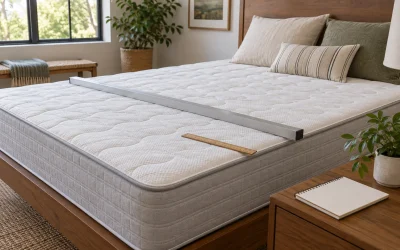
Measure from the same local floor reference to the headboard top and to the top of the sleep surface near the headboard. Keep the tape vertical. Where the floor or headboard shape varies, take matching measurements at the positions you care about instead of treating one reading as representative of the whole width.
A straightedge resting gently across the surface can help locate its height, provided it does not compress the bedding or damage it. Do not lift a heavy mattress alone or reach into an unstable assembly just to obtain an inaccessible dimension.
Original headboard visibility worksheet
| Measurement | Reference | Record |
|---|---|---|
| Headboard top | Same floor point to top edge | H |
| Sleep surface | Same floor point to unoccupied top | S |
| Visible height above surface | Subtract S from H | H − S |
| Styled pillow top | Same floor point after normal styling | P |
| Visible height above pillows | Subtract P from H | H − P |
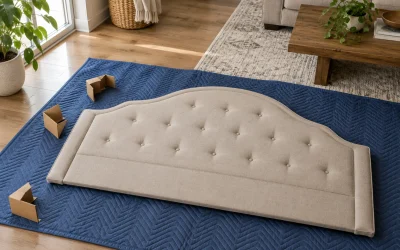
For a curved headboard, repeat H at the center and sides. For a design with an upholstered upper section and exposed lower supports, also record where the decorative section begins. Positive visible height does not guarantee that all the exposed material is the part you want to see.
Worked example: changing the mattress stack
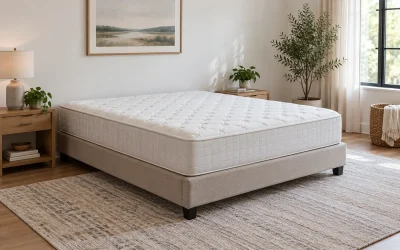
Imagine a headboard top 110 centimeters above the floor and a support surface 30 centimeters above the same reference. An illustrative mattress-and-topper stack is 35 centimeters thick. The unoccupied sleep surface is therefore 65 centimeters high, leaving 45 centimeters of headboard above it.
If a replacement stack is 42 centimeters thick with the support unchanged, the sleep surface becomes 72 centimeters high and visible headboard height falls to 38 centimeters. The seven-centimeter increase in bedding height reduces the visible height by the same amount. These are hypothetical dimensions, not specifications for the MALM example.
Now place the usual pillows against the headboard and measure their top in the normal arrangement. That result answers a different question: how much design shows in the made bed. Keep both numbers, since judging only the styled view can hide the relationship between mattress and headboard.
Use a side sketch before ordering a replacement
Draw the floor, support surface, mattress stack and headboard as four labeled levels. Add the window sill, wall light or artwork if it influences the appearance. Keep actual dimensions separate from desired ones. A taller headboard may solve a visual preference but create a different conflict with the room.
For a prospective mattress, use its stated height as an estimate and identify any product-specific variation or settling guidance. Do not add a generic allowance or assume that a soft topper retains its advertised maximum loft in every situation. Where an exact visual match matters, ask the supplier what dimension should be used.
Keep adjustment within the designed configuration
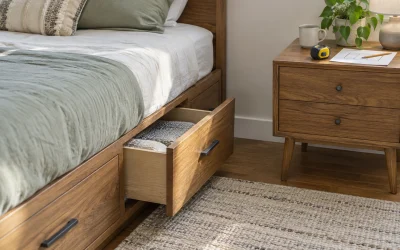
If the bed offers approved support or headboard positions, compare those positions using the maker’s instructions and compatible mattress requirements. Do not drill new holes, stack improvised supports or remove required parts to recover a few centimeters of visible panel.
This worksheet evaluates appearance and measured fit; it does not certify attachment strength, safe gaps or suitability for leaning against the headboard. Treat those as separate product requirements. Likewise, an adjustable base needs its own operating-clearance check rather than a calculation made only with the mattress flat.
Save the side sketch with the product references. It gives a clear answer to a common buying question: after the intended mattress and pillows are in place, which part of the headboard will actually be seen?