Key takeaways
- Record pillow height using consistent conditions and measurement points, with a repeat-reading worksheet and an uncertainty example.
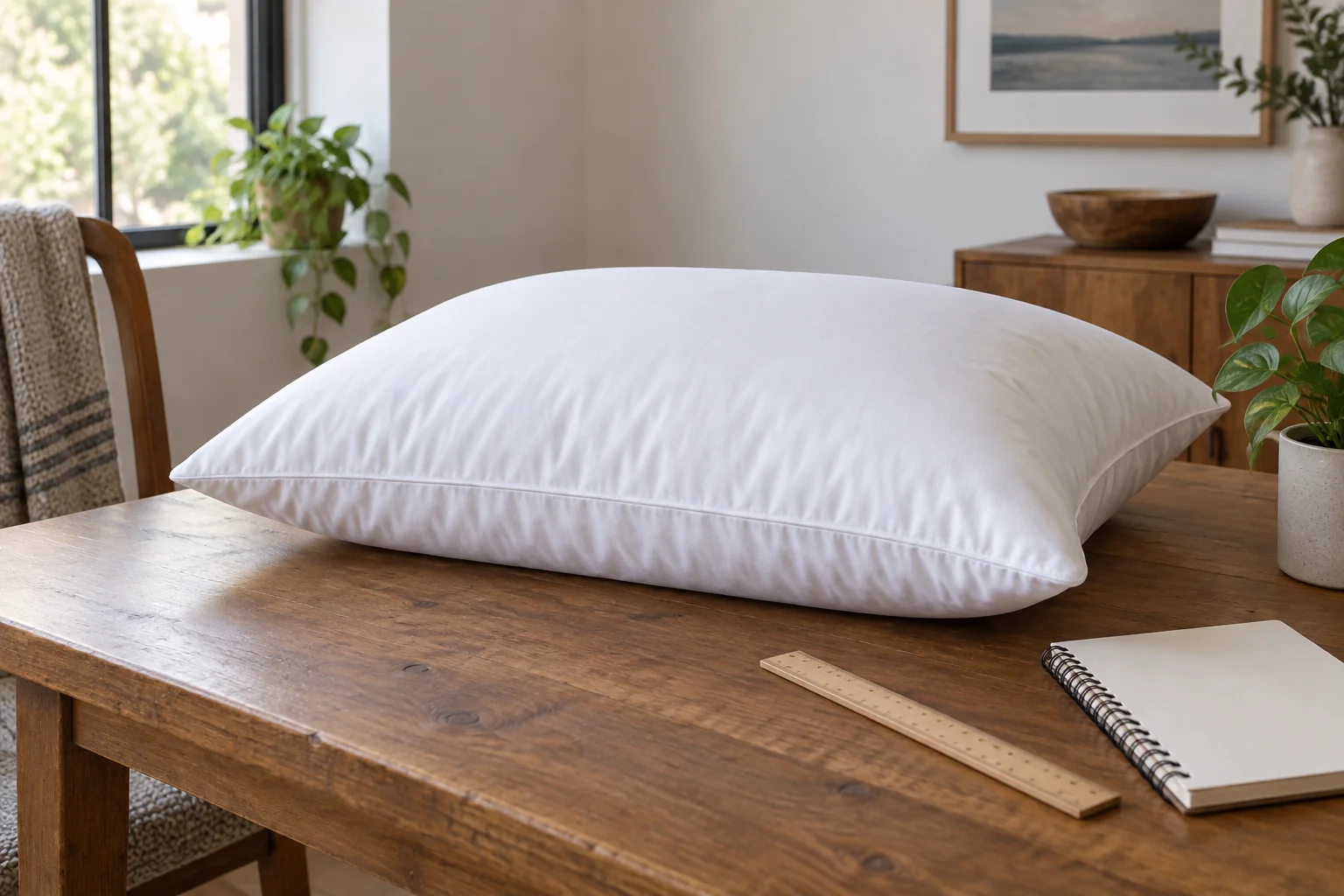
Measure pillow height consistently by using the same surface, cover state, resting condition and measurement locations each time. Record the unloaded shape rather than pressing the pillow down with a book and calling that its normal height. An at-home measurement can describe the pillow you own; it does not determine a medically appropriate pillow or reproduce a manufacturer’s test.
This guide offers a repeatable observation method for comparing a pillow before and after an ordinary change, or explaining its shape to a seller. Keep comfort observations separate from dimensional measurements. Two pillows with similar unloaded heights can feel different in use.
Identify which height you mean
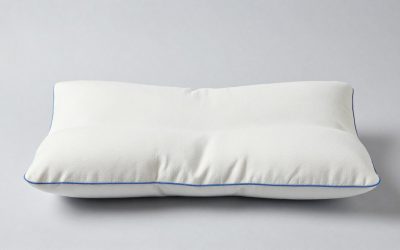
A traditional filled pillow may be tallest near the center, while a contoured pillow may have two raised edges and a lower middle. A gusset measurement describes the side panel, which may differ from the pillow’s overall height. Record the feature you are measuring instead of labeling every number simply “loft.”
For a concrete example, the TEMPUR-Neck product page lists approximate heights of 3½, 4 and 4¾ inches for its small, medium and large versions. These are that product’s published dimensions, not universal categories. Tempur-Pedic’s sizing explanation says the size distinction concerns the tallest point while the length stays the same.
Write down the starting condition
Choose a clean, firm, level surface large enough to support the whole pillow. Remove loose bedding from that surface. Decide whether you are measuring with the normal removable cover in place, and record that choice. Do not open a sealed pillow or remove a component that is not intended to be removed.
If the pillow was recently unpacked, washed or compressed for storage, follow its instructions before measuring. Record the elapsed time since that event. For ordinary repeat checks, use the same chosen resting interval and handling routine. There is no universal recovery time that makes every pillow comparable.
| Record | What to write | Keep consistent |
|---|---|---|
| Pillow identity | Model, size and fill version | Do not combine similar-looking models |
| Condition | Cover on or off; recent use or care | Same preparation for each check |
| Locations | Center and named edge or ridge | Same points and orientation |
| Readings | Three observations at each point | Same ruler and viewing method |
| Notes | Range, uncertainty and visible change | No invented precision |
Use one unit throughout the sheet. If you convert later, keep the original readings as well. Rounding every stage can make a small apparent change look more definite than the measurement method supports.
Measure without adding a test load
Stand a ruler vertically beside the measurement point, with its zero aligned to the supporting surface. Read across at the pillow surface without squeezing it. If helpful, use a lightweight straight reference held level just above the point, rather than resting a heavy object on the filling. Avoid compressing the pillow to make the reading easier.
Take a side photograph with the ruler and reference point visible. Keep the camera approximately level with the measured height to reduce perspective confusion. A photograph helps document the setup, but it does not improve an uncertain measurement into a precise one.
Repeat the reading after repositioning the ruler. If the pillow is irregular, record the range rather than forcing a single value. For a contoured shape, keep separate readings for each raised edge and the center. Do not average those different features into a number that describes none of them.
A worked comparison with honest uncertainty
In this fictional example, a household records an ordinary filled pillow’s center height as 12.0, 12.5 and 12.0 centimeters using the same setup. The useful result is a range of 12.0–12.5 centimeters. Writing 12.17 centimeters would imply a precision that the soft surface and ruler placement do not justify.
At a later check, the readings are 11.8, 12.3 and 12.0 centimeters. Because the ranges overlap, the household does not claim a definite height loss from those numbers alone. It checks whether the cover, resting interval and handling were the same and keeps both sets of observations.
If an obvious shape change persists under comparable conditions, the photographs and record can support a question to the seller. They do not by themselves establish a defect, a warranty entitlement or the cause of a change in comfort.
Keep adjustable fill changes traceable
For a pillow designed to have fill removed, follow its adjustment instructions and record what you changed. Keep removed fill in the manner the maker specifies. Measure again using the same locations and preparation, rather than comparing a freshly handled pillow with one that has rested undisturbed.
Do not add weights, repeatedly fold a pillow or tightly compress it to create a homemade durability test. The TEMPUR-Neck care instructions specifically caution against extended tight compression of its foam. Other products have their own care limits, so a method appropriate for one filling should not be assumed suitable for another.
Use the record for the right decision
The completed sheet should make your observation understandable: which pillow, which condition, which point and how much variation occurred. Pair it with a separate note about personal comfort if useful, without translating height into a promised sleep or pain outcome.
When comparing a replacement, ask the manufacturer how its listed height is defined and whether it is approximate. Matching a familiar pillow’s measured shape can be a useful starting point, but construction and feel still need their own consideration.