Key takeaways
- Document an unloaded mattress indentation using the applicable claim instructions, a measurement record and clear original photographs.
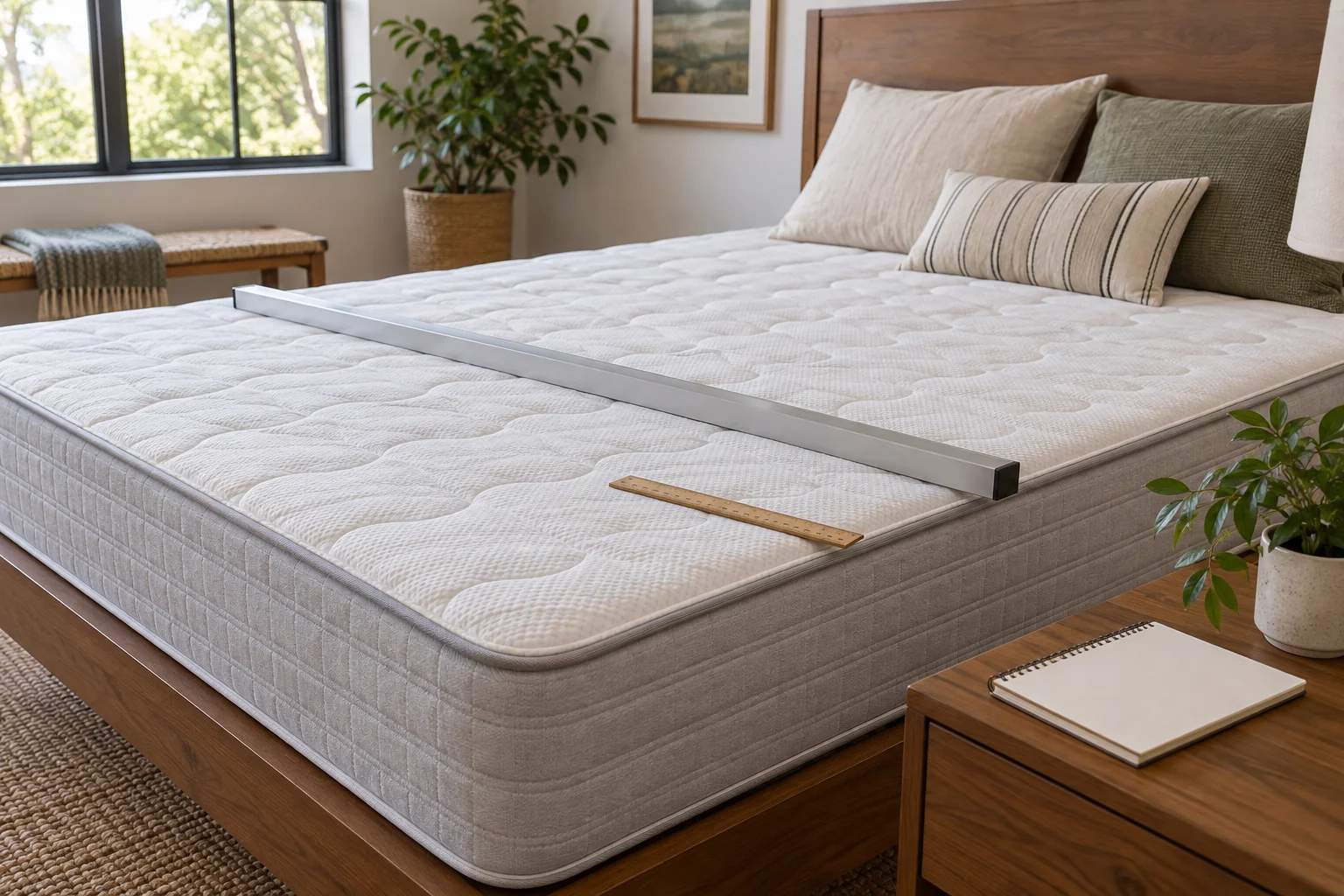
Measure a mattress indentation using the claim instructions for your exact product and seller, with the mattress unloaded and the requested measuring tools visible. Record the method, units and photographs together. A measurement documents what you observe; it does not by itself establish that a warranty covers the condition.
Begin by finding the applicable warranty and claim page. Mattress construction, purchase date, seller and country can affect the process. Do not borrow an indentation threshold from a different model or assume an online example is the rule for your purchase.
Collect the claim instructions before moving the mattress
Save the product name, size, purchase record and the maker’s current claim instructions. Note which seller or support team handles the request. Keep private purchase details in your records rather than posting them publicly with photographs.
Check what support or foundation information is requested. Document the actual setup honestly; do not change the support arrangement and present it as the condition in which the mattress has always been used. If the setup itself is unclear, ask the maker how to document it before attempting a correction.
Heavy mattresses and bed components can be difficult to handle. Arrange suitable help if the requested photographs require movement, and do not dismantle an adjustable base or electrical equipment for a claim photograph. Ask support for an alternative if a requested view cannot be obtained safely.
Use a named procedure as a procedure, not a universal rule
Tempur-Pedic’s claim instructions request purchase and product information, foundation details and photographs. For a sagging concern, the page describes a straightedge across the affected area with a ruler or quarter showing the deepest point, both ends of the straightedge resting on the mattress surface and no weight applied. It also requests a full mattress photograph without bedding or protectors.
That is a specific manufacturer’s documentation example. Use your own product’s current requirements if they differ. Keep the factory cover intact unless the exact claim instructions for your issue expressly require and permit something else; removing a protector is not the same as unzipping the mattress itself.
Prepare an honest, repeatable view
Remove bedding and removable accessories only as directed. Ensure no person, pet or heavy object is loading the mattress during an unloaded measurement. Do not press on the measuring tool or lean on the nearby surface while taking the photograph.
Position the straightedge according to the applicable instructions. Its role is to provide a visible reference across the affected area. Check that it is actually straight and that its ends rest as required, rather than holding one end in the air to exaggerate a gap.
Show where the measurement begins and which units the ruler uses. A close-up that hides the straightedge’s contact points can be difficult to interpret. Take the requested wider view as well as a detail view, preserving the original files rather than editing the apparent depth.
Create a measurement record
| Record field | What to enter | Why it helps |
|---|---|---|
| Product and purchase | Exact model, size, seller and date | Connects evidence to the applicable product |
| Instruction source | Claim-page URL and date checked | Shows which method was followed |
| Support arrangement | Actual foundation or base details | Preserves the setup information requested |
| Measurement location | Describe area and photograph reference | Makes a later view easier to compare |
| Reading and units | Observed value without rounding toward a threshold | Avoids ambiguity |
| Image files | Wide view and requested close-up filenames | Keeps the submission organized |
Do not fill a missing field with a guess. “Purchase receipt requested from retailer” is more useful than an invented purchase date. Likewise, an uncertain model should be resolved from product identification or support before a policy is applied.
Worked example: organizing evidence without deciding the claim
In this fictional example, an owner observes a depression near one sleeping position. The applicable instructions request an unloaded view, a straightedge and a ruler. The owner records the product details, saves the instructions and photographs the full mattress before taking the requested detail view.
The ruler appears to show a three-quarter-inch gap at the recorded point. The owner writes that observation with its units, notes the photograph filename and submits the original images. This number is illustrative only: it is not a recommended threshold or a statement that any particular mattress qualifies for coverage.
On reviewing the first close-up, the owner notices that one straightedge end is outside the frame. A second photograph includes both contact points. The first image is retained in the owner’s records rather than altered. If support wants another angle or method, the owner follows that request and records the new date.
Separate visible indentation from other concerns
A complaint about comfort, noise, support or a change in feel is not automatically measured by the same procedure as an unloaded visible depression. Describe each concern in plain language and ask which documentation the maker needs. Do not stage a depression to represent a sensation that is not visible.
Keep correspondence and submission confirmations together with your worksheet. Avoid cutting tags, opening layers or making repairs while trying to improve the evidence. If support requests an action you do not understand, clarify the exact product and purpose before proceeding.
The useful outcome is a complete, truthful record that the responsible company can assess. A careful measurement reduces confusion about method and units; the actual claim decision still depends on the applicable terms and the company’s assessment.