Key takeaways
- Identify the mattress layer and exact model before opening a zipper, with manufacturer examples and a cover-removal permission checklist.
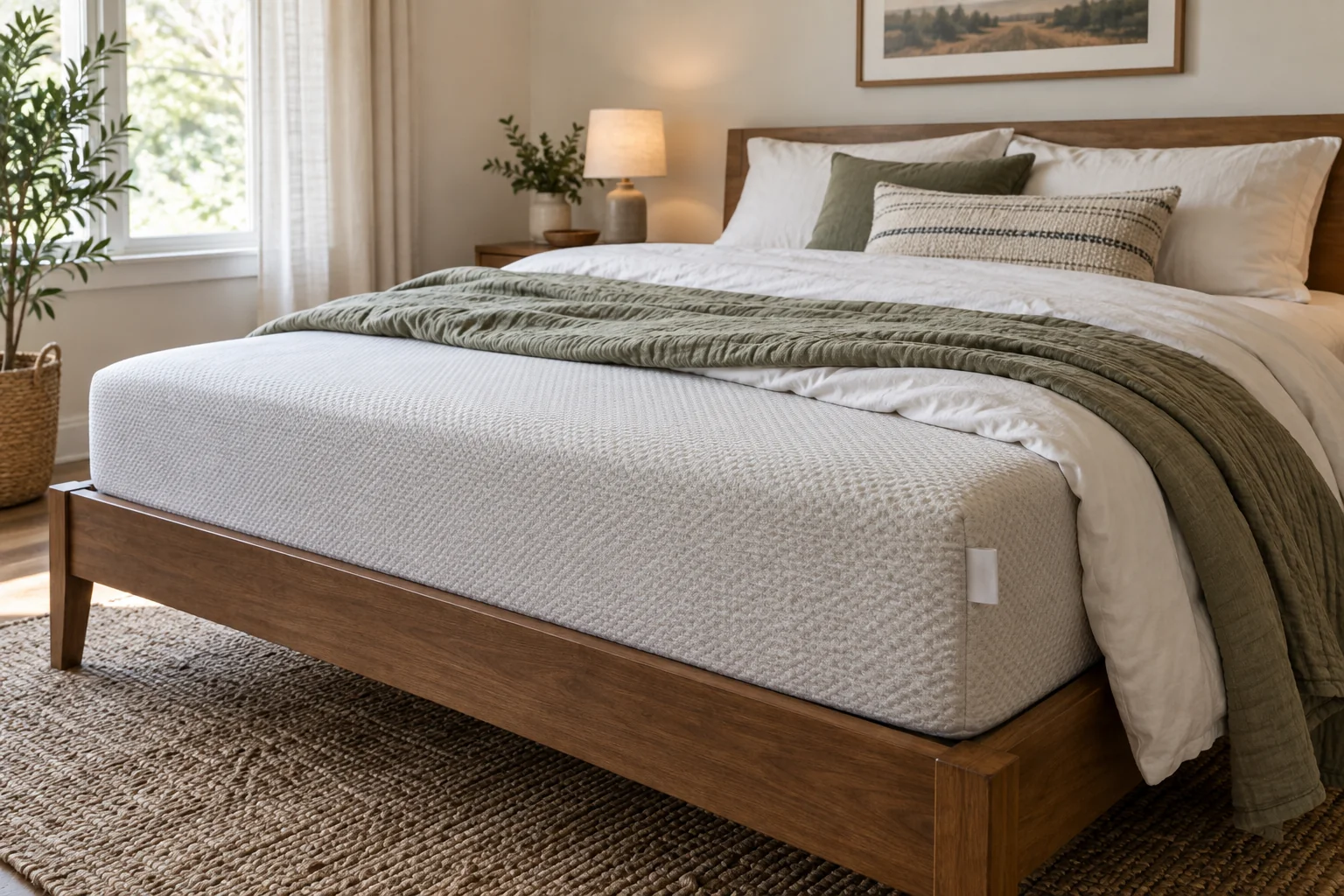
A zipper does not prove that a mattress cover is removable. Identify the layer, the exact mattress model and its care instructions before opening anything. Only remove the part the manufacturer explicitly identifies as removable for that version of the mattress.
This check is different from washing a separately purchased protector. The cover fitted around the mattress during manufacture can have different restrictions, even when the two layers look similar. The steps below help you reach a documented yes, no or “ask the maker” decision without experimenting on the mattress.
Identify which layer you are looking at
Start with the bedding you put on the bed yourself: sheet, separate protector, pad or topper. If possible, find the purchase record and care label for that accessory. Do not transfer those instructions to the fabric enclosing the mattress underneath.
Describe the questionable layer in plain terms. Is it a fitted accessory purchased separately, a zippered encasement added later, the factory outer cover, or an inner layer visible because something has already been opened? Stop before opening further layers to investigate. A photograph of the exterior and its accessible label is a better starting point for support.
Use the model name and production information you already have. Keep the receipt date separate from the model generation. A mattress bought recently could be an earlier version, and familiar marketing names may be reused across changing constructions.
Read the exact manufacturer’s exception
Tuft & Needle’s cover guidance says its covers generally are not intended for removal and explains that older zippers were used during manufacturing. It identifies exceptions for the removable top portions of the Mint launched in 2022 and Mint Hybrid launched in 2023. The bottom portions are not designed for removal. The page says to follow removal instructions only when the model was specifically described as having a removable cover.
Tempur-Pedic’s product-care guidance says most of its mattress covers can be removed and washed, while directing owners to sewn-in tags or customer service when uncertain. “Most” is not “all.” Together, these examples show why neither a zipper nor a brand name alone settles the question.
Read the mattress section of the source, not a nearby section for pillows or toppers. A page can contain several products with similar-looking headings. Save the exact section or page number with your model record.
Use a removal-permission checklist
| Question | Evidence needed | If the answer is unclear |
|---|---|---|
| Which layer is this? | Accessory receipt or mattress description | Keep the cover closed |
| Which model and version? | Label, order record or maker confirmation | Ask support to identify it |
| Is removal explicitly allowed? | Exact model’s written care instruction | Do not infer permission from a zipper |
| Which portion may be removed? | Top only, whole specified cover or none | Do not extend instructions to inner layers |
| How is it cleaned and refitted? | Applicable care label and directions | Resolve before starting |
Write the outcome at the bottom: “removal permitted for this part,” “do not remove,” or “awaiting confirmation.” Do not let a partially completed checklist become an assumed yes because laundry day has arrived.
Ask a precise support question
Send the maker the model, available production information and exterior label photographs through its official support channel. Explain which layer you mean. Ask whether removal is permitted, exactly which portion can come off, and where to find the applicable cleaning and refitting instructions.
Keep serial information private rather than posting it in a public comment. If you cannot identify the mattress, say so. A response about a similarly named model should not be treated as confirmation for yours unless the support team has resolved that match.
Save the written answer beside your care record. If it conflicts with a sewn-in instruction, ask the maker to reconcile the conflict before acting. Do not choose whichever answer seems easier.
Worked example: two covers, two decisions
Imagine a bed with a separately purchased fitted protector over an older mattress. The protector’s label permits removal for laundering. The factory mattress cover has a zipper, but the owner cannot find a statement allowing it to be removed.
The owner records two separate entries. The protector can follow its own label; the factory cover stays closed while the exact mattress model is checked. The visible zipper does not change the second decision.
In another fictional case, the maker confirms that only the top portion of a particular cover is removable. The owner records that limit and leaves the bottom and any inner layers in place. This is not a cleaning recipe: temperatures, products and drying methods still come from the applicable instructions.
Plan the task only after permission is clear
Before permitted removal, read the entire process, including refitting. Check that the cleaning method suits your equipment and that you can allow the cover to become fully dry as instructed before returning the bed to use. Do not improvise stretching, heating or aggressive stain treatment to make a cover fit.
If removal is prohibited or remains uncertain, use only the care method specified for the intact mattress or ask the maker for help. Do not cut a zipper, detach a sewn layer or assume a replacement cover will solve an identification problem.
The useful result is a reliable boundary around the task: the right product, the right layer and explicit permission. Once those are known, the care instructions become much easier to follow correctly.