Key takeaways
- Measure folded king bedding and its storage opening separately, then compare bag dimensions, usable shape and care requirements with a fit worksheet.
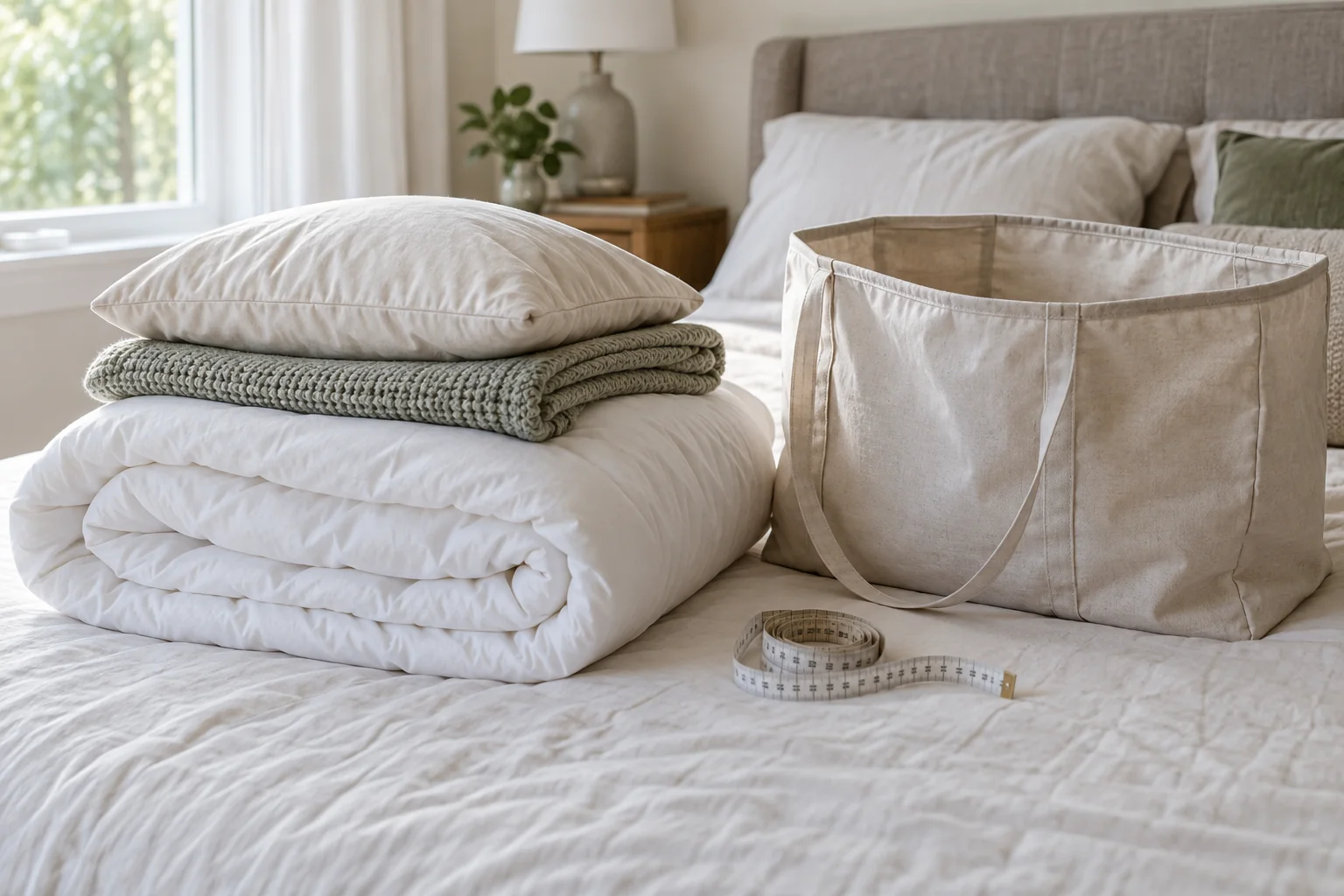
Choose a storage bag for king bedding by measuring the actual folded bundle, then checking the filled bag against its storage location. “King” describes the bedding’s intended bed size, not the volume of a folded duvet, quilt or sheet set. Two king sets can need very different storage because their materials, fill and folding methods differ.
Keep three dimensions separate throughout the comparison: the bedding bundle, the bag as used and the opening through which you will place it. A bag can hold the bedding yet fail to fit a shelf, or fit under the bed when empty and bulge too much when filled.
Define exactly what goes in one bag
List the contents before measuring. Decide whether the duvet cover and pillowcases stay with the duvet or in a separate linen location. For seasonal rotation, record which pieces should be retrieved together. Avoid comparing a bag for one summer quilt with another expected to hold a winter duvet plus spare pillows.
Read the bedding’s care and storage instructions. Start with clean, fully dry items, and do not assume that vacuum compression is suitable for every filling or construction. This guide compares ordinary storage geometry; it does not establish how much a textile can safely be compressed or whether a particular storage environment is suitable.
Measure the relaxed folded bundle
Fold the bedding using a repeatable method, place it on a clean flat surface and measure its length, width and height without sitting on it or pulling it tight with straps. Let a bulky item settle naturally, then check again. Note the thickest part rather than measuring only a conveniently flat edge.
Try a second fold if the first creates a shape poorly suited to the available shelf. Keep the fold practical enough to repeat after laundering. If separating the sheets from the duvet gives two manageable bundles, record that as a genuine alternative rather than assuming one larger bag is always more convenient.
Read assembled dimensions, not shipping measurements
The IKEA Ireland listing for SKUBB 605.910.47 gives a used size of 43 × 53 × 19 cm, while its flat package measurements are 23 × 4 × 55 cm. The listing also identifies ventilation nets and specifies vacuuming or a lint roller for care, with no washing. These details apply to that item; they do not prove that a particular king duvet fits or that another fabric bag has the same care instructions.
When a listing gives only outside dimensions, ask about the usable inside shape and opening. Seams, internal supports and the zip path can reduce practical space. Treat a capacity in litres as supplementary information: two bags with equal volume can accommodate very different folded shapes.
Use a three-part fit worksheet
| Item to measure | Record | Decision it supports |
|---|---|---|
| Folded bedding bundle | Length, width, thickest height and contents | Whether the bag can close without forcing |
| Bag in use | Usable inside shape, filled outside size and handles | Whether the filled bag fits its destination |
| Storage opening | Narrowest width, height and entry direction | Whether the bag can pass through |
| Storage position | Depth, obstructions and retrieval route | Whether you can remove it independently |
| Care instructions | Textile and bag requirements separately | Whether the proposed routine is compatible |
Include the product code beside each candidate. Similar photographs may show different sizes in the same range. Save the dimension page with the date checked, especially when a retailer combines several size options on one listing.
A worked fit comparison
Suppose a folded king quilt measures 48 × 40 × 22 cm without compression. A hypothetical bag with an internal space of 52 × 44 × 18 cm is long and wide enough but 4 cm too shallow. Its generous-looking footprint does not solve the height mismatch.
A second bag with a confirmed usable height of 25 cm may hold the quilt, but the intended under-bed opening is only 21 cm high. That arrangement fails at the entry stage. The household chooses a suitable shelf instead, or investigates a different fold consistent with the textile’s care guidance. These invented measurements illustrate three separate checks; they are not a claim about the SKUBB example.
Check closure and retrieval before committing
If a sample or returnable trial is available under the seller’s terms, fill the bag normally and close it without pulling the zip against a strained seam. Note the largest filled dimension. Try taking it in and out of the intended location without scraping, dragging handles under furniture or moving unrelated heavy items.
For lift-up storage beds, follow the bed’s own access and loading instructions and keep bags clear of moving components. Do not use a bag to prop a mechanism open. For shelves, check the shelf’s supported load and whether the filled bundle is manageable at that height.
Label the contents and keep the fold repeatable
Use a removable label naming the bedding set and included pieces. Add a simple fold sketch or photograph to your household notes if it is difficult to reproduce. Keep care information where it remains accessible after packing, rather than sealing the only instructions inside an unlabelled bag.
A successful choice closes normally, fits the actual opening and can be retrieved without a furniture rearrangement. That is more useful than a broad claim that a bag is “large enough for king bedding,” because the fit is tied to your own bundle and storage space.