Key takeaways
- Compare US and UK mattress names using actual dimensions, unit conversions, frame compatibility and separate bedding checks.
Compare US and UK mattress listings by their stated width and length, not by the size name alone. “King” describes different footprints in the two markets. Convert the measurements into one unit, then check the actual mattress, frame, foundation and bedding specifications as separate parts of the purchase.
Our top picks
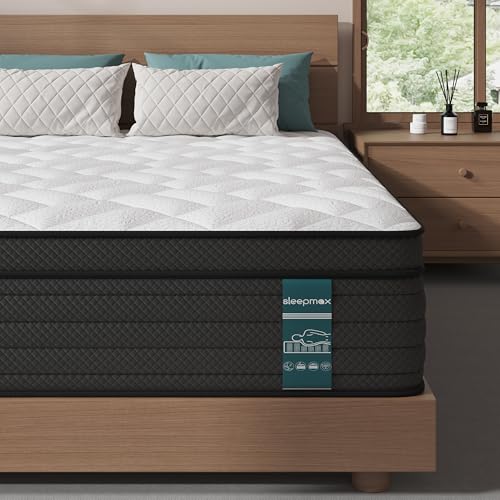 Sleepmax Queen Mattress 14 Inch
- Combining the supportive benefits of coils with the…
- With a deluxe Euro top, pressure-relieving foam layers,…
- Sleepmax Mist is crafted using CertiPUR-US and OEKO-TEX…
| Product | Key specs | |
|---|---|---|
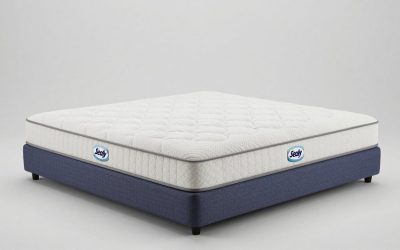
 Sealy Dreamlife 12” Foam Mattress-in-a-Box Sealy Dreamlife 12” Foam Mattress-in-a-Box | Check price | |
| Sleepmax Queen Mattress 14 Inch | Combining the supportive benefits of coils with the… With a deluxe Euro top, pressure-relieving foam layers,… Sleepmax Mist is crafted using CertiPUR-US and OEKO-TEX… | Check price |
 Sealy Dreamlife 12” Hybrid Mattress-in-a-Box Sealy Dreamlife 12” Hybrid Mattress-in-a-Box | Check price | |
 BedStory Firm Queen 14 Inch Mattress BedStory Firm Queen 14 Inch Mattress | BedStory Monologue hybrid mattress combines plush 38D fusion… The hybrid design relieves pressure points and aligns… Individually pocketed springs absorb motion to minimize disturbances,… | Check price |
As an Amazon Associate we earn from qualifying purchases at no extra cost to you.
Identify the market and the exact product
Start with the country version of the manufacturer’s website and the selected size in its product menu. Save the model name and dimension table together. A search result may show a familiar name while opening a different regional page, and a product family may include special sizes beyond its standard range.
Separate mattress measurements from bed-frame measurements. A frame’s outside width includes rails or upholstery, while its accepted mattress size describes the intended sleeping component. Neither is the same as the delivery carton dimensions. Put each in its own row so a generous-looking frame measurement does not mask the wrong mattress cavity.
For an existing bed, record its label and instructions before relying on a tape measurement alone. The manufacturer can clarify the intended mattress size and permitted variation. Do not assume that an approximate fit establishes compatibility with the support system.
Use named manufacturer examples
TEMPUR UK’s size guide lists its standard single as 90 × 190 centimeters, double as 135 × 190, king as 150 × 200 and super king as 180 × 200. It also identifies alternative sizes. Check the chosen model because a regional size guide does not guarantee every size is offered in every product.
The US Tempur-Pedic Breeze collection size guide lists queen at 60 × 80 inches, king at 76 × 80 and California king at 72 × 84. The page notes that individual mattress dimensions may vary. These are manufacturer examples that illustrate the naming problem, not a promise about all mattresses sold in either country.
| Listing example | Published dimensions | Converted comparison |
|---|---|---|
| TEMPUR UK king | 150 × 200 cm | About 59.06 × 78.74 in |
| Tempur-Pedic US queen | 60 × 80 in | 152.4 × 203.2 cm |
| Tempur-Pedic US king | 76 × 80 in | 193.04 × 203.2 cm |
| TEMPUR UK super king | 180 × 200 cm | About 70.87 × 78.74 in |
Make one conversion sheet
Multiply inches by 2.54 to obtain centimeters. Divide centimeters by 2.54 to obtain inches. Keep the original figure beside the converted one, and retain enough decimal places for comparison. Do not round two different dimensions to the same whole number and then describe the products as identical.
Use the same width-first, length-second order throughout the sheet. If a retailer’s notation is unclear, resolve it before doing arithmetic. Also check whether a split configuration’s dimensions refer to each component or the combined bed. A photograph of two halves does not answer that question.
Create separate columns for stated mattress dimensions, frame compatibility, mattress height, bedding fit and unanswered questions. This turns a size-name comparison into a practical buying record.
Worked example: a familiar name hides a mismatch
Suppose an owner of a frame specified for a 150 × 200-centimeter mattress considers a US queen listed at 60 × 80 inches. Converting gives 152.4 × 203.2 centimeters, which is 2.4 centimeters wider and 3.2 centimeters longer than the frame’s specified mattress size.
Those differences are total width and length differences. They are not a claim that the frame has spare space or that the mattress can safely compress into it. The correct next step is to obtain the frame manufacturer’s compatibility answer, not to force the mattress between the rails.
A US king would be a much larger departure from that UK king specification despite sharing the word “king.” This is why renaming a product in a comparison spreadsheet cannot replace its numbers.
Check bedding and support separately
A fitted sheet needs the appropriate width, length and supported mattress-depth range. A close footprint does not settle pocket depth, and a loose flat sheet does not prove that a fitted protector will work. Compare the chosen bedding manufacturer’s measurements rather than translating the mattress name into a shopping category.
For foundations, adjustable bases and frames, check the actual model requirements and configuration. Do not import one manufacturer’s slat-spacing, center-support or weight instructions into another brand’s bed. If components come from different markets, record written compatibility information before ordering.
Keep a final four-part confirmation
Before paying, confirm the exact regional product, its dimensions, the intended supporting furniture and the matching bedding. Include the selected size and model reference in any question to the seller. “Will your king fit my king bed?” leaves the main ambiguity unresolved.
Finally, save the specification and ordering details with the receipt. If a listing changes later, the record helps explain what was selected. The goal is not to memorize a universal naming chart; it is to make every component of this particular bed refer to the same measured footprint.