Key takeaways
- Bedrooms and living rooms: 45–50%. Prioritize quiet operation and a light you can dim or switch off.
- Basements: 50%. Going lower is tempting but rarely necessary, and concrete walls will keep feeding moisture back in, so the compressor will simply run longer for little benefit.
- Bathrooms and laundry areas: 50%, run after use rather than continuously. These rooms spike and recover quickly.
- Crawl spaces and storage: 50–55% is usually adequate to protect stored goods without excessive runtime.
What's inside
Humidity is the variable most people forget when they’re troubleshooting bad sleep. You can buy the blackout curtains, dial the thermostat to 66°F, and still wake up at 3 a.m. clammy and restless — because the air itself is holding more moisture than your body can offload. Sleep depends on your core temperature dropping about one to two degrees, and that drop happens largely through evaporation from your skin. When the air is already saturated, evaporation stalls, and your thermoregulation has to work overtime. That’s the sticky, tossing-and-turning feeling you can’t quite name.
The good news: this is a solvable problem with one dial. Below, I’ll walk you through the humidity range that actually supports sleep and comfort, how that number should shift by room and by season, why the “lowest possible setting” is a mistake, and how to match your target to the size and features of the machine you own. You’ll also learn what to do about basements, bathrooms, and the noise trade-off that makes or breaks a bedroom unit.
As an Amazon Associate we earn from qualifying purchases.


🛒 Best Price Today on Amazon
Prime members get fast, free shipping on everything above, plus member-only deals. New members get a 30-day free trial — cancel anytime.
The Short Answer: 45–50% For Most Homes
If you want one number, set your dehumidifier to 45–50% relative humidity. This band is wide enough to be forgiving and narrow enough to do real work. Below about 50%, dust mites can no longer maintain their water balance and populations collapse over a few weeks — which matters enormously if anyone in the house wakes up congested. Mold and mildew also need sustained moisture above roughly 60% to colonize surfaces, so 45–50% keeps you comfortably clear. Meanwhile, staying at or above 45% protects you from the downside of over-drying: cracked lips, scratchy throats, nosebleeds, static, and shrinking hardwood or furniture joints. For a bedroom specifically, I nudge clients toward the lower half of that range — 45% paired with a cool room is the most reliable combination I know for uninterrupted sleep.
Adjust By Room, Not By Habit
A single setting for the whole house ignores how differently spaces behave. Use these starting points:
- Bedrooms and living rooms: 45–50%. Prioritize quiet operation and a light you can dim or switch off.
- Basements: 50%. Going lower is tempting but rarely necessary, and concrete walls will keep feeding moisture back in, so the compressor will simply run longer for little benefit.
- Bathrooms and laundry areas: 50%, run after use rather than continuously. These rooms spike and recover quickly.
- Crawl spaces and storage: 50–55% is usually adequate to protect stored goods without excessive runtime.
Season Changes The Math
Relative humidity is relative to temperature, which is why a setting that felt perfect in July can cause condensation in January. In cold weather, warm indoor moisture meets chilled window glass and single-pane surfaces and turns to water. If you see fogging or beading on windows, drop your target by 5% at a time until it stops — often landing near 35–40% in a genuinely cold climate. In summer, the opposite pressure applies: outdoor air is loaded, so aim for 45–50% and expect longer runtimes. A unit with a true built-in humidistat, like the 5500 Sq. Ft Energy Star Most Efficient Dehumidifier with intelligent humidistat, handles this cycling without you babysitting it.
Match The Setting To The Machine’s Capacity
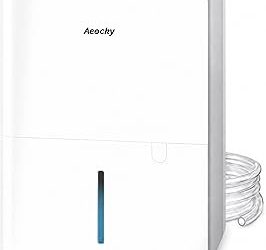
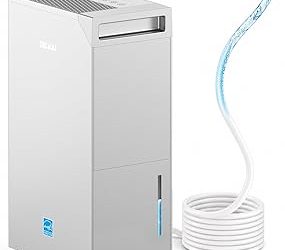
A target humidity is only meaningful if the unit can actually reach it. Asking a small tank-based model to hold 45% across an open-plan floor means it runs constantly, never satisfies the sensor, and fills its reservoir every few hours. Match capacity to space first: for a single bedroom or a 1,000 sq ft area, a compact unit such as the ToLife 1000 Sq Ft 95 oz Dehumidifier or the comparable 95OZ Dehumidifier with 7-Color Ambient Light is right-sized and quiet enough to sleep beside. For a mid-sized main floor, the Waykar 34 Pint, 2,000 Sq. Ft. Energy Star model with 30%–80% humidity control gives you real headroom. For damp basements and whole-floor coverage, step up to a compressor unit like the KNKA Energy Star 4,500 Sq. Ft., 80 Pint/Day or the 4500 Sq. Ft Dehumidifier with Drain Hose — both continuous-drain capable, which matters when you’re pulling gallons a day.
Use Sleep Mode And Continuous Drainage
Two features do more for real-world results than any setting tweak. Sleep mode (found on the KNKA and ToLife units) dims the display, lowers fan speed, and reduces the audible fluctuation that pulls light sleepers toward waking — a steady low hum is far less disruptive than a compressor cycling loudly on and off. Continuous drainage via a hose to a floor drain or sump means the unit never pauses on a full tank, which is the single most common reason a correctly-set dehumidifier fails to hold its target. If your unit includes a hose, use it.
Tips
- Verify with an independent hygrometer placed away from the unit; onboard sensors read the air they just dried and often report low.
- Leave at least 8–12 inches of clearance around the intake and exhaust so the machine isn’t recycling its own dry air.
- Rinse the filter monthly — a clogged filter quietly cuts extraction capacity and drives up runtime and noise.
- Below about 60°F, choose a model with automatic defrost (the Waykar has this) or coils will ice over and stop pulling moisture.
Frequently Asked Questions
Is 30% too low for a bedroom?
Yes, for continuous use. Sustained humidity below 40% dries nasal passages and airways, which can worsen snoring and morning throat irritation. Reserve 30–35% for short-term drying after a leak or in very cold weather to prevent window condensation.
Should I run it all night?
Yes, but on sleep mode with a set target rather than continuous mode. The unit will cycle only as needed, which is quieter and cheaper than running full-time.
Why does my humidity never reach the setting?
Usually undersizing, a full tank, an open window or door, or ambient temperature too low for the coils. Check those four in order before assuming the unit is faulty.
Does a lower setting cool the room?
It doesn’t lower air temperature, but it makes a given temperature feel noticeably cooler because your sweat can finally evaporate. Many people find they can raise the thermostat 2–3 degrees once humidity is controlled.
Conclusion
Set your dehumidifier to 45–50%, lean toward 45% in bedrooms, hold basements at 50%, and drop lower only in winter if windows fog — then let a properly sized unit with a real humidistat, sleep mode, and continuous drainage do the rest. Get that one number right and you’ll notice it first in your sleep, then in your allergies, and eventually in the absence of that faint damp smell you’d stopped noticing.