Key takeaways
- 2 inches — a surface refresh. The Linenspa 2 Inch Gel Memory Foam topper is the right category here: it softens a mattress that’s slightly too firm without changing its fundamental support. Best for stomach sleepers, lighter body weights, and anyone who likes their current bed but wants less pressure at the shoulders.
- 3 inches — the versatile middle. This is where most people land. Options like the EGO 3 Inch Gel Memory Foam Topper, the Best Price Mattress 3 Inch Ventilated topper, and the SINWEEK 3 Inch Gel Memory Foam Topper give enough material for real hip and shoulder immersion while staying stable enough for combination sleepers who shift positions.
- 5 inches — a rebuild. The WhatsBedding 5 Inch pillow-top style topper and the SHOUREN 5 Inch Gel Memory Foam Topper are for tired mattresses, guest beds, or side sleepers with persistent hip pain. Expect a noticeable change in bed height and check that your fitted sheets have deep enough pockets.
A mattress topper is the most underrated piece of sleep equipment in most homes. When someone tells me their mattress “went bad” after four years, the problem is rarely the whole bed — it’s usually the top inch or two of comfort material that has compressed under the same hip and shoulder pressure night after night. Replacing a mattress is a four-figure decision. Restoring its surface feel is often a two-figure one, and it can buy you two or three more years of decent sleep while you save for the real upgrade.
Memory foam remains the go-to material for that job because it responds to body heat and weight, redistributing pressure instead of pushing back against it. But thickness, density, cooling treatment, and cover design vary enormously between products, and the wrong choice can make a firm bed feel unstable or a soft bed feel like quicksand. Below, I’ll walk you through how to match topper specs to your actual sleep situation — your position, your mattress’s current condition, your temperature tendencies — and flag the practical details that matter more than marketing copy.
Our top picks


As an Amazon Associate we earn from qualifying purchases at no extra cost to you. Ratings are shown as listed on Amazon.
🛒 Best Price Today on Amazon
Prime members get fast, free shipping on everything above, plus member-only deals. New members get a 30-day free trial — cancel anytime.
Start With Your Mattress, Not the Topper
Diagnose before you prescribe. Pull off your sheets and look at the surface with a flashlight held at a low angle: visible valleys where you sleep mean the comfort layer has broken down, and a topper will genuinely help. If the mattress sags in the middle as a whole — a dip you can see across the entire width — that’s a support-core or foundation failure, and no topper will correct it. In that case, foam laid on top simply follows the curve. Also press down on the edges. A bed that has lost edge integrity will feel less secure with an added layer, since the topper extends the sleep surface upward without reinforcing the perimeter.
Choosing Thickness: 2, 3, or 5 Inches
- 2 inches — a surface refresh. The Linenspa 2 Inch Gel Memory Foam topper is the right category here: it softens a mattress that’s slightly too firm without changing its fundamental support. Best for stomach sleepers, lighter body weights, and anyone who likes their current bed but wants less pressure at the shoulders.
- 3 inches — the versatile middle. This is where most people land. Options like the EGO 3 Inch Gel Memory Foam Topper, the Best Price Mattress 3 Inch Ventilated topper, and the SINWEEK 3 Inch Gel Memory Foam Topper give enough material for real hip and shoulder immersion while staying stable enough for combination sleepers who shift positions.
- 5 inches — a rebuild. The WhatsBedding 5 Inch pillow-top style topper and the SHOUREN 5 Inch Gel Memory Foam Topper are for tired mattresses, guest beds, or side sleepers with persistent hip pain. Expect a noticeable change in bed height and check that your fitted sheets have deep enough pockets.
Density and Support: The Spec Nobody Lists
Foam density (measured in pounds per cubic foot) determines both feel and lifespan, but few listings publish it. Use proxies. Look for the phrase “high density,” as SINWEEK uses, and pay attention to shipping weight — a queen topper that weighs under about eight pounds at three inches is almost certainly low-density foam that will compress quickly. CertiPUR-US certification, which all six products here carry, doesn’t measure density; it verifies the foam was made without certain flame retardants, formaldehyde, and heavy metals, and meets low-VOC emission standards. Treat it as a baseline for indoor air quality, not a quality grade.
Managing Heat
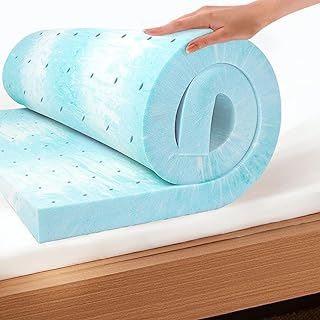
Memory foam’s temperature sensitivity is what makes it contour — and what makes it sleep warm. Two engineering approaches help. Gel infusion adds a heat-absorbing material to the foam itself, which moderates the initial warm-up. Ventilation — the visible channels or holes in the EGO, Best Price, and SINWEEK toppers — creates pathways for air and moisture to move laterally instead of pooling under your torso. Neither turns foam into a cooling device, but combined with breathable cotton or percale sheets, they meaningfully reduce the sensation of being trapped in a heat pocket.
Covers, Straps, and Staying Put
A topper that migrates every night will get returned. Anchoring systems vary: elasticized skirts wrap the mattress corners and hold best on beds under about 12 inches thick, while corner straps like the four-way system on the SHOUREN topper work on deeper mattresses. Removable, washable covers — as on the SINWEEK — matter more than people expect, because bare memory foam cannot be washed. If a topper lacks a cover, budget for a waterproof protector.
Tips
- Unbox and air out your topper in a well-ventilated room for 24 to 72 hours; new foam off-gasses a temporary odor and needs time to fully decompress.
- Allow two full weeks of adjustment before judging feel. Your body recalibrates to a new pressure distribution, and early-night impressions are unreliable.
- Never fold or bend memory foam for storage — permanent creases form along the fold line. Store flat or loosely rolled.
- Rotate the topper 180 degrees every three months to distribute compression across the foam rather than concentrating it in one spot.
Frequently Asked Questions
How long does a memory foam topper last?
Three to five years for mid-density foam with regular use. You’ll notice the decline as slower recovery when you shift position, and eventually as a permanent body impression that doesn’t rebound by morning.
Will a topper fix my back pain?
It can help if pain stems from inadequate pressure relief or a sagging comfort layer. Side sleepers with hip and shoulder pain generally benefit most from three to five inches. Persistent pain warrants a conversation with a clinician rather than another purchase.
Should I use a topper on a brand-new mattress?
Usually no — and it may void warranty coverage on some beds. The exception is when a new mattress is simply firmer than expected and the return window has closed; a two-inch topper is a reasonable correction.
Can I put a memory foam topper on an adjustable base?
Yes. Memory foam flexes readily with articulation. Thicker toppers benefit from corner straps to prevent shifting during position changes.
Conclusion
The best topper for you is the one matched to your specific situation: two inches to soften a firm bed, three inches for balanced pressure relief and the widest appeal, five inches to revive a mattress that’s clearly past its prime. Prioritize a genuinely high-density foam, a ventilated or gel-infused build if you sleep warm, and a secure anchoring system — then give it two weeks before you decide. Done thoughtfully, it’s the highest-return sleep purchase available under a hundred dollars.