Key takeaways
- No stated loft or height. If the listing gives only width and length, you cannot match it to your shoulder.
- “Perfect for all sleep positions.” A pillow right for a stomach sleeper at 2.75 inches is wrong for a side sleeper by 2 inches or more.
- Adjustable pillows that ship with no spare fill or no way to add it back; you can only go down.
- Foam without a CertiPUR-US or similar certification.
- Very light weight, under 2 pounds for a Queen foam pillow, which usually means low-density fill that flattens fast.
- Return policies that exclude opened pillows. A loft you cannot test is a loft you are guessing at.
Side sleepers buy the wrong pillow more often than anyone else, and the reason is almost always loft. They pick a pillow that feels plush in the store, sleep on it for a week, and wake up with a stiff neck because their head has been tilting down toward the mattress all night. Or they overcorrect with a tall firm pillow that pushes the head up and the shoulder into a shrug. The mistake is treating loft as a comfort preference when it is actually a measurement: the distance from the side of your neck to the outside of your shoulder, minus whatever the mattress lets your shoulder sink. Get that number and the pillow choice mostly makes itself.
Decide These 3 Things First
Your shoulder width. Stand against a wall and measure from the base of your neck straight out to the point of your shoulder. Most adults land between 4 and 7 inches. That is your starting loft before adjustments.
Our top picks



As an Amazon Associate we earn from qualifying purchases at no extra cost to you.
Your mattress firmness. On a soft mattress, the shoulder sinks 1 to 2 inches, so subtract that from your loft. On a firm mattress, the shoulder barely sinks, so use the full measurement.
Adjustable or fixed. If you are unsure of your number, an adjustable pillow with removable fill lets you dial loft in half-inch steps. A fixed-loft pillow is fine once you know exactly what works.
Loft
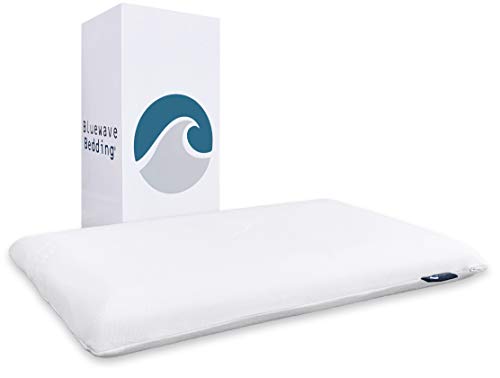
Loft is the height of the pillow when your head is resting on it, not when it is sitting fluffed on the bed. Low loft is under 3 inches and suits stomach sleepers; the Bluewave Bedding Ultra Slim Gel Memory Foam Pillow at 2.75 inches and $39.95 is built for them and is too flat for almost every side sleeper. Medium loft is 3 to 5 inches and suits side sleepers under about 150 pounds or on softer mattresses. High loft is 5 to 7 inches and suits broad-shouldered side sleepers on firm mattresses. Because pillows compress, buy 1 to 2 inches taller than your target compressed height in a soft fill, or about half an inch taller in solid memory foam.
Fill Material
Solid memory foam holds a fixed loft and compresses about half an inch under the head; it is the most predictable. Shredded memory foam can be removed by the handful and compresses 1 to 2 inches; models such as the DreamyBlue Signature Adjustable Shredded Memory Foam Pillow at $66.50 or the LOFE Adjustable Memory Foam Pillow at $45.99 ship overfilled so you can tune them down. Down and feather compress the most, often 2 to 3 inches, so a 7-inch down pillow may end up at 4 inches under a heavy head. Polyester fiber sits between foam and down and flattens within a year. Latex holds loft like foam but sleeps cooler and bounces back faster. For side sleepers, shredded foam or latex are the most forgiving first choices.
Size and Shape
Standard pillows are 20 x 26 inches, Queen 20 x 30, and King 20 x 36. Size affects how much room you have to move, not loft. A Queen is the practical choice for a side sleeper who shifts position; a King suits a King bed or someone who wants to hug the pillow. Gusseted pillows have a 2 to 4 inch fabric wall around the edge that keeps the loft even from center to edge, which matters for side sleepers who end up near the pillow’s edge. Contour pillows with a raised side ridge are an alternative for people who want a fixed loft with a shoulder cutout.
Firmness and Support
Loft and firmness are related but different. A soft pillow at 6 inches may compress to 4 inches under a heavy head; a firm pillow at 5 inches stays at 4.5. For side sleeping, medium-firm is usually right: firm enough to hold the head level, soft enough that the cheek and ear are not pressed against a block. Adjustable pillows such as the Nuzzle Pillow Standard Adjustable Neck Pillow at $44.21 let you change both by removing or repositioning inner layers. A quick test: lie on your side and have someone check whether your nose lines up with the center of your chest. If it points up, remove fill. If it points down, add.
Price Tiers
Budget, $20 to $40. Polyester fiber or basic shredded foam, standard size, fixed loft or a single zipper for adjusting. Expect to replace in 1 to 2 years.
Mid-range, $40 to $70. Adjustable shredded memory foam or solid gel foam, Queen sizes, removable washable covers, cooling fabrics. The LOFE at $45.99, the Nuzzle at $44.21, and the DreamyBlue at $66.50 sit here and cover most side sleepers.
Premium, $70 to $150. Latex or high-density foam, organic cotton covers, 100-night trials, and 3 to 5 year warranties. Worth it if a mid-range pillow worked and you want longevity.
Care and Warranty
Solid foam pillows cannot be washed; only the cover goes in the machine. Shredded foam pillows can often be washed cold and dried on low for 1 to 2 hours, but check the label. Latex is spot-clean only. Expect 1 to 3 year warranties on mid-range pillows and trial periods of 30 to 100 nights; take advantage of the trial, since loft adjustment takes at least a week to judge.
Spec Checklist
| Spec | Budget | Mid | Premium |
|---|---|---|---|
| Price | $20 to $40 | $40 to $70 | $70 to $150 |
| Loft range | Fixed 4 to 6 in | Adjustable 3 to 7 in | Adjustable or two fixed heights |
| Fill | Polyester or basic shredded foam | Shredded memory foam or gel foam | Latex or high-density foam |
| Size | Standard 20 x 26 in | Standard and Queen | Standard, Queen, King |
| Cover | Polyester, not removable | Removable, cooling knit or bamboo | Removable organic cotton or Tencel |
| Gusset | Rarely | Often 2 to 3 in | Usually 2 to 4 in |
| Lifespan | 1 to 2 years | 2 to 4 years | 4 to 8 years |
| Trial and warranty | Retailer return | 30 to 100 nights, 1 to 3 years | 100 nights, 3 to 5 years |
Red Flags
- No stated loft or height. If the listing gives only width and length, you cannot match it to your shoulder.
- “Perfect for all sleep positions.” A pillow right for a stomach sleeper at 2.75 inches is wrong for a side sleeper by 2 inches or more.
- Adjustable pillows that ship with no spare fill or no way to add it back; you can only go down.
- Foam without a CertiPUR-US or similar certification.
- Very light weight, under 2 pounds for a Queen foam pillow, which usually means low-density fill that flattens fast.
- Return policies that exclude opened pillows. A loft you cannot test is a loft you are guessing at.
FAQ
How high should a pillow be for a side sleeper?
Usually 4 to 6 inches under the head, matching the distance from neck to shoulder point minus how far the shoulder sinks into the mattress. Broad shoulders on a firm mattress can need 6 to 7 inches.
Can a pillow be too high for side sleeping?
Yes. If the head is pushed above the spine line, the neck bends toward the ceiling and the top shoulder shrugs. Morning pain on the upper side of the neck is the usual sign.
Should side sleepers use a firm or soft pillow?
Medium-firm. It has to hold the head level for 7 to 8 hours without collapsing, but a rock-hard pillow puts pressure on the ear and jaw. Adjustable shredded foam gets both right.
How often should I replace my pillow?
Fiber pillows every 1 to 2 years, foam every 2 to 4, latex every 4 to 8. Fold the pillow in half; if it stays folded instead of springing back, it has lost its loft. A pillow bought in 2026 should get a loft check each time you change the mattress or notice new neck stiffness.