The best lightweight mirrorless cameras for travel are the Canon EOS R50 for the lowest carry weight, the Sony a6700 for the strongest all-round balance, the Fujifilm X-S20 for battery life and a comfortable grip, and the OM System OM-5 Mark II for the smallest stabilized lens system.
Our top picks
 Canon EOS R100 Mirrorless Camera RF-S18-45mm F4.5-6.3
- Stellar Image Quality: Canon EOS R100 4K digital…
- Compact Design: Compact, lightweight EOS R series 4K…
- Powerful Image Processor: DIGIC 8 image processor allows…
 Canon EOS R100 Mirrorless Camera with RF-S
- Beginner-Friendly Mirrorless Power: The Canon EOS R100 offers…
- Versatile RF-S 18-45mm Lens Included: This kit comes…
- Dual Pixel CMOS Autofocus for Sharp Results: Canon’s…
 Nikon Z50 II with Two Lenses
- Go Beyond Your Phone: Capture lifelike colors and…
- Find Your Aesthetic: At the press of the…
- Focus with Confidence: People, dogs, cats, birds and…
| Product | Key specs | |
|---|---|---|
| Canon EOS R100 Mirrorless Camera RF-S18-45mm F4.5-6.3 | Stellar Image Quality: Canon EOS R100 4K digital… Compact Design: Compact, lightweight EOS R series 4K… Powerful Image Processor: DIGIC 8 image processor allows… | Check price |
| Canon EOS R100 Mirrorless Camera with RF-S | Beginner-Friendly Mirrorless Power: The Canon EOS R100 offers… Versatile RF-S 18-45mm Lens Included: This kit comes… Dual Pixel CMOS Autofocus for Sharp Results: Canon’s… | Check price |
| Nikon Z50 II with Two Lenses | Go Beyond Your Phone: Capture lifelike colors and… Find Your Aesthetic: At the press of the… Focus with Confidence: People, dogs, cats, birds and… | Check price |
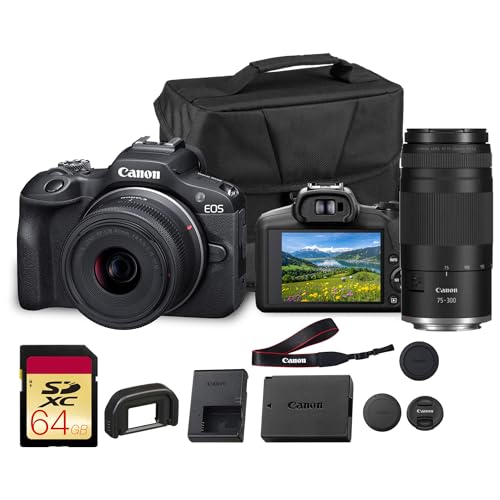 Canon EOS R100 Mirrorless Camera with 18-45mm Canon EOS R100 Mirrorless Camera with 18-45mm | Capture every perspective with the Canon EOS R100… High-Resolution Imaging with APS-C Sensor - Equipped with… Canon’s renowned Dual Pixel CMOS AF ensures accurate… | Check price |
As an Amazon Associate we earn from qualifying purchases at no extra cost to you.
Quick comparison: camera body and practical travel kit
Body weight matters, but it is only half the carrying experience. A small body paired with a large zoom can weigh more than a slightly heavier camera using a compact prime lens. The figures below use approximate camera-body weights with battery and memory card where manufacturers publish them; lens weights are typical published figures and can vary by mount.
| Camera | Body weight | Stabilization | Battery rating | Compact travel pairing | Approx. combined weight |
|---|---|---|---|---|---|
| Canon EOS R50 | 375 g | No in-body stabilization | About 440 shots | RF-S 18-45mm f/4.5-6.3 IS STM, about 130 g | About 505 g |
| Sony a6700 | 493 g | 5-axis in-body stabilization | About 550 shots | E 16-50mm f/3.5-5.6 PZ OSS, about 116 g | About 609 g |
| Fujifilm X-S20 | 491 g | 5-axis in-body stabilization | About 750 shots | XC 15-45mm f/3.5-5.6 OIS PZ, about 135 g | About 626 g |
| OM System OM-5 Mark II | 418 g | 5-axis in-body stabilization | About 310 shots | M.Zuiko 12-45mm f/4 PRO, about 254 g | About 672 g |
| Sony a7C II | 514 g | 5-axis in-body stabilization | About 530 shots | FE 28-60mm f/4-5.6, about 167 g | About 681 g |
Battery figures are CIPA-style estimates, not a promise for a particular trip. Cold weather, video recording, continuous autofocus and frequent image transfer can reduce them substantially. Carrying one spare battery is usually more useful than choosing a body that is 50–80 grams lighter.
Best picks by travel situation
- Smallest everyday kit: OM System OM-5 Mark II with a compact Micro Four Thirds zoom or 20mm/25mm prime.
- Lightest body and simplest entry point: Canon EOS R50.
- Best balance of autofocus, grip and stabilization: Sony a6700.
- Best for long days away from a charger: Fujifilm X-S20.
- Best full-frame option in a small body: Sony a7C II, provided you accept heavier and more expensive lenses.
Head-to-head: what the weight numbers do not show
Canon EOS R50: the lightest body for casual trips
At roughly 375 grams, the EOS R50 is the easiest camera here to carry in a small shoulder bag. Its handgrip is adequately shaped for the compact RF-S lenses, and its autofocus is particularly useful for people, children and animals. The supplied-style 18-45mm kit zoom creates a very light combination for sightseeing.
The compromise is the lack of in-body image stabilization. The kit lens has optical stabilization, so still photographs in ordinary low light remain practical, but stabilization does not help every lens or every video situation. The R50 is a good choice when daylight photography, low weight and straightforward operation matter more than ruggedness or extensive lens selection.
Sony a6700: the most versatile one-camera solution
The a6700 weighs more than the Canon but still stays below 500 grams. Its grip is deeper and more secure, especially when using a telephoto zoom or carrying the camera by hand for several hours. In-body stabilization helps with static subjects in dim streets, museums and interiors, while Sony’s autofocus system is a strong fit for moving subjects.
Sony’s APS-C lens range includes very small options, including the power-zoom 16-50mm, but some of the most attractive travel lenses are considerably heavier. A kit built around the 18-135mm lens offers useful reach but moves the total well above 900 grams. Choose the a6700 when you want room to expand into wildlife, family photography or video without changing systems.
Fujifilm X-S20: comfortable grip and exceptional battery endurance
The X-S20 is about the same weight as the a6700 but has a pronounced grip that suits larger hands and longer lenses. Its battery rating is the highest among these choices, which can be a major advantage on train journeys, hiking days and trips where charging is inconvenient. In-body stabilization also makes compact prime lenses more useful after sunset.
Its APS-C sensor and Fujifilm’s compact lenses produce a kit that remains manageable, although some fast Fujifilm zooms are not lightweight. The camera is especially appealing if you want strong still images, dependable video features and physical controls without moving to a full-frame system.
OM System OM-5 Mark II: the portability specialist
The OM-5 Mark II is not the lightest complete kit in every combination, but the Micro Four Thirds system offers unusually small lenses for the focal lengths they provide. A 40-150mm-style telephoto lens can be far easier to pack than an equivalent full-frame lens. The camera’s stabilization is also valuable for handheld landscapes, interiors and night scenes.
The smaller sensor can show more noise than APS-C or full frame at the same exposure, and the battery rating is modest. Its compact body may feel cramped with heavy lenses, so it is worth handling one before buying. For hikers, cyclists and travelers who prioritize weather-resistant portability over maximum low-light performance, it is one of the most practical systems available.
Sony a7C II: small full-frame body, not necessarily a small system
The a7C II provides full-frame image quality, strong autofocus and effective stabilization in a body weighing about 514 grams. The compact 28-60mm lens makes it a credible lightweight travel camera, particularly for city photography, portraits and low-light scenes.
Full-frame lenses are the important trade-off. A fast standard zoom, telephoto zoom or portrait lens can add 500–1,000 grams by itself. Select the a7C II when sensor performance and lens choice matter more than the lowest possible carry weight; it is not automatically the lightest option once the bag contains two or three lenses.
How to choose a genuinely lightweight kit
1. Set a complete-kit limit
For all-day sightseeing, a useful target is 600–750 grams for the camera, standard zoom, spare battery and strap. A two-lens kit often lands around 900–1,300 grams. If you have back, shoulder or wrist discomfort, a compact camera with one lens may be more enjoyable than a technically superior kit that stays in the hotel.
2. Match stabilization to your subjects
Stabilization helps reduce blur from your movement, but it cannot freeze a moving child, cyclist or animal. For static subjects in dark places, prioritize in-body stabilization. For action, prioritize a bright lens, fast shutter speed and reliable autofocus. The Canon R50 can be the right choice in bright conditions, while the Sony a6700, Fujifilm X-S20 and OM-5 Mark II offer more flexibility in dim light.
3. Check the grip against the lens
A shallow grip is pleasant with a pancake lens but tiring with a long zoom. As a practical rule, lenses around 300–500 grams benefit from a deeper grip and a well-placed thumb rest. The X-S20 and a6700 feel more secure with such lenses; the smallest bodies are best kept with compact primes and kit zooms.
4. Count charging and weather requirements
A camera rated for 300–450 shots may need a spare battery for a full day of intensive shooting. USB charging is convenient in airports and trains, but bring a suitable power bank and cable. If your itinerary includes rain, dust or cold mountain conditions, check the weather-sealing combination of both body and lens; a sealed body paired with an unsealed lens is not a fully weather-resistant kit.
Typical spending levels
Entry-level body-and-kit-zoom packages usually fall around $700–$1,000, depending on discounts and included lenses. Mid-range APS-C kits such as the Sony a6700 or Fujifilm X-S20 generally sit around $1,200–$1,800 for the body and a basic zoom. The OM System option varies widely because compact lenses range from inexpensive kit models to professional weather-sealed designs. A Sony a7C II full-frame kit commonly costs around $2,000–$3,000 before adding extra lenses.
Budget at least $100–$300 for a spare battery, protective case, memory card and compact charger. Those accessories add little weight but can prevent a failed day of photography.
Final recommendation
Choose the Canon EOS R50 if minimum weight and price are the priorities. Choose the Sony a6700 for the most balanced travel system, the Fujifilm X-S20 for grip comfort and battery life, and the OM System OM-5 Mark II when the size of multiple lenses matters most. Choose the Sony a7C II only if full-frame performance justifies the larger lens budget and carrying weight.