Key takeaways
- Two cutoffs, not one: Look for both a tip-over switch and an independent overheat sensor. The first handles the pet-or-toddler scenario; the second handles blocked intakes, blankets, and dust-clogged grilles. A heater with only one of the two is doing half the job.
- Third-party certification: ETL or UL listing means the shut-off mechanisms were verified by someone other than the manufacturer’s marketing team. Treat this as non-negotiable for anything running in a bedroom.
- A real thermostat, not a dial guess: Digital thermostats hold your set point within a degree or two, which keeps the room in that 65–68°F sleep window instead of overshooting into stuffiness and dry sinuses.
- Noise at bedside distance: Anything above roughly 40dB tends to intrude on light sleep stages. PTC ceramic models with slow fans are the quiet category; look for published dB figures rather than the word “silent.”
- Timer granularity: A 12-hour timer is useful, but hourly increments are what let you warm the room for the 60–90 minutes it takes to fall asleep, then let the natural overnight temperature drop do its work.
What's inside
Anyone who has lain awake at 2 a.m. doing mental math about whether the heater in the corner is still running knows the problem: a cold bedroom wrecks sleep, but so does low-grade anxiety about the appliance meant to fix it. Sleep science is fairly settled on the temperature part — most adults drift off fastest in a room somewhere around 65–68°F, because the body needs to shed about a degree of core heat to initiate sleep. What the research can’t do is quiet the part of your brain that’s worried about a tipped-over heating element on a rug.
That’s where automatic shut-off matters more than any wattage claim on the box. In this guide I look at portable heaters through a sleep-wellness lens: which safety systems actually exist (tip-over switches, overheat cutoffs, timers, thermostats), how quiet each model is at bedside distance, and which units hold a stable temperature instead of cycling loudly all night. Below are six well-reviewed 1500W PTC ceramic heaters worth considering in 2026, followed by a buying framework, individual assessments, and answers to the questions I’m asked most often.
As an Amazon Associate we earn from qualifying purchases.


🛒 Best Price Today on Amazon
Prime members get fast, free shipping on everything above, plus member-only deals. New members get a 30-day free trial — cancel anytime.
How to Choose a Space Heater With Automatic Shut-Off (2026)
- Two cutoffs, not one: Look for both a tip-over switch and an independent overheat sensor. The first handles the pet-or-toddler scenario; the second handles blocked intakes, blankets, and dust-clogged grilles. A heater with only one of the two is doing half the job.
- Third-party certification: ETL or UL listing means the shut-off mechanisms were verified by someone other than the manufacturer’s marketing team. Treat this as non-negotiable for anything running in a bedroom.
- A real thermostat, not a dial guess: Digital thermostats hold your set point within a degree or two, which keeps the room in that 65–68°F sleep window instead of overshooting into stuffiness and dry sinuses.
- Noise at bedside distance: Anything above roughly 40dB tends to intrude on light sleep stages. PTC ceramic models with slow fans are the quiet category; look for published dB figures rather than the word “silent.”
- Timer granularity: A 12-hour timer is useful, but hourly increments are what let you warm the room for the 60–90 minutes it takes to fall asleep, then let the natural overnight temperature drop do its work.
The Best Space Heaters With Automatic Shut-Off, Reviewed
VOCRS 1500W PTC Electric Heater
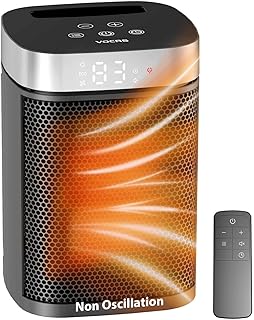
A compact, no-drama option with thermostat control, Eco and fan modes, and a 12-hour timer — the fan-only setting is genuinely useful in shoulder seasons when you want air movement without heat. Its small footprint suits a nightstand or under-desk placement where a larger tower would be awkward.
DREO 2026 Upgraded Quiet Heater (Gold)
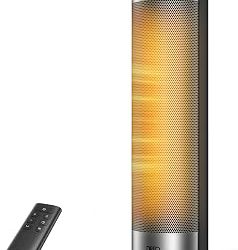
At a rated 34dB, this is the model I’d point a light sleeper toward first; it sits below most bedroom fridges and well under the threshold where sound starts fragmenting sleep. Five modes plus remote control mean you can adjust the set point without leaving the bed and re-waking yourself.
DREO 70° Oscillation Heater with ECO Mode
The 70-degree oscillation solves the classic problem of one hot shin and one cold shoulder, spreading warmth across a seating area or the width of a bed instead of a single column. ECO mode paired with the thermostat keeps overnight cycling gentle and power draw sensible.
DREO ETL-Certified Heater for Large Rooms
This is the pick for open bedrooms, converted lofts, or spaces above roughly 200 square feet where smaller units simply can’t keep up. Fast ramp-up, ETL-verified safety cutoffs, and quiet operation make it a credible primary heat source for a chilly room rather than a supplement.
WINHL Oscillating Ceramic Heater
A strong value proposition: oscillation, thermostat, remote, five modes, and a 12-hour timer at a friendlier price than the category leaders. Build quality is a step behind premium models, but the safety feature set is complete.
Frequently Asked Questions
Is it safe to leave a space heater on all night?
With an ETL-listed unit that has both tip-over and overheat protection, plugged directly into a wall outlet on a clear, hard surface, the risk is low. That said, I still recommend the timer — a heater that runs eight straight hours usually leaves the room warmer than is ideal for deep sleep.
What temperature should I set for sleep?
Start at 66°F and adjust by a degree or two over a few nights. If you wake up kicking off blankets, you’re too warm; if you wake at 4 a.m. curled tight, nudge it up.
Do PTC ceramic heaters dry out the air?
They don’t remove moisture, but warming air lowers its relative humidity, which can feel drying. A small humidifier placed away from the heater solves it.
Can I run one on an extension cord or power strip?
No. A 1500W heater draws close to the limit of a standard circuit, and most strips and light-gauge cords aren’t rated for sustained loads like that. Wall outlet only.
Final Thoughts
For bedrooms, the DREO 2026 Upgraded Quiet Heater is the one I’d buy on sound alone, with the DREO 70° Oscillation model close behind for anyone sharing a room or heating a wider space. If your bedroom is large or poorly insulated, step up to the ETL-certified DREO large-room unit — and whichever you choose, set the timer, keep 3 feet of clearance, and let your body handle the rest.