
Key takeaways
- Target Use Body Part: Ankle, Wrist
- Target Audience: men, teenager, women
- Specific Uses For Product: Physical Therapy, Strength Training
Barre, mat pilates and floor-based conditioning classes have a specific relationship with load. The exercises are small, slow and repeated dozens of times — pulses, clamshells, tabletop lifts, tiny arcs held at the top. Those movements do not want a heavy weight; they want a weight that is still noticeable on rep forty. Get it wrong in either direction and the class stops working: too light and the burn never arrives, too heavy and your form collapses by the second set while your hip flexor takes over from the muscle you were targeting.
There is also a mechanical requirement people underestimate. Floor work means the cuff spends a lot of time in contact with the mat, pressed between your leg and the ground, and being rotated through positions where a bulky cuff simply gets in the way. A tall, heavily loaded design that is fine for standing kickbacks becomes an obstacle during side-lying sequences. The comparison below weighs both factors: the right load band for high-rep work, and the right shape for the floor.
Our top picks
 Sportneer Adjustable Ankle Weights
- Target Use Body Part: Ankle, Wrist
- Target Audience: men, teenager, women
- Specific Uses For Product: Physical Therapy, Strength Training
 BAGAIL Ankle Wrist Weights for Women &
- Target Use Body Part: Ankle, Arm, Legs, Wrist
- Product Style: 2 Lb Pair (1 Lb Each)
- Material: Lycra-SBR Fabric, iron sand
 Amazon Basics Adjustable Ankle Weights for Men
- Target Use Body Part: Ankle
- Specific Uses For Product: Strength Training
- Product Style: 5 Pound Set (2.5 Pounds Each)
| Product | Key specs | |
|---|---|---|
| Sportneer Adjustable Ankle Weights | Target Use Body Part: Ankle, Wrist Target Audience: men, teenager, women Specific Uses For Product: Physical Therapy, Strength Training | Check price |
| BAGAIL Ankle Wrist Weights for Women & | Target Use Body Part: Ankle, Arm, Legs, Wrist Product Style: 2 Lb Pair (1 Lb Each) Material: Lycra-SBR Fabric, iron sand | Check price |
| Amazon Basics Adjustable Ankle Weights for Men | Target Use Body Part: Ankle Specific Uses For Product: Strength Training Product Style: 5 Pound Set (2.5 Pounds Each) | Check price |
 Sportneer Adjustable Ankle Weights Sportneer Adjustable Ankle Weights | Check price | |
 Sportneer Adjustable Ankle Weights Sportneer Adjustable Ankle Weights | Check price | |
 Adjustable Ankle Weights 1-3/4/5/6/8/10/12/15/20 LBS Pair with Adjustable Ankle Weights 1-3/4/5/6/8/10/12/15/20 LBS Pair with | Check price | |
 Adjustable Ankle Weights for Women and Men Adjustable Ankle Weights for Women and Men | Check price | |
 Ankle Weights Set of 2 Ankle Weights Set of 2 | 【Becojadde offers 3 weights options】 ①2 lb Pair… 【Durable & Comfortable】Our ankle weights for women are… 【Adjustable Resistance】Each wrist weights includes 8 blocks (6… | Check price |
As an Amazon Associate we earn from qualifying purchases at no extra cost to you.
Quick Comparison
| Product | Best For | Standout Feature | Watch Out For |
|---|---|---|---|
| Sportneer Neoprene Adjustable Pair | Side-lying and mat sequences | Soft face that lies flat against the mat | Warm during long studio-style classes |
| BAGAIL Ankle & Wrist Weights, Set of 2 | Classic barre loading | Light fixed weights suited to high reps | Too light once you progress to strength work |
| Sportneer Adjustable Ankle Weights (2–10 lb Pair) | Mixing barre with strength days | Strip bars for pulses, add them for kickbacks | Setting changes mid-class break the flow |
| Amazon Basics Adjustable Ankle Weights | Following along at home | Fast to put on when a class is starting | Plainer padding under prolonged floor pressure |
| Sportneer Removable-Weight Cuff | Matching a class’s prescribed load | Reconfigure to the weight the instructor calls for | Requires setting up before class, not during |
| Adjustable Ankle Weights, 1–20 lb Pair | Strength work after class | Range that continues well past barre loads | Bulky and intrusive during floor sequences |
How to Choose
- Rep count first: Choose the weight you can still control at rep forty, not rep ten. High-rep conditioning is governed by the end of the set.
- Low profile for the floor: A slim cuff stays out of the way during side-lying and tabletop work. Tall cuffs press awkwardly between leg and mat.
- Smooth outer face: The cuff will drag along the mat repeatedly. A snag-prone surface wears both the cuff and the mat.
- No mid-class fiddling: Set your weight before you start. Any design that needs two minutes to reconfigure will disrupt a flowing sequence.
- Room to progress: Barre loads are light, but the same cuff often gets used for glute strength work later. A little headroom saves a second purchase.
Top Picks Reviewed
Best for Mat Sequences: Sportneer Neoprene Adjustable Pair
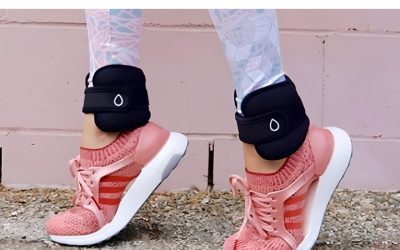
During side-lying work one cuff is on the floor for the entire set, and the neoprene face makes that a non-issue — it lies flat, does not snag the mat, and does not press a hard edge into the leg underneath. For clamshells, fire hydrants and side-lying raises it is the most comfortable option here.
The limitation shows up in a warm room over a long session. Neoprene holds heat and moisture, and by the end of a forty-minute class the contact area is damp. Air it open afterwards rather than rolling it away.
Best Traditional Barre Load: BAGAIL Ankle and Wrist Weights
Barre has always run light, and cuffs available from half a pound to a few pounds each land exactly in that band. They also work on the wrists for arm sequences, which is precisely how most barre classes structure their upper-body segments.
The honest constraint is that light equipment stays light. Once you start doing loaded glute bridges or standing abduction as strength work, these cuffs will not be enough, and the fixed fill means no way to move up within the same item.
Best Dual-Purpose Set: Sportneer Adjustable Ankle Weights
If your week includes both a mat class and a strength session, being able to run the same cuff light for pulses and loaded for kickbacks is genuinely convenient. Removing bars takes seconds, and the 2–10 lb per pair span covers both ends of that use.
Just do the switching before class starts. Stopping a sequence to redistribute metal bars is the kind of interruption that quietly ends the habit of following along.
Best for Progressing Beyond Class: Adjustable Ankle Weights, 1–20 lb Pair
Conditioning classes are a gateway, and many people eventually want to load hip work seriously. Steps through 6, 8, 10, 12, 15 and 20 lb per pair mean the equipment does not become the ceiling on that progression.
It is a poor floor-work companion at the top of its range. The cuff is tall, and during tabletop and side-lying positions it presses into the leg and catches on the mat. Use the low settings for class and save the rest for standing work.
Frequently Asked Questions
What weight do barre and pilates classes usually call for?
Commonly between one and three pounds per ankle. The exercises are built around volume and control, so loads that feel almost trivial at the start are appropriate by design.
Should I wear them for the whole class?
Not usually. Most sequences intend the weights for specific segments — leg work and arm work — while balance and core sections are better unloaded. Following the instructor’s cues is more useful than wearing them throughout.
Will ankle weights change my alignment?
They can, if too heavy. The first sign is your lower back arching during tabletop lifts or your hip rolling back during side-lying raises. Drop the load rather than pushing through.
Can I use the same cuffs on my wrists during arm sequences?
Only if they are short enough to close properly on a wrist and light enough for the shoulder. Purpose-sized cuffs at half a pound to a pound are far better suited than a stripped-down ankle cuff.
Final Thoughts
For class-style floor work, shape matters as much as weight. A neoprene-faced Sportneer pair is the most comfortable thing to have between your leg and the mat, light BAGAIL cuffs hit the traditional barre load without fuss, and an adjustable set earns its place if the same cuffs also serve strength days. Pick the load you can still hold at rep forty, and let the class dictate the number rather than your ego.

Write Your Review
No reviews yet. Be the first to share your experience!