Key takeaways
- No momme listed. Every legitimate silk seller states it. A listing that gives only thread count is hiding thin fabric or a polyester blend.
- “Silk satin” or “silky” in the title without “100% silk.” These describe weave or feel, not fiber.
- Prices under $60 for a fitted sheet or $15 for a pillowcase. Raw silk costs more than that to produce.
- Machine-wash-hot instructions. Real silk cannot take hot water; this is a polyester tell.
- Thread counts above 600. Silk yarn is fine enough that these numbers are meaningless and usually invented.
- No stated pocket depth. You will not know if it fits your mattress until it pops off at 2 a.m.
- Stock photos showing a plastic-looking high gloss. Charmeuse silk has a soft luster, not a mirror shine.
Most first-time silk sheet buyers make the same three mistakes. They shop by thread count because that is what cotton taught them, they assume anything labeled “silk” or “silky” is the real fiber, and they buy a fitted sheet with a pocket sized for a mattress they measured years ago. The result is a $200-$400 set that feels thin, slides off the bed, or turns out to be polyester satin. Silk is sold by weight, not by weave density, and once you understand momme, the rest of the decision gets much simpler.
Decide These 3 Things First
1. Momme, not thread count. Momme (mm) is the weight of a piece of silk 45 inches by 100 yards, measured in pounds; in practical terms, 19 momme is about 2.3 oz per square yard, 22 momme about 2.7 oz, and 30 momme about 3.6 oz. Heavier silk is denser, more opaque, and lasts longer. Thread count on silk is either a marketing number or a translation of momme, so when a listing shows both, like a 19 momme, 400 thread count set, the momme is the figure that matters.
Our top picks
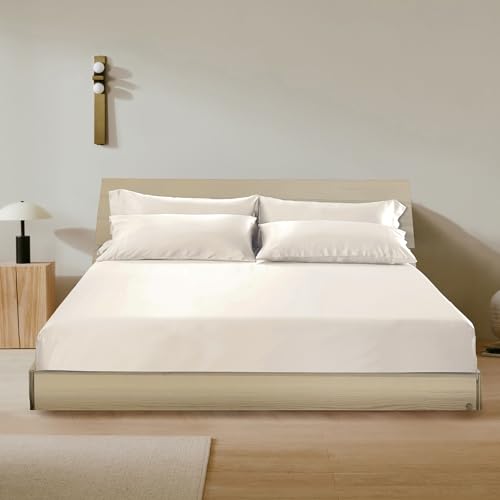


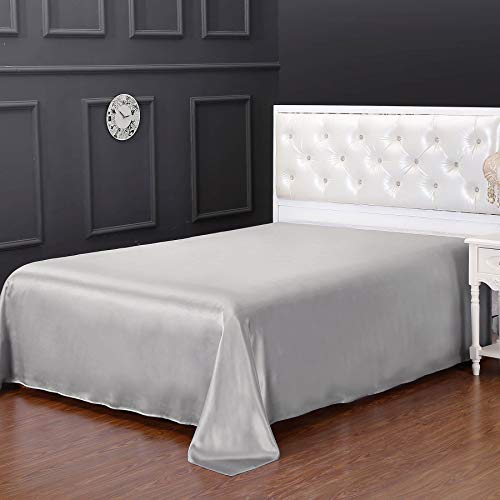
As an Amazon Associate we earn from qualifying purchases at no extra cost to you. Ratings are shown as listed on Amazon.
2. Pure mulberry silk or a blend. Only “100% mulberry silk” or “100% silk” with a grade (6A is the top long-fiber grade) is the real fiber. “Silk satin,” “silky,” or “silk-like” almost always means polyester. A blend of silk and cotton or bamboo costs less and washes easier but gives up most of the friction and temperature benefits.
3. Which pieces you actually need. A full four-piece set (fitted, flat, two cases) in real silk runs $400-$1,300 depending on size and momme. Many buyers get 80% of the benefit from a fitted sheet plus two pillowcases for $230-$410, and use a cotton or Tencel flat sheet and duvet cover on top.
Size and Pocket Depth
Silk stretches very little and slides, so a fitted sheet that is even an inch short of your mattress depth will pop off a corner by morning. Measure your mattress with the topper and protector on. A queen mattress is 60 x 80 inches; a king is 76 x 80; a California king is 72 x 84. Most silk fitted sheets come with a 14-16 inch pocket; a 16-inch deep pocket, as on the LilySilk 19 momme queen fitted set at $409, handles mattresses up to about 14 inches with 2 inches of tuck. If your mattress is 15 inches or deeper, look for an 18-inch pocket or plan on a separate silk fitted sheet cut for deep mattresses. Flat sheets should be at least 10 inches wider than the mattress on each side; a king flat sheet of 108 x 102 inches, like the LILYSILK 19 momme king flat sheet at $309, gives enough drop for a 12-14 inch mattress.
Material and Grade
Mulberry silk comes from silkworms fed only mulberry leaves, which produces long, uniform, white filaments. Grades run from C up to 6A; 6A means the longest fibers with the fewest breaks, which translates to a smoother surface and fewer weak points. Tussah or “wild” silk is coarser and darker and is rarely used in bedding. Look for an OEKO-TEX Standard 100 certification, which confirms the dyes and finishes were tested for harmful substances; it is common on reputable sets and absent on most low-end ones. A product like the made-in-USA 22 momme 6A full fitted sheet at $229 shows the pricing for verified grade and origin: roughly $230 for one fitted sheet versus $400-plus for a three-piece set.
Construction and Weave
Almost all silk bedding is charmeuse, a satin weave with a glossy face and a matte back. Check which side faces the sleeper on a fitted sheet; quality makers put the smooth face up. Seams should be French seams or double-stitched with 10-12 stitches per inch; single-stitched seams pull apart on silk. Pillowcases should have hidden zippers rather than envelope closures so they survive a mesh-bag wash. A fitted sheet should have elastic all the way around, not just at the corners. Reinforced corner gussets are a plus; silk fitted sheets tear at the corners first.
Comfort and Performance by Momme
At 16-19 momme the sheet feels light and fluid, slightly translucent in pale colors, and cool in summer; expect 1-3 years of weekly use. At 22 momme the fabric is noticeably denser, drapes heavier, and blocks light; this is the sweet spot for durability, typically 3-5 years. At 25-30 momme, as in the 30 momme four-piece king set at $1,264.99, the sheet feels almost like a lightweight blanket, holds warmth in winter, and can last 5-8 years, but it is heavy for hot sleepers and costs roughly three times as much as 19 momme. Silk regulates temperature reasonably well but does not wick like cotton, so heavy night sweaters should stay at 19-22 momme or use silk only on the pillowcases.
Price Tiers
Real silk has a floor price because the raw material is expensive: a queen fitted sheet uses roughly 6-7 square yards of fabric. Below about $60 for a fitted sheet or $20 for a pillowcase, assume polyester. Realistic price ranges in 2026 for 100% mulberry silk: pillowcases $20-$60 each; fitted sheet $150-$300 (queen, 19-22 momme); three-piece set $350-$500; four-piece set $500-$800 at 19-22 momme and $1,000-$1,400 at 25-30 momme in king. Sales of 20-30% are common around holidays, so an out-of-season purchase is worth waiting for if you are not in a hurry.
Warranty and Return Policy
Silk is not covered by the multi-year warranties common on mattresses; a 30-90 day return window and a 1-year defect guarantee are typical from established silk brands. Read whether the return window requires unwashed, tagged product, since you cannot judge sizing without putting it on the bed. Some brands offer a free eye mask or a swatch; the swatch is the more useful of the two because it lets you feel the momme weight before committing $400.
Delivery and Care Setup
Silk sheets arrive folded in a box or dust bag and weigh little: a queen three-piece set at 19 momme is about 2.5-3 lb, a king four-piece at 30 momme about 6-7 lb. There is nothing to assemble, but plan the laundry side before the first wash. You need a mesh wash bag large enough for a fitted sheet (at least 24 x 32 inches), a pH-neutral or silk-specific detergent, and a place to air dry a flat sheet 100-plus inches long. If you do not have that drying space, buy silk pillowcases and a fitted sheet only, which dry on a standard rack.
Spec Checklist
| Spec | Budget | Mid | Premium |
|---|---|---|---|
| Fiber | 100% mulberry silk, grade 5A or unspecified | 100% mulberry silk, grade 6A | 100% mulberry silk, grade 6A, OEKO-TEX certified |
| Momme | 16-19 | 19-22 | 22-30 |
| Pieces | 2 pillowcases | Fitted sheet + 2 pillowcases | 4-piece set |
| Pocket depth | 12-14 inches | 14-16 inches | 16-18 inches |
| Seams | Single stitch | Double stitch | French seams, reinforced corners |
| Closure | Envelope | Hidden zipper | Hidden zipper with fabric pull |
| Expected life (weekly wash) | 1-2 years | 3-5 years | 5-8 years |
| Price (queen) | $40-$120 | $230-$450 | $500-$1,300 |
Red Flags
- No momme listed. Every legitimate silk seller states it. A listing that gives only thread count is hiding thin fabric or a polyester blend.
- “Silk satin” or “silky” in the title without “100% silk.” These describe weave or feel, not fiber.
- Prices under $60 for a fitted sheet or $15 for a pillowcase. Raw silk costs more than that to produce.
- Machine-wash-hot instructions. Real silk cannot take hot water; this is a polyester tell.
- Thread counts above 600. Silk yarn is fine enough that these numbers are meaningless and usually invented.
- No stated pocket depth. You will not know if it fits your mattress until it pops off at 2 a.m.
- Stock photos showing a plastic-looking high gloss. Charmeuse silk has a soft luster, not a mirror shine.
FAQ
What momme is best for bed sheets?
22 momme is the best balance of durability, opacity, and price for sheets you will wash weekly. 19 momme is acceptable if you want a lighter, cooler feel and accept a shorter lifespan; 25-30 momme is a luxury choice that adds warmth and weight along with cost.
Does thread count matter at all for silk?
Not in any useful way. Silk filaments are far finer than cotton yarns, so thread counts of 400-600 are normal at 19-22 momme and tell you nothing extra. Use momme to compare weight and grade to compare fiber quality. If two sheets have the same momme, the one with the higher grade will feel smoother.
How do I tell real silk from polyester once it arrives?
Real silk feels cool then warms quickly to your hand; polyester stays at room temperature. Silk has a soft, shifting luster and wrinkles slightly when crushed; polyester has a flat, uniform shine and springs back. Rubbing silk between your fingers produces a faint squeak. If the care label allows hot washing or tumble drying, it is not silk.
Can silk sheets go in the washing machine?
Yes, on a cold delicate cycle inside a mesh bag with a small dose of pH-neutral detergent, no bleach or softener. Air dry away from sun and iron on the lowest setting from the reverse side if needed. Expect slight softening of the sheen over time compared to hand washing, but 22 momme sheets handle machine care well for years.