
Key takeaways
- Target Use Body Part: Ankle, Wrist
- Target Audience: men, teenager, women
- Specific Uses For Product: Physical Therapy, Strength Training
Ankle weights are the rare piece of fitness gear that solves a storage problem instead of creating one. A pair of adjustable cuffs takes up roughly the volume of a folded sweatshirt, slides into a nightstand drawer, and adds meaningful load to glute bridges, standing abductions, and step-ups without a single square foot of dedicated floor space. The catch is that “adjustable” covers two very different designs: sand-filled pockets you slide in and out of a neoprene sleeve, and fixed-fill cuffs that only change weight if you buy another pair. One packs down; the other stacks up.
If you live in an apartment, a shared house, or anywhere the workout equipment has to disappear between sessions, that distinction matters more than the maximum load rating. A removable-pocket cuff at 10 lb per pair collapses to a few ounces of empty fabric when the bars come out, so you can store the shell flat and the weights in a shoebox. A sealed 5 lb cuff is 5 lb forever. This guide sorts the options by how they behave in a small home, how much of your storage they actually claim, and where each one starts to annoy you.
Our top picks
 Sportneer Adjustable Ankle Weights
- Target Use Body Part: Ankle, Wrist
- Target Audience: men, teenager, women
- Specific Uses For Product: Physical Therapy, Strength Training
 BAGAIL Ankle Wrist Weights for Women &
- Target Use Body Part: Ankle, Arm, Legs, Wrist
- Product Style: 2 Lb Pair (1 Lb Each)
- Material: Lycra-SBR Fabric, iron sand


 Ankle Weights for Women
- Target Use Body Part: Ankle
- Recommended Uses For Product: Gym, Gymnas, Strength Training
- Product Style: 4Lbs Pair (2lb x 2) - Blue
As an Amazon Associate we earn from qualifying purchases at no extra cost to you.
Quick Comparison
| Product | Best For | Standout Feature | Watch Out For |
|---|---|---|---|
| Sportneer Adjustable Ankle Weights (2–10 lb Pair) | Drawer storage in tight rooms | Weight bars lift out so the shell packs flat | Loose bars rattle if you remove several at once |
| BAGAIL Ankle & Wrist Weights, Set of 2 | Small increments and dual wrist use | Sold from 0.5 lb up to 5 lb each | Fixed fill, so each step means another purchase |
| Amazon Basics Adjustable Ankle Weights | A no-fuss first pair | Simple wrap-and-cinch closure | Plainest build of the group |
| Sportneer Removable-Weight Cuff | Households sharing one set | Two people can split the bars across sessions | Needs a labelled bin or bars go missing |
| Sportneer Neoprene Adjustable Pair | Barefoot work on hard floors | Soft neoprene face sits flat against the ankle | Neoprene holds moisture and needs air-drying |
| Adjustable Ankle Weights, 1–20 lb Pair | Anyone who expects to keep progressing | Load ladder reaches 20 lb per pair | Bulky sleeve at the top of its range |
How to Choose
- Collapsed size: Ask what the cuff looks like empty. Removable-bar designs flatten to a soft strip you can roll; sealed sand cuffs keep their shape and want shelf space.
- Increment size: Half-pound steps let you nudge load upward without a strength jump. Two-pound jumps are fine for legs, rough for shoulders and arms.
- Closure length: Measure just above your ankle bone. A strap that barely overlaps will peel open mid-set, and one that overlaps by six inches flaps against the other leg.
- Face material: Neoprene against bare skin is comfortable but slow to dry. A denser oxford shell breathes faster and survives being tossed in a bin.
- Shared use: If two people will use one set, a removable-bar cuff doubles as two lighter pairs. A fixed cuff means the lighter user is stuck with the heavier load.
Top Picks Reviewed
Best for Small Spaces: Sportneer Adjustable Ankle Weights
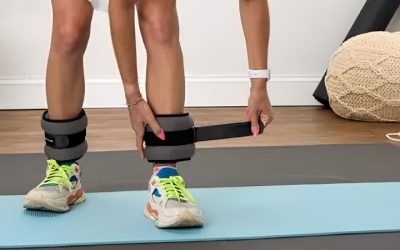
The design that makes this work in a one-bedroom is the pocket system: individual metal bars slide into sewn channels behind a neoprene face, and the cuff runs from about 2 lb to 10 lb per pair depending on how many you leave in. Pull them all out and the shell rolls to the size of a paperback.
The honest limitation is bar management. Once you start removing weights for different exercises, you accumulate loose bars that need a home, and a half-loaded cuff can shift slightly on the leg because the remaining bars are not evenly distributed. Load symmetrically — outermost channels first — and the wobble disappears.
Best Small Increments: BAGAIL Ankle and Wrist Weights
Sold in singles from 0.5 lb through 5 lb, this set is how you build a load ladder in half-pound steps rather than committing to one heavy pair. The shorter cuff also works on the wrist, which matters if your storage budget is one drawer and you want the same item covering leg and arm work.
The tradeoff is that these are fixed-fill. Each new load is a new purchase, and if you buy three weights you now store three pairs instead of one adjustable set. That is the opposite of space efficiency unless you plan the ladder deliberately.
Best Simple Starter: Amazon Basics Adjustable Ankle Weights
Straightforward wrap cuffs with a hook-and-loop closure, aimed at walking, light resistance work, and standing leg drills. Nothing here is clever, which is exactly the point when you are not sure yet whether ankle weights will become part of your routine.
Expect the plainest construction of the group. The closure is functional rather than plush, and heavy users will notice the strap edge sooner than on a padded neoprene cuff. For twenty-minute sessions it is a non-issue.
Best Room to Grow: Adjustable Ankle Weights, 1–20 lb Pair
This one exists for people who expect to outgrow a 10 lb pair. The removable-weight ladder runs through 4, 5, 6, 8, 10, 12, 15 and up to 20 lb per pair, so a single purchase covers a long stretch of progression for jogging drills, gymnastics conditioning, and aerobics.
At the top of the range the cuff gets physically tall on the leg, and a tall cuff on a short lower leg can crowd the calf or brush the opposite ankle during fast footwork. If you are under about 5’4″, plan to stay in the lower half of the load ladder.
Frequently Asked Questions
Where do these actually live between workouts?
Removable-bar cuffs store as two flat sleeves plus a bag of bars, which fits a nightstand drawer or a shoebox on a closet shelf. Fixed cuffs need a bin — they will not lie flat and they slump if you stand them upright.
Do ankle weights damage hardwood or laminate?
Only if you drop them. The risk is the metal bars inside, not the fabric. Set the cuffs down rather than tossing them, and put a mat under any floor work where you might roll onto the weighted side.
Can I walk around the house wearing them all day?
Not advisable. Extended wear changes your gait and loads the knee at angles it does not normally see. Twenty to thirty minutes of deliberate work beats hours of passive wear, and it also keeps the neoprene from getting soaked.
How do I stop them smelling after a few weeks?
Pull the weights out, wipe the shell with mild soap and water, and hang it to dry fully before storing. Sealed cuffs cannot be opened, so wipe and air them the same day rather than folding them damp into a drawer.
Final Thoughts
In a small home the right ankle weight is the one that disappears when you are done with it, which pushes the decision toward removable-bar designs like the Sportneer cuffs or the wider 1–20 lb ladder, with the BAGAIL singles making sense only if you are deliberately building fine increments. Measure your ankle, decide whether the set has to serve two people, and pick the shell you will genuinely be willing to air out — a cuff you avoid because it smells is worse than no cuff at all.

Write Your Review
No reviews yet. Be the first to share your experience!