Key takeaways
- Weight rating headroom: Choose a chair rated 100–150 pounds above your body weight. Ratings are tested statically; daily sitting, shifting, and leaning apply dynamic forces well beyond your scale number.
- Seat width and depth: Look for a 21–24 inch seat pan so your hips aren’t pinched between armrest posts, and leave two to three fingers of clearance behind the knee to keep the popliteal vessels unrestricted.
- Cushion architecture: Pocket spring cushions respond zonally under each sit bone, while thin polyurethane foam compresses into a hammock shape within months. Zonal support is what prevents the numbness that becomes evening ache.
- Adjustable lumbar depth: A fixed lumbar bump is a coin flip. Height- and depth-adjustable support lets you match the curve to your own spine, which matters far more when torso length varies.
- Base, cylinder, and casters: Insist on a reinforced five-star metal base, a Class 4 gas lift, and rubber wheels. Silent casters aren’t a luxury if your office shares a wall with a bedroom.
What's inside
In sleep consultations, the conversation almost always begins with the mattress. It rarely ends there. When a client over 250 pounds describes hips that throb at 2 a.m., a low back that won’t settle, or legs that feel heavy and restless the moment they lie down, the culprit is frequently something they sat in for nine hours — not something they slept on for seven. Standard office chairs are engineered around a body mass most big and tall users exceeded years ago. The foam bottoms out by month four, the seat pan is too narrow to let the pelvis settle, and the gas cylinder sags a half-inch every afternoon. The body compensates by bracing, and braced muscles don’t switch off just because the lights do.
This guide looks at heavy-duty seating through a recovery lens rather than a purely ergonomic one. I’ve assessed six chairs rated between 400 and 650 pounds on the factors that actually influence how you feel at bedtime: pressure redistribution under the sit bones, lumbar contact that holds its position, seat geometry that protects circulation behind the knee, and frame engineering that stays rigid under real load. Below you’ll find the current picks, a buying checklist, and answers to the questions I hear most often from clients who work long seated days.
As an Amazon Associate we earn from qualifying purchases.


🛒 Best Price Today on Amazon
Prime members get fast, free shipping on everything above, plus member-only deals. New members get a 30-day free trial — cancel anytime.
How to Choose an Office Chair Large Person (2026)
- Weight rating headroom: Choose a chair rated 100–150 pounds above your body weight. Ratings are tested statically; daily sitting, shifting, and leaning apply dynamic forces well beyond your scale number.
- Seat width and depth: Look for a 21–24 inch seat pan so your hips aren’t pinched between armrest posts, and leave two to three fingers of clearance behind the knee to keep the popliteal vessels unrestricted.
- Cushion architecture: Pocket spring cushions respond zonally under each sit bone, while thin polyurethane foam compresses into a hammock shape within months. Zonal support is what prevents the numbness that becomes evening ache.
- Adjustable lumbar depth: A fixed lumbar bump is a coin flip. Height- and depth-adjustable support lets you match the curve to your own spine, which matters far more when torso length varies.
- Base, cylinder, and casters: Insist on a reinforced five-star metal base, a Class 4 gas lift, and rubber wheels. Silent casters aren’t a luxury if your office shares a wall with a bedroom.
The Best Office Chair Large Person (2026)s Reviewed
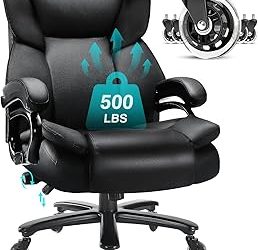
500lbs Big and Tall Office Chair with Pocket Spring Cushion
The independently responding coil array is the standout here, distributing load beneath the ischial tuberosities instead of concentrating it, which is precisely what reduces the deep gluteal soreness that surfaces after you lie down. Quiet rubber wheels and adjustable lumbar support round out a genuinely well-balanced package.
600LBS Heavy Duty Office Chair with 5D Flip Arms
The 5D armrests are the reason to buy this one: adjusting height, width, depth, and angle lets you truly unload the shoulder girdle, and trapezius tension is one of the most reliable predictors of restless early-sleep hours. The flip-up function also makes standing transitions easy, which encourages the movement breaks your circulation needs.
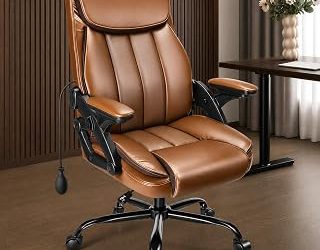
650lbs Big and Tall Leather Executive Chair
With the highest capacity in this roundup and padding built for eight-hour days, this is the choice when other chairs have already failed you structurally. The leather surface runs warmer, so it suits cooler rooms — worth noting, since thermal load during the day influences evening comfort.
500lbs Extra Wide Executive Chair for Back Pain
Designed explicitly around lumbar complaints, it pairs a generous seat pan with thick armrest padding that reduces the elbow pressure points long typists know well. The upgraded wheels and heavy-duty base give it a planted, non-wobbly feel that discourages unconscious core bracing.
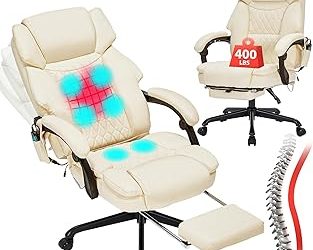
400LBS Big and Tall PU Leather Office Chair
A sensible entry point for users comfortably under the rating who want extra width without an executive footprint, with flip-up armrests that let it tuck fully beneath a desk. Expect solid daily comfort rather than the deep pressure relief of the pocket spring models.
Frequently Asked Questions
Can a desk chair genuinely affect how I sleep?
Indirectly but meaningfully. Sustained compression and postural bracing leave muscles in a low-grade contracted state, and that residual tension delays the physical downshift required for sleep onset. Clients who fix daytime seating often report falling asleep faster within two weeks.
Should I size up beyond my current weight?
Yes. Buying at your exact weight puts components at their design limit from day one, and cylinders and welds fatigue quickly there. Extra headroom buys you years of stable performance.
Are pocket springs worth it over thick foam?
For larger frames, generally yes. Springs compress zonally and rebound, whereas foam of any density eventually takes a permanent set under concentrated load, leaving you sitting in a bowl that tilts the pelvis backward.
What else helps if my legs feel heavy at night?
Stand every 45 minutes, keep both feet flat on the floor rather than tucked, and get outdoors briefly at midday. Movement and light exposure address the circulatory and circadian halves of the problem that no chair alone can solve.
Final Thoughts
For most buyers, the 500lbs Pocket Spring model offers the best balance of pressure relief and price, while the 600LBS 5D Flip Arms chair earns the recommendation for anyone whose tension concentrates in the neck and shoulders. If you need maximum durability, the 650lbs Executive Chair is the safest long-term investment — and the 400lbs Ergonomic Heavy Duty Desk Chair with flip-up arms remains a reasonable budget alternative for lighter users.