Key takeaways
- Ignore the range, check the floor: Manufacturers advertise the highest setting. Measure from the floor to the crease behind your knee in socks — that number is your target lowest seat height, usually 15–17 inches (38–43 cm) for a 5’0″–5’4″ frame.
- Seat depth decides your circulation: With your back against the lumbar pad, you should fit two to three fingers between the seat edge and your calf. Anything over 18 inches (46 cm) deep will press on the popliteal vessels and leave your legs buzzing at bedtime.
- Lumbar apex, not lumbar marketing: The curve needs to land at your belt line. A high-back chair with a fixed apex at 10 inches will push a shorter torso into thoracic rounding — height-adjustable or genuinely small-scale backrests win here.
- Armrests that drop low or get out of the way: If armrests sit above your relaxed elbow, your shoulders creep upward and stay there. Flip-up designs solve this outright and let the chair tuck fully under the desk.
- A soft front edge and dense foam core: Look for a waterfall-contoured lip over firm, high-density padding. Plush-but-collapsing cushions sink you below your set height within weeks and undo every adjustment you made.
What's inside
As a sleep-wellness consultant, I spend my days asking people about their nights — and a surprising share of that time talking about their chairs. When your feet dangle for eight hours, the underside of your thigh absorbs the load your heels should be carrying. Circulation slows, hip flexors shorten, and the lumbar spine quietly compensates. By 10 p.m. that accumulated tension resurfaces as fidgeting, hip ache, and a restless first hour in bed. Shorter desk workers feel it first, because nearly every “standard” office chair is engineered around a 5’9″ body.
This guide treats seating as recovery equipment rather than furniture. Below are the measurements that genuinely matter if you’re 5’4″ and under — minimum seat height, seat depth, lumbar apex, armrest drop — followed by honest reviews of the chairs that scale down properly instead of simply calling themselves compact. Each pick is assessed on one question: does it let you finish the workday with your feet flat, your sacrum supported, and no postural debt to pay off after dark?
As an Amazon Associate we earn from qualifying purchases.




🛒 Best Price Today on Amazon
Prime members get fast, free shipping on everything above, plus member-only deals. New members get a 30-day free trial — cancel anytime.
How to Choose an Office Chair For Short Person (2026)
- Ignore the range, check the floor: Manufacturers advertise the highest setting. Measure from the floor to the crease behind your knee in socks — that number is your target lowest seat height, usually 15–17 inches (38–43 cm) for a 5’0″–5’4″ frame.
- Seat depth decides your circulation: With your back against the lumbar pad, you should fit two to three fingers between the seat edge and your calf. Anything over 18 inches (46 cm) deep will press on the popliteal vessels and leave your legs buzzing at bedtime.
- Lumbar apex, not lumbar marketing: The curve needs to land at your belt line. A high-back chair with a fixed apex at 10 inches will push a shorter torso into thoracic rounding — height-adjustable or genuinely small-scale backrests win here.
- Armrests that drop low or get out of the way: If armrests sit above your relaxed elbow, your shoulders creep upward and stay there. Flip-up designs solve this outright and let the chair tuck fully under the desk.
- A soft front edge and dense foam core: Look for a waterfall-contoured lip over firm, high-density padding. Plush-but-collapsing cushions sink you below your set height within weeks and undo every adjustment you made.
The Best Office Chairs For Short People (2026) Reviewed
PU Leather Ergonomic Chair with 360° Swivel and Adjustable Armrests
A genuinely small-scale shell with a contoured back that meets a shorter spine where it actually curves, plus armrests that adjust rather than sitting fixed and high. It’s the most straightforward pick here for anyone who simply wants their feet flat without a footrest.
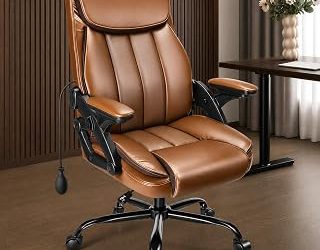
Brown Executive Leather Chair with Lumbar Support
Proof that an executive-style chair doesn’t have to swallow a smaller frame — the padded arms and pronounced lumbar bolster deliver traditional boardroom comfort at a scaled-down seat depth. Best suited to home offices where the chair has to look presentable on camera.
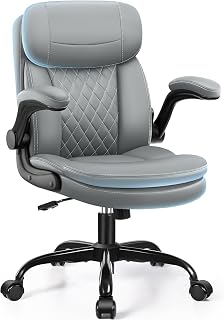
Upgraded PU Chair with Double-Layer Cushion and Neckrest (Grey)
The dual-density seat is the standout: a resilient base layer resists the sag that gradually raises your effective sitting height, while the softer top layer keeps ischial pressure comfortable through long sessions. The neckrest is a real asset for anyone who reclines to decompress mid-afternoon.
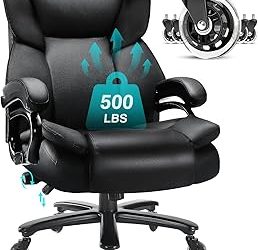
Executive Chair with Flip-Up Armrests (Black)
Flip-up arms let this one slide completely beneath a desk, which quietly fixes the forward-perch posture that plagues short users at deep desktops. Firm lumbar support and a clean silhouette make it a sensible all-day workhorse.
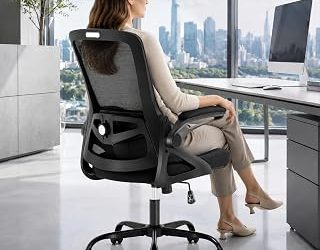
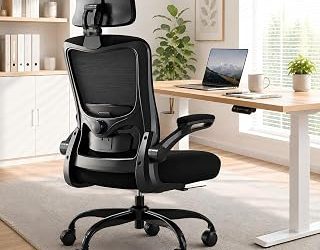
Mesh-Back Ergonomic Task Chair with Flip-Up Arms
The breathable mesh back paired with adjustable lumbar support suits warm rooms and anyone whose core temperature runs high — worth noting, since afternoon overheating tends to blunt the evening thermal drop that helps trigger sleep. A strong value choice for compact workspaces.
Frequently Asked Questions
What seat height should I look for if I’m 5’0″ to 5’3″?
Aim for a chair that drops to roughly 15.5–17 inches (39–43 cm). Measure your popliteal height in the shoes you actually wear at your desk, then subtract nothing — that measurement is your ideal, not your minimum.
Can I just add a footrest to a normal chair?
A footrest fixes dangling feet but not seat depth or lumbar placement, which are the two dimensions most responsible for evening back pain. Use one as a supplement, not a substitute.
Is mesh or PU leather better for a smaller frame?
Mesh breathes and forgives varied postures; PU leather offers firmer, more defined support and wipes clean. Choose mesh if you run warm, leather if you want structured lumbar contact.
Does my desk chair really affect how I sleep?
Indirectly but meaningfully. Prolonged compression and static loading produce the low-grade hip and lumbar discomfort that fuels position-shifting and micro-arousals after lights out.
Final Thoughts
For most shorter users, the Upgraded PU Chair with Double-Layer Cushion is the smartest long-term investment, since its foam holds your carefully set seat height instead of collapsing under it. If you run warm or want flip-up arms and 330 lb capacity, the Mesh-Back Ergonomic Task Chair and the High-Back Mesh Computer Chair are both excellent, budget-conscious alternatives.