Key takeaways
- Cut depth versus your actual material: Most of these saws top out between 12mm and 26mm. Measure the thickest stock you genuinely use — basswood sheet, 6mm plywood, acrylic panel — and buy with 5mm of headroom rather than paying for capacity you’ll never touch.
- Single motor or dual motor: Dual-motor designs run a saw spindle and a rotary tool spindle independently, so you can cut, then immediately sand or engrave without swapping arbors. If your projects involve finishing as much as cutting, this saves genuine hours.
- Variable speed with real range: Seven-step or fully variable control matters less for wood and enormously for plastics. Too fast on acrylic and you get melted, gummy edges; too slow on hardwood and you get burn marks. Fixed-speed units force compromise.
- Noise and vibration behaviour: A 200W motor is inherently quiet, but a light chassis on a hollow desk becomes a drum. Look for rubber feet, a metal baseplate, and mounting holes so you can bolt the saw to a scrap of MDF and kill resonance for late-evening sessions.
- Accessory ecosystem and fence quality: The blade will need replacing; the fence will not. Prioritise a rigid, squarely machined rip fence and a mitre gauge that locks positively. A generous accessory bundle is a bonus, not a substitute.
What's inside
Most craft-scale cutting happens in stolen hours — after dinner, after the kids are down, in the quiet window before bed when the house finally belongs to you. That timing creates a very specific problem. Full-size table saws are loud, dusty, and demand a garage; a hobby knife and miter box are quiet but slow and wildly imprecise on anything thicker than balsa. What miniature makers actually need is a machine small enough to live on a desk, accurate enough for 1:12 scale trim, and civil enough that nobody two rooms away notices you’re working.
This guide approaches the category with that reality in mind. As someone who spends a lot of time thinking about how workshops and bedrooms coexist in small homes, I’ve weighted noise output, vibration transfer through furniture, dust containment, and how quickly a saw lets you finish a task and actually wind down — alongside the usual metrics of cut depth, motor torque, and blade quality. Below you’ll find selection criteria, honest assessments of the leading 2026 models, and answers to the questions that come up most often from readers building dollhouses, model railways, resin dioramas, and handmade gifts.
As an Amazon Associate we earn from qualifying purchases.
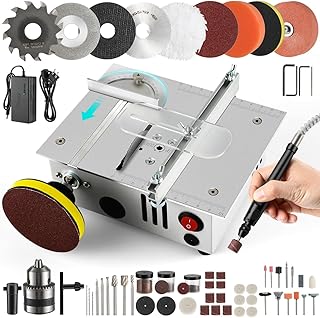
![Mini Table Saw for Crafts & Hobbyists [Dual 795 Motors & Switches] 200W/12,000RPM/26mm Adjustable Height with Accessories – Perfect for DIY Crafts, Handmade Gifts & Exploring Hobbies](https://m.media-amazon.com/images/I/71yotzYsRaL._AC_UL320_.jpg)

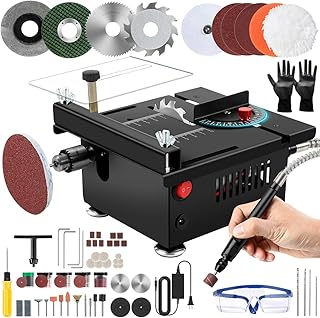
![Super Mini Table Saw for Crafts & Hobbyists, [Dual Motor & Switches] 7 Speeds 200W Max, Multifunctional, 122+ Accessories, Cut/Engrave/Polish/Drill, Compact for Model Making, Gift for Creators](https://m.media-amazon.com/images/I/71XhPTpz18L._AC_UL320_.jpg)

🛒 Best Price Today on Amazon
Prime members get fast, free shipping on everything above, plus member-only deals. New members get a 30-day free trial — cancel anytime.
How to Choose a Mini Table Saw For Crafts (2026)
- Cut depth versus your actual material: Most of these saws top out between 12mm and 26mm. Measure the thickest stock you genuinely use — basswood sheet, 6mm plywood, acrylic panel — and buy with 5mm of headroom rather than paying for capacity you’ll never touch.
- Single motor or dual motor: Dual-motor designs run a saw spindle and a rotary tool spindle independently, so you can cut, then immediately sand or engrave without swapping arbors. If your projects involve finishing as much as cutting, this saves genuine hours.
- Variable speed with real range: Seven-step or fully variable control matters less for wood and enormously for plastics. Too fast on acrylic and you get melted, gummy edges; too slow on hardwood and you get burn marks. Fixed-speed units force compromise.
- Noise and vibration behaviour: A 200W motor is inherently quiet, but a light chassis on a hollow desk becomes a drum. Look for rubber feet, a metal baseplate, and mounting holes so you can bolt the saw to a scrap of MDF and kill resonance for late-evening sessions.
- Accessory ecosystem and fence quality: The blade will need replacing; the fence will not. Prioritise a rigid, squarely machined rip fence and a mitre gauge that locks positively. A generous accessory bundle is a bonus, not a substitute.
The Best Mini Table Saw For Crafts (2026)s Reviewed
Dual 795 Motor Mini Table Saw (200W, 12,000 RPM)
The twin 795 motors and independent switches make this the most versatile pick for makers who alternate constantly between cutting and detail work, and the 26mm adjustable height is the deepest capacity in this roundup. It’s the sensible default choice for dollhouse and furniture-model builders working in 6–20mm stock.
MIMYTH Multifunctional Portable Mini Table Saw
MIMYTH’s strength is adjustability: angle, speed, and saw depth are all genuinely tunable rather than nominally so, which pays off on repeated bevel cuts. Grinding and sanding functions are competent, and the compact footprint suits a shared desk that has to convert back to a workspace by bedtime.
Super Mini Table Saw with 122+ Accessories
With dual motors, seven speeds, and an enormous accessory bundle covering cutting, engraving, polishing, and drilling, this is the strongest starter kit for someone entering model making without an existing tool collection. The trade-off is variable accessory quality — the bits are fine, the saw blades and mandrels are the parts worth upgrading first.
MXBAOHENG Mini Table Saw S3
The S3 is the precision specialist here: a solidly built table, seven-speed power supply, and a 1/2″ cut depth that keeps it firmly in fine-craft territory. Choose it if miniature accuracy and repeatability matter more than raw capacity or multifunction extras.
Dual-Motor Mini Multifunctional Table Saw
Explicitly rated for wood, PCB, acrylic, and plastic, this model earns its place with adjustable speed and angle plus dual-motor cutting, grinding, engraving, and drilling. It’s a strong option for electronics hobbyists and resin modellers who need one machine to handle mixed materials cleanly.
Frequently Asked Questions
Are mini table saws quiet enough to use in a flat or shared house?
Generally yes. At 200W these run considerably quieter than a shop vacuum, and most of the perceived noise is vibration passing into the desk. Clamping the saw to a heavy board on a rubber mat reduces that transfer dramatically and makes evening work far less intrusive.
What thickness of wood can these actually cut?
Comfortably 3–12mm across the range, with the 26mm models handling thicker basswood and thin ply in a single pass. For anything beyond that, take two passes from opposite faces or step up to a full-size saw.
Do I need dust extraction?
Not extraction, but do manage it. Fine wood and acrylic dust lingers in the air far longer than people assume, which matters if you work in or near a bedroom. A small shop vac positioned at the blade, plus a mask for extended sessions, is sufficient.
How long do the supplied blades last?
Expect weeks of moderate use on wood, less on acrylic and PCB. Blades are inexpensive and consumable — keep two or three spares, and replace at the first sign of burning or ragged edges rather than pushing through.
Final Thoughts
For most craft makers, the Dual 795 Motor Mini Table Saw is the best all-round buy, pairing the deepest cut capacity in this group with true two-spindle versatility. Beginners assembling a first kit will get more immediate value from the Super Mini Table Saw with its 122+ accessories, while anyone whose work lives at 1:12 scale and finer should choose the MXBAOHENG S3 for its precision and build quality.