Key takeaways
- Thickness matched to body weight: Lighter sleepers under roughly 150 lbs often get sufficient offloading from 2–3 inches, while heavier or broader-hipped sleepers may compress a thin layer entirely and need 4–5 inches to keep the hip from bottoming out onto the original mattress.
- Contouring without pelvic sag: The goal is a surface that yields at the hip and shoulder while still holding the lumbar curve. Memory foam does this well; overly soft fiber-fill can let the pelvis drop and increase nerve tension.
- Heat management: Dense foam traps warmth, and fragmented sleep worsens pain perception. Look for gel infusion, ventilated cores, or breathable natural-fiber covers if you sleep hot.
- Anchoring system: A topper that shifts overnight undoes its own benefit. Deep elasticized pockets or four-way straps matter more than they sound, especially on taller mattresses.
- Certification and off-gassing: CertiPUR-US and OEKO-TEX marks indicate tested foam content and emissions — worth prioritising when the product sits inches from your face all night.
Sciatic pain has a cruel relationship with sleep. The nerve that runs from your lower back through the hip and down the leg doesn’t appreciate being pressed against an unforgiving surface for eight hours, and it doesn’t appreciate sinking so deeply that your pelvis rotates out of alignment either. Most people shopping for relief are caught between a mattress that’s too firm to tolerate and a budget that won’t stretch to replacing it outright — which is exactly the gap a well-chosen topper fills.
This guide approaches the problem from a sleep-wellness perspective rather than a spec-sheet one: what actually reduces nerve compression overnight, how thickness interacts with your body weight and sleeping position, and where cooling matters (because pain-related wakeups and heat-related wakeups compound each other). Below are the toppers worth considering in 2026, followed by a practical selection framework and answers to the questions readers ask most.
Our top picks



As an Amazon Associate we earn from qualifying purchases at no extra cost to you. Ratings are shown as listed on Amazon.
🛒 Best Price Today on Amazon
Prime members get fast, free shipping on everything above, plus member-only deals. New members get a 30-day free trial — cancel anytime.
How to Choose a Mattress Topper For Sciatica (2026)
- Thickness matched to body weight: Lighter sleepers under roughly 150 lbs often get sufficient offloading from 2–3 inches, while heavier or broader-hipped sleepers may compress a thin layer entirely and need 4–5 inches to keep the hip from bottoming out onto the original mattress.
- Contouring without pelvic sag: The goal is a surface that yields at the hip and shoulder while still holding the lumbar curve. Memory foam does this well; overly soft fiber-fill can let the pelvis drop and increase nerve tension.
- Heat management: Dense foam traps warmth, and fragmented sleep worsens pain perception. Look for gel infusion, ventilated cores, or breathable natural-fiber covers if you sleep hot.
- Anchoring system: A topper that shifts overnight undoes its own benefit. Deep elasticized pockets or four-way straps matter more than they sound, especially on taller mattresses.
- Certification and off-gassing: CertiPUR-US and OEKO-TEX marks indicate tested foam content and emissions — worth prioritising when the product sits inches from your face all night.
The Best Mattress Topper For Sciatica (2026)s Reviewed
SHOUREN 5 Inch Memory Foam Topper
At five inches, this is the closest a topper gets to functioning as a replacement sleep surface, which makes it the strongest option for heavier sleepers or anyone battling a genuinely rock-hard mattress. The four-way strap system is a meaningful inclusion at this depth, since thick foam is precisely what tends to creep out of position by morning.
Lucid 4 Inch Memory Foam Topper
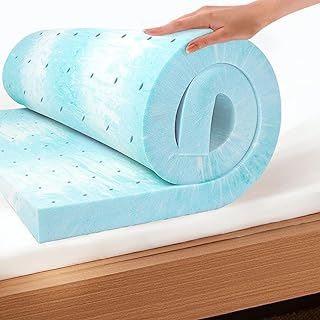
Four inches of gel-infused foam with a ventilated core strikes a sensible middle ground: enough depth to unload the hip in side sleeping, enough airflow to avoid the sealed-in heat that plagues plush foam. A reliable pick for side sleepers whose pain flares on the down-leg.
JSELF 3 Inch Dual-Layer Gel Topper
The dual-layer construction pairs a softer contouring surface with a firmer base, which is the configuration that best serves sciatica — pressure relief where you need it, structural support underneath so the lumbar spine doesn’t collapse. Non-slip backing plus dual CertiPUR-US and OEKO-TEX certification make this the most thoughtfully engineered option here.
BEDLORE Viscose Bamboo Pillow Top
Best suited to sleepers whose mattress is broadly supportive but punishingly firm at the surface. The bamboo-derived cover sleeps notably cooler than foam, and the stretchable deep pockets accommodate 6–18 inch mattresses, though it offers cushioning rather than the deep contouring that acute sciatica often requires.
EGO 3 Inch Gel Memory Foam Topper
A straightforward, well-executed three-inch gel foam layer with a ventilated design and CertiPUR-US certification. Sensible value for average-weight back and side sleepers who need moderate pressure redistribution without radically altering mattress feel.
Frequently Asked Questions
Is soft or firm better for sciatica?
Neither extreme. You want a medium-firm result: a surface soft enough to accommodate the hip so the sciatic nerve isn’t compressed, but supportive enough to keep the pelvis level with the spine. If a topper makes you feel like you’re being swallowed, it’s too soft.
Will a topper fix pain caused by a sagging mattress?
No. Toppers modify the surface, not the support core — foam laid over a dip simply follows the dip. If your mattress has visible sagging or broken coils, address that first.
How long before I notice a difference?
Give it two to four weeks. New foam needs 48–72 hours to fully expand, and your body needs time to adapt to a changed sleep posture. A brief adjustment period of mild stiffness is common and not a reason to abandon the topper.
Does sleeping position still matter?
Considerably. Side sleeping with a pillow between the knees and back sleeping with a pillow under the knees both reduce sciatic nerve tension. A good topper supports these positions; it doesn’t replace them.
Final Thoughts
For most sciatica sufferers, the JSELF 3 Inch Dual-Layer Gel Topper offers the smartest balance of contouring and underlying support at a sane thickness, while the Lucid 4 Inch is the better call for side sleepers who need deeper hip relief. If your mattress is genuinely too firm to salvage with anything thinner, the SHOUREN 5 Inch is the one worth the investment — and pair whichever you choose with attention to sleep position for the fullest benefit.