Key takeaways
- Get the Twin XL right: Standard dorm beds are 38″ x 80″ — five inches longer than a regular Twin. A Twin topper will leave your feet on bare vinyl, so confirm the XL designation before ordering.
- Match thickness to your frame: Two inches is enough to soften a firm surface for lighter sleepers. Side sleepers and anyone over roughly 180 lbs generally need three to four inches to keep the hip from bottoming out onto the original mattress.
- Prioritise heat management: Core body temperature must drop to initiate sleep. Look for gel or copper infusion plus ventilation channels — open-cell structures move warm air far better than solid foam blocks.
- Insist on a removable, washable cover: Dorm rooms are shared-air environments with limited laundry access. A zip-off cover you can machine wash is a genuine hygiene feature, not a marketing bullet.
- Check certification and off-gassing: CertiPUR-US certification limits VOC emissions — important in a small, poorly ventilated room. Unbox at least 48 hours before move-in day where possible.
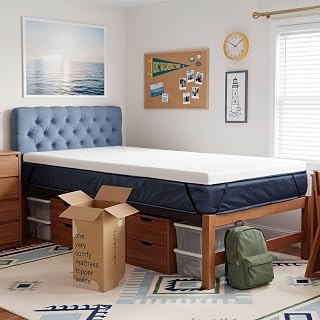
University-issued mattresses are built for durability, not for the person trying to sleep on them. Most are thin slabs of high-density institutional foam wrapped in wipe-clean vinyl — a combination that traps body heat, transmits every pressure point straight into the hip and shoulder, and leaves students waking at 3 a.m. wondering why they feel worse than when they went to bed. As someone who spends their working life studying sleep architecture, I see the same pattern every September: fragmented sleep in the first six weeks of term, blamed on stress, when the real culprit is a sleeping surface that never allows the body to settle into deep, uninterrupted stages.
The good news is that this is one of the cheapest sleep problems to solve. A well-chosen topper resets the pressure profile of a bad mattress and can meaningfully improve thermal comfort — the single most underrated variable in sleep quality. Below, I’ve assessed the toppers most worth considering for a Twin XL dorm bed in 2026, judged on cooling performance, support depth, cover hygiene, and how well each one survives being hauled up three flights of stairs twice a year.
Our top picks




As an Amazon Associate we earn from qualifying purchases at no extra cost to you. Ratings are shown as listed on Amazon.
🛒 Best Price Today on Amazon
Prime members get fast, free shipping on everything above, plus member-only deals. New members get a 30-day free trial — cancel anytime.
How to Choose a Mattress Topper For Dorm Rooms (2026)
- Get the Twin XL right: Standard dorm beds are 38″ x 80″ — five inches longer than a regular Twin. A Twin topper will leave your feet on bare vinyl, so confirm the XL designation before ordering.
- Match thickness to your frame: Two inches is enough to soften a firm surface for lighter sleepers. Side sleepers and anyone over roughly 180 lbs generally need three to four inches to keep the hip from bottoming out onto the original mattress.
- Prioritise heat management: Core body temperature must drop to initiate sleep. Look for gel or copper infusion plus ventilation channels — open-cell structures move warm air far better than solid foam blocks.
- Insist on a removable, washable cover: Dorm rooms are shared-air environments with limited laundry access. A zip-off cover you can machine wash is a genuine hygiene feature, not a marketing bullet.
- Check certification and off-gassing: CertiPUR-US certification limits VOC emissions — important in a small, poorly ventilated room. Unbox at least 48 hours before move-in day where possible.
The Best Mattress Topper For Dorm Rooms (2026)s Reviewed
Linenspa 2 Inch Gel Memory Foam Topper
The most sensible entry point for a first-year student: two inches of gel-infused foam that takes the edge off institutional firmness without swallowing you. Best suited to back sleepers and lighter frames who want cushioning rather than a wholesale change in feel.
ViscoSoft 3 Inch Ventilated Topper
This is the balanced choice, and the one I recommend most often. The high-density core resists the premature sagging that plagues cheap foam, while the ventilation pattern and removable rayon cover keep surface temperature stable through the night.
Sleepyhead 2 Inch Cooling Gel Topper
Purpose-designed for college beds, with a genuinely well-fitted washable cover and a responsive gel foam that contours quickly without the slow sinking sensation some sleepers dislike. A strong pick if you want pressure relief but sleep hot on thicker slabs.
ViscoSoft Active Cooling 4 Inch Copper-Infused Topper
The most substantial option here, and the one to choose if your dorm mattress is genuinely punishing. Copper infusion aids heat dissipation, the firmer construction supports heavier sleepers properly, and the anchoring straps stop it drifting on a slick vinyl surface.
ELEMUSE 3 Inch Dual Layer Topper
Its two-part build — cooling gel foam beneath a softer pillow-top layer — delivers plush surface comfort over real structural support, which is unusual at this depth. Ideal for side sleepers who want shoulder relief without sacrificing spinal alignment.
Frequently Asked Questions
Will a topper fit under standard dorm sheets?
A two-inch topper fits comfortably under most Twin XL sheets. At three inches or more, buy deep-pocket sheets rated to 15 inches to avoid corners popping off nightly.
How long should I let a new topper expand?
Allow 24 to 72 hours in a ventilated room. Sleeping on it too early means an uneven surface and unnecessary exposure to residual manufacturing odour.
Do these toppers slide around on vinyl mattresses?
Some do. Look for a non-slip backing or elastic anchor straps — the ELEMUSE 3 Inch and ViscoSoft Active Cooling both address this directly.
Can memory foam actually sleep cool?
Modern gel and copper-infused foams with ventilation channels perform far better than the dense foams of a decade ago, though no foam matches the airflow of an innerspring. Pair with breathable cotton or bamboo sheets for the best result.
Final Thoughts
For most students, the ViscoSoft 3 Inch Ventilated Topper offers the best combination of durability, airflow, and support at a defensible price. Heavier sleepers and anyone facing a particularly unforgiving mattress should step up to the ViscoSoft Active Cooling 4 Inch, while the Linenspa 2 Inch remains the smartest low-cost fix for a bed that needs softening rather than rebuilding.