
Key takeaways
- Target Audience: Adult
- Recommended Uses For Product: Health & Fitness
- Format: Notebook
Most home leg training stalls for a boring reason: you run out of load before you run out of reps. A pair of 25-pound dumbbells feels heavy on a Romanian deadlift for about three weeks, and then your hamstrings adapt and you’re doing sets of 20 just to feel something. The usual fix is buying heavier dumbbells, which is expensive and eats floor space. The cheaper fix is changing where the resistance sits. Strap eight pounds to each ankle and a simple reverse lunge becomes a different exercise — the load now sits at the end of a long lever, so your hip flexors, adductors, and glute medius have to control the limb through the entire arc instead of just resisting a vertical pull.
That’s the whole argument for ankle weights as a dumbbell accessory rather than a replacement. Hold 30-pound dumbbells for a step-up and your quads are the bottleneck. Add ankle weights to that same step-up and the trailing leg has to actively pull itself up instead of pushing off the floor, which is exactly the pattern that shows up in glute-focused programming. Below is a close look at one adjustable pair worth owning, what to check before you buy any wearable load, and how to slot it into leg days you’re already running.
Our top picks


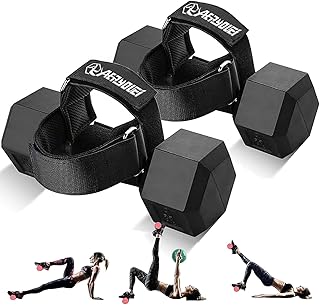


 Women's Health The Woman's Guide To Strength
- Target Audience: Adult
- Recommended Uses For Product: Health & Fitness
- Format: Notebook
As an Amazon Associate we earn from qualifying purchases at no extra cost to you.
Quick Comparison
| Product | Load Range | Adjustment Method | Best Use | Fit Notes |
|---|---|---|---|---|
| CAP Barbell Adjustable Ankle Weights (Pair) | 10–20 lb per pair (5–10 lb per ankle) | Removable sand-filled inserts, hook-and-loop closure | Lunge and step-up variations, glute isolation, walking and tempo work | Wide cuff, fits most ankles and lower calves; also wearable on wrists |
How to Choose
- Adjustability over a fixed number. A fixed 10-pound cuff is either too light for carries or too heavy for lateral raises of the leg. Removable inserts let you run 5 pounds for hip abduction and 10 for weighted step-ups without owning two sets.
- Closure quality decides everything. Hook-and-loop that loosens mid-set will end your workout faster than fatigue. Look for a strap that wraps and doubles back rather than one that simply butts up against itself, and check that the loop panel runs the full length of the cuff so you have real adjustment range.
- Fill material and shift. Sand and iron shot both work, but sand conforms to the ankle better and stays quieter. What matters more is whether the fill is compartmentalized — undivided fill migrates to one side and creates an off-balance cuff that rotates as you walk.
- Cuff width relative to your ankle. A narrow cuff concentrates pressure on the malleolus, the bony bump on the side of your ankle, and that gets uncomfortable within minutes. Wider cuffs spread the same weight over more surface and can ride slightly higher on the calf where there’s more padding.
- Match the load to the movement, not your ego. Ten pounds per ankle is significant on a leg curl or a standing kickback because of the lever length. Start at half of what you think you need, run two weeks, then add inserts.
Top Picks Reviewed
CAP Barbell Adjustable Ankle Weights | 10–20lb Pair | Black
CAP has spent decades making unglamorous iron for garage gyms, and this pair follows the same philosophy: no app, no color-coded gimmicks, just a neoprene-covered cuff with pockets of sand you can pull out. Each ankle takes up to 10 pounds, so a full pair runs 20. The practical range is better than that number suggests, because removing inserts symmetrically gives you usable settings at roughly 5, 7.5, and 10 pounds per side depending on how the fill is divided.
Where it earns its keep is in accessory work that dumbbells handle awkwardly. Standing hip abduction with a dumbbell is nearly impossible — you can’t hold a bell on the outside of your shin. With cuffs on, you get clean sets of 15 per side against real resistance. Same story for prone hamstring curls, quadruped kickbacks, and the reverse hyper pattern you can improvise off a bench. Then there’s the compound application: 10-pound cuffs plus a pair of moderate dumbbells turns walking lunges into a genuinely hard conditioning block, because the trailing leg has to decelerate the weight on every swing-through.
The tradeoffs are real and worth knowing. The hook-and-loop closure needs to be cinched properly or it will creep during dynamic work, and it collects lint and sock fuzz over time, which gradually weakens the grip — a quick pass with a stiff brush restores most of it. The cuffs are also bulkier than premium options, so they don’t disappear under joggers. And like every sand-filled product, they are not indestructible: dragging them across concrete or leaving them in a car trunk in summer heat shortens their life. Treat them as gym equipment rather than luggage and they hold up.
For the price of a single heavy dumbbell, you get a load source that unlocks a category of exercises your rack simply can’t reach. That’s an efficient trade for anyone training in a spare bedroom.
Frequently Asked Questions
Can ankle weights really build muscle, or are they just for toning?
Muscle responds to mechanical tension and progressive overload, and it doesn’t care whether the load is cast iron or sand. Ten pounds at the ankle produces substantially more hip torque than 10 pounds held at the waist because the moment arm is longer. Where ankle weights fall short is absolute loading for squats and deadlifts — those still need dumbbells or a barbell.
Are they safe for my knees?
For most people, yes, with two caveats. Avoid using them for explosive kicking or high-speed running, where the added inertia at the end of the limb increases stress on the joint and alters your gait mechanics. And if you have a current knee issue, start with the lightest setting on slow, controlled movements — hip abduction and bridges rather than leg extensions.
How do I add them to a dumbbell leg day without overhauling my program?
Keep your main lifts exactly as they are. Put the cuffs on for the last two accessory exercises: something for the glute medius, like a standing abduction or a lateral walk, and something for the hamstrings, like a lying curl or a slow bridge march. That’s about eight extra minutes and it hits tissue your dumbbell work under-serves.
Should I wear them around the house all day?
Not a good idea. All-day wear encourages compensatory movement patterns, and the calorie difference is trivial compared to the joint exposure. Use them as training equipment for defined sets, then take them off. Short weighted walks of 10 to 20 minutes are fine and genuinely useful.
Final Thoughts
The best leg workout with dumbbells usually isn’t limited by your imagination — it’s limited by leverage. You can only load a lunge so heavily before your grip and your spine object, and at that point the honest solution is to change where the resistance lives. An adjustable pair like the CAP cuffs costs less than a dinner out, stores in a drawer, and immediately makes half a dozen glute and hamstring movements trainable at home. Buy them, set them light, run them for a month alongside the dumbbells you already own, and judge by how your hips feel on week four.
Write Your Review
No reviews yet. Be the first to share your experience!