Key takeaways
- Motor type: DC motors run quieter at low speeds and draw meaningfully less power, which matters because the ideal sleep setting is a slow, continuous drift of air — not a burst of wind. AC motors are fine in living rooms and kitchens where you’re awake and ambient noise masks them.
- Color temperature control: Look for 3CCT or selectable white tones. A fan locked at 5000K over a bed is working against your circadian rhythm every evening; being able to drop to roughly 2700K after sunset is the single most underrated feature in this category.
- Dimming range, not just “dimmable”: Many LEDs dim to 20% and stop. If you read in bed or need a low-glare path to the bathroom at 3 a.m., test how far down the light actually goes before you commit to it as your only bedroom fixture.
- Ceiling height and mount style: Flush or low-profile mounts are for ceilings under about 8 feet; downrods let air circulate properly on taller ceilings. Blade-to-ceiling clearance affects both airflow efficiency and how much shadow flicker you’ll notice from the light.
- Control method: Remotes and app control save you from crossing a dark room, but pull chains never lose signal, never need pairing, and never wake you up with a status chime. Choose based on your room layout and your tolerance for troubleshooting.
What's inside
Most people shop for a ceiling fan the way they shop for a light switch — by looks, and by whatever is in stock. Then they install it above the bed and discover the part nobody mentions in the product photos: a fan is a sleep device. It moves air across your skin, which is how your body sheds the core heat it needs to lose in order to fall asleep. It also hums, ticks, wobbles, and glows. Get the combination wrong and you’ve mounted a nightlight and a metronome directly over your pillow.
I evaluate fans the way I’d evaluate a mattress or a blackout curtain: does it help the body cool down, does it stay acoustically boring, and can you dim it to something warm enough not to suppress melatonin an hour before bed? That framework rules out a surprising number of popular models and elevates a few unglamorous ones. Below are the indoor ceiling fans with lights I’d actually put in a bedroom in 2026, plus a buying checklist built around sleep quality rather than square footage alone.
As an Amazon Associate we earn from qualifying purchases.


🛒 Best Price Today on Amazon
Prime members get fast, free shipping on everything above, plus member-only deals. New members get a 30-day free trial — cancel anytime.
How to Choose a/an Indoor Ceiling Fans With Light (2026)
- Motor type: DC motors run quieter at low speeds and draw meaningfully less power, which matters because the ideal sleep setting is a slow, continuous drift of air — not a burst of wind. AC motors are fine in living rooms and kitchens where you’re awake and ambient noise masks them.
- Color temperature control: Look for 3CCT or selectable white tones. A fan locked at 5000K over a bed is working against your circadian rhythm every evening; being able to drop to roughly 2700K after sunset is the single most underrated feature in this category.
- Dimming range, not just “dimmable”: Many LEDs dim to 20% and stop. If you read in bed or need a low-glare path to the bathroom at 3 a.m., test how far down the light actually goes before you commit to it as your only bedroom fixture.
- Ceiling height and mount style: Flush or low-profile mounts are for ceilings under about 8 feet; downrods let air circulate properly on taller ceilings. Blade-to-ceiling clearance affects both airflow efficiency and how much shadow flicker you’ll notice from the light.
- Control method: Remotes and app control save you from crossing a dark room, but pull chains never lose signal, never need pairing, and never wake you up with a status chime. Choose based on your room layout and your tolerance for troubleshooting.
The Best Indoor Ceiling Fans With Light (2026)s Reviewed
52″ Modern DC Ceiling Fan with Light and Remote (3CCT)
This is the closest thing to a purpose-built sleep fan on the list: a reversible DC motor that stays genuinely unobtrusive on its lowest speeds, paired with three selectable color temperatures so the light can go warm at night. At 52 inches it suits a primary bedroom or open living space without needing to run fast to move air.
Westinghouse Comet, Matte Black
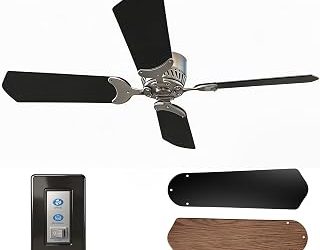
A well-proportioned contemporary fan with a dimmable LED behind frosted glass, which diffuses the light instead of throwing a hard hotspot onto the ceiling. Reversible blades give you a second look for the price of flipping them, and the matte black finish hides dust far better than gloss.
Hunter Builder 42″ Low Profile, New Bronze
The practical answer for low ceilings and smaller bedrooms, with a flush mount that keeps blades safely overhead and a pull chain instead of a remote to misplace. It’s a no-frills build from a brand that has been making quiet motors for a very long time, and it does the job without asking for a firmware update.
Hunter Swanson 52″, Fresh White
A standard-mount, five-blade fan that reads as clean and architectural rather than trend-driven, which is why it ages well in bedrooms and kitchens alike. Pull-chain operation is a deliberate strength here: nothing to pair, nothing to reconnect, nothing to beep.
Depuley 42″ Modern Flush Mount with Remote
Six speeds and a built-in timer make this one easy to tune to your own thermal comfort, and the timer is genuinely useful if you like air movement while falling asleep but not at 4 a.m. The black reversible blades and low-profile mount work well in compact rooms and apartments.
Frequently Asked Questions
Is sleeping with a ceiling fan on bad for you?
For most people it’s helpful, since it supports the drop in core body temperature that initiates sleep. If you wake with a dry throat, stiff neck, or irritated sinuses, aim the airflow away from your head, run a lower speed, or add a humidifier rather than abandoning the fan entirely.
What size fan does my bedroom need?
As a rough guide, 42-inch fans suit rooms up to about 144 square feet, while 52-inch models handle spaces in the 225-to-400-square-foot range. Sizing up and running slower is usually better for sleep than sizing down and running fast.
Which direction should the blades turn?
Counterclockwise in warm months pushes air down and creates the cooling wind-chill effect on skin. Clockwise on a low speed in winter pulls air up and redistributes warm air from the ceiling without blowing a draft over the bed.
Do I need a remote or an app?
A remote is a real convenience for a dark bedroom and for fans without wall-switch control of the light. App control adds scheduling and voice-assistant integration, but if you’d rather not have your bedroom lighting depend on Wi-Fi, a pull chain remains a perfectly respectable choice.
Final Thoughts
If the fan is going above a bed, the 52″ Modern DC Ceiling Fan with 3CCT lighting is the strongest all-around pick — quiet at low speed and warm-dimmable when it counts. For low ceilings, the Hunter Builder 42″ Low Profile is the dependable, mechanically simple option, while the Westinghouse Comet is the one I’d choose when the fixture has to look good in a living room as well as move air.