Key takeaways
- Stretch behavior: Prioritize polyester webbing described as no-stretch or low-elongation. Nylon absorbs water and creeps under sustained load, which means the hang you dial in at dusk is not the hang you’re sleeping in at midnight.
- Loop count and spacing: More loops equal finer control over sag. Sets with 30 to 40 loops let you adjust in small increments to hit that 30-degree hang angle; a seven-loop strap forces you to accept whatever’s closest.
- Usable length: Ten feet per side covers most trees and backyard posts. If your anchors are widely spaced, thick-trunked, or you need to clear a slope, 20-foot straps prevent the awkward workaround of daisy-chaining or slinging low.
- Rated capacity with margin: Look for a stated working load well above your body weight. Entry into and exit from a hammock generates dynamic loading several times static weight, so headroom here is a safety feature, not a marketing number.
- Tree-friendly width: Wide, flat webbing distributes pressure across bark instead of cutting into cambium the way rope does. It’s better for the tree and it also grips more securely, reducing the slow downward slide that ruins a long rest.
What's inside
Most people blame the hammock when a nap goes wrong. In practice, the culprit is almost always the suspension. Straps that creep and stretch under load slowly change the geometry of your lay, and geometry is everything: a hang that starts at a comfortable 30-degree angle can sag into a taco-shaped pinch by the time you’ve drifted off, compressing your shoulders and forcing your spine into a shallow C. That’s the mechanism behind the classic complaint of waking with a stiff neck after an hour outside — not the fabric, but the hardware holding it.
Good straps solve a sleep problem disguised as a gear problem. They lock in a repeatable ridgeline height, let you fine-tune sag loop by loop, and hold that position for hours so your body can actually settle into deeper stages of rest instead of making constant micro-adjustments. This guide breaks down what matters in a 2026 strap set — webbing stretch, loop spacing, working load, tree protection — and reviews the sets worth your money, whether you’re rigging a backyard rest spot or a mobile sleep system for the trail.
As an Amazon Associate we earn from qualifying purchases.


🛒 Best Price Today on Amazon
Prime members get fast, free shipping on everything above, plus member-only deals. New members get a 30-day free trial — cancel anytime.
How to Choose a Hammock Strap (2026)
- Stretch behavior: Prioritize polyester webbing described as no-stretch or low-elongation. Nylon absorbs water and creeps under sustained load, which means the hang you dial in at dusk is not the hang you’re sleeping in at midnight.
- Loop count and spacing: More loops equal finer control over sag. Sets with 30 to 40 loops let you adjust in small increments to hit that 30-degree hang angle; a seven-loop strap forces you to accept whatever’s closest.
- Usable length: Ten feet per side covers most trees and backyard posts. If your anchors are widely spaced, thick-trunked, or you need to clear a slope, 20-foot straps prevent the awkward workaround of daisy-chaining or slinging low.
- Rated capacity with margin: Look for a stated working load well above your body weight. Entry into and exit from a hammock generates dynamic loading several times static weight, so headroom here is a safety feature, not a marketing number.
- Tree-friendly width: Wide, flat webbing distributes pressure across bark instead of cutting into cambium the way rope does. It’s better for the tree and it also grips more securely, reducing the slow downward slide that ruins a long rest.
The Best Hammock Straps (2026) Reviewed
Foxelli XL Hammock Straps (20 ft)
The 20-foot length and no-stretch construction make this the most forgiving set here for imperfect anchor spacing, and the 40-plus loops give you granular control over ridgeline height. If you sleep in a hammock regularly rather than lounging occasionally, the stability of this suspension is what keeps your lay consistent hour after hour.
Wise Owl Outfitters Hammock Straps
A well-executed 10-foot kit with 38 loops, solid carabiners, and the kind of stitching quality that inspires confidence on repeat setups. It’s the safe recommendation for campers who want a proven, no-drama suspension without paying for extra length they’ll never use.
MalloMe Hammock Straps for Trees
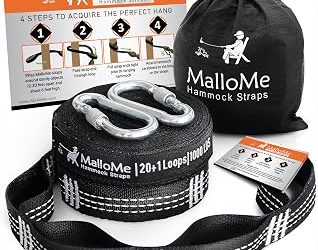
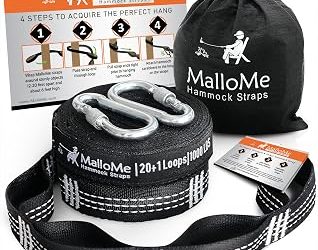
MalloMe’s multi-purpose kit is the versatile pick, working equally well between two trees or off a single sturdy branch for a swing. Adjustment is quick and intuitive, which matters more than it sounds when you’re rigging in fading light.
SZHLUX Hammock Straps (10 ft, 38 Loops)
Generous loop count, two included carabiners, and a compact packed size make this a strong value set for backyard and campsite use alike. Nothing exotic here — just competent webbing that does the job at a sensible price.
Heavy Duty Long Extender Hammock Webbing Kit
With 32 adjustable loops and a stated 1,000-pound capacity per strap, this set leans toward buyers who want visible load margin and a bit of extra reach. A practical choice for heavier hammocks, chair setups, or shared use.
Frequently Asked Questions
What hang angle should I aim for?
Roughly 30 degrees from horizontal on each strap. This produces the deep, flat-bottomed curve that supports a neutral spine, rather than the tight V that squeezes your shoulders and elevates your feet uncomfortably.
How high should I attach the straps?
Slightly above head height on the trunk is a good starting point, adjusting so the hammock’s lowest point sits around 18 inches off the ground. That height makes entry and exit safe while leaving room for the fabric to settle under your weight.
Do straps damage trees?
Wide webbing spreads load across the bark and is far gentler than rope or wire. Choose live trunks at least six inches in diameter, avoid thin-barked species where possible, and take the straps down when you’re finished.
Can I use tree straps indoors?
Yes, provided you anchor into structural framing with hardware rated for the load — never drywall anchors alone. Longer sets are especially useful indoors, where wall studs rarely fall exactly where you want them.
Final Thoughts
For anyone treating their hammock as genuine sleep equipment, the Foxelli XL set is the strongest overall choice: the no-stretch webbing and long reach protect your hang angle over a full night. The Wise Owl Outfitters kit is the better-balanced pick for camping and general use, while the MalloMe straps are the most adaptable option if you’re hanging a swing or working with a single branch.