The best fishing kayaks for big guys are 12 to 14-foot sit-on-top kayaks with at least 400 lb total capacity, a 34-inch or wider beam, and a raised frame seat rated for 300+ lb, with top stable picks being the Old Town Sportsman BigWater 132, Bonafide SS127, Native Watercraft Titan 13.5, Wilderness Systems ATAK 140, and Nucanoe Frontier 12.
Our top picks
 BKC Brooklyn 13.0 Pro Tandem Fishing Kayak
- Reinforced hull supports two adults and a child…
- Two-inch height-adjustable aluminum seats and adjustable footrests provide…
- Designed for tandem use, yet allows one seat…
 BKC Brooklyn 13.0 Pro Tandem Fishing Kayak
- Reinforced hull supports two adults and a child…
- Two-inch height-adjustable aluminum seats and adjustable footrests provide…
- Designed for tandem use, yet allows one seat…
 BKC Brooklyn 12.5 Tandem Fishing Kayak
- TANDEM OR SOLO FLEXIBILITY (2–3 PERSONS): Spacious 12.5…
- Outfitted with 6 rod holders (4 flush +…
- Wide 34-inch beam provides outstanding balance for standing…
| Product | Key specs | |
|---|---|---|
| BKC Brooklyn 13.0 Pro Tandem Fishing Kayak | Reinforced hull supports two adults and a child… Two-inch height-adjustable aluminum seats and adjustable footrests provide… Designed for tandem use, yet allows one seat… | Check price |
| BKC Brooklyn 13.0 Pro Tandem Fishing Kayak | Reinforced hull supports two adults and a child… Two-inch height-adjustable aluminum seats and adjustable footrests provide… Designed for tandem use, yet allows one seat… | Check price |
| BKC Brooklyn 12.5 Tandem Fishing Kayak | TANDEM OR SOLO FLEXIBILITY (2–3 PERSONS): Spacious 12.5… Outfitted with 6 rod holders (4 flush +… Wide 34-inch beam provides outstanding balance for standing… | Check price |
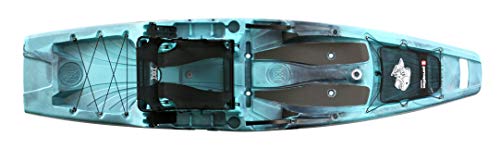 Perception Kayaks Perception Kayaks | Ultimate Fishing & Storage Space: Perception Outlaw 11.5… Unparalleled Comfort & Design: Enjoy maximum comfort during… Integrated Fishing Features: Efficient multi-rod fishing is made… | Check price |
As an Amazon Associate we earn from qualifying purchases at no extra cost to you.
What Actually Makes a Fishing Kayak Work for Bigger Anglers
Weight capacity alone is misleading. A kayak listed at 500 lb capacity can still feel unstable, cramped, or low in the water if the hull is narrow, the seat is low, or the weight distribution is poor. For anglers over 230 lb, or over 6’2″, evaluate these seven specs together:
- Usable weight capacity: Subtract 30-40 lb for gear, battery, tackle, and fish. You want at least 100 lb of buffer between your body weight plus gear and the maximum capacity. For a 280 lb angler with 40 lb of gear, look for 425 lb+ capacity.
- Beam width and hull type: 33 to 37 inches wide with a pontoon or tunnel hull provides primary stability for casting and leaning. Narrow V-hulls under 32 inches will feel tippy regardless of capacity.
- Deck and cockpit dimensions: A flat, open deck 55 to 65 inches long and footwell width of 18+ inches gives room to stand, shift weight, and stretch legs. Low, enclosed cockpits restrict tall anglers.
- Seat height and support: Frame seats sitting 12 to 16 inches off the deck with aluminum or steel framing, mesh suspension, and 20+ inch seat width distribute weight better than molded plastic seats and make standing/sitting easier on knees and back.
- Standing stability: Look for a standing area with EVA deck padding, 34-inch+ width at the standing zone, and 400+ lb standing rating. Add-on lean bars help but are not a substitute for hull width.
- Hull weight vs. transport: Stable big-guy kayaks weigh 75 to 120 lb bare. That affects car-topping, launching solo, and storage. Factor in whether you will trailer, truck-bed, or roof-rack it.
- Gear storage and layout: Larger anglers need gear out of the leg area. Check tankwell dimensions, front hatch size, and track systems for rods and crates without cluttering standing room.
Stable Picks Compared: Specs That Matter
These models are consistently recommended for higher weight anglers because they combine high capacity with wide, flat hulls and high-mounted frame seats. Specs are manufacturer-published for 2026 model year hulls and may vary slightly by outfitting.
| Model | Length / Beam | Total Capacity | Hull Weight | Seat Type / Seat Width | Best For |
|---|---|---|---|---|---|
| Old Town Sportsman BigWater 132 | 13’2″ / 34″ | 475 lb | 86 lb | Frame seat, 21″ wide, 15″ high | Big water and chop, paddling efficiency |
| Bonafide SS127 | 12’7″ / 33.75″ | 475 lb | 85 lb | Hi-Rise frame seat, 20.5″ wide, 13.5″ high | Stability for standing, river and lake versatility |
| Native Watercraft Titan 13.5 | 13’6″ / 37.5″ | 550 lb | 107 lb | Elevated frame seat, 22″ wide, 16″ high | Maximum stability and standing room |
| Wilderness Systems ATAK 140 | 14′ / 35″ | 550 lb | 95 lb | AirPro MAX frame seat, 21″ wide, 14″ high | Taller anglers needing legroom and tracking |
| Nucanoe Frontier 12 | 12′ / 41″ | 650 lb | 77 lb | 360-degree swivel frame seat, 20″ wide, 15″ high | Heaviest anglers, wide deck, tandem option |
| Jackson Big Rig HDFD | 13’3″ / 38″ | 550 lb | 108 lb | Ergonomic frame seat, 22″ wide, 15.5″ high | Standing and pedal-drive option for large anglers |
Price range for this class in 2026 is usually $1,000–$1,700 for paddle models and usually $2,200–$3,800 for pedal or motor-ready versions without electronics.
Hull Construction Trade-Offs for Heavy Loads
How the hull is built affects stiffness under weight, long-term sagging, and how heavy it is to move. This matters more at higher loads.
| Construction | Weight For 13′ Hull | Stiffness Under 300+ lb Load | Durability | Trade-off |
|---|---|---|---|---|
| Rotomolded polyethylene (single layer) | 75–110 lb | Good, flexes slightly but resists oil-canning if hull has keel channels | Very durable, resists impact and dragging, UV stable | Heaviest to carry; can dent under prolonged strapping if stored on uneven surface |
| Thermoformed ABS/acrylic | 65–85 lb | Very stiff, less flex under heavy angler, better glide | Stiff but can crack on sharp impact; needs cradle storage | Lighter and faster, usually $400–$700 more than rotomolded |
| Inflatable drop-stitch (high-pressure) | 40–55 lb | Moderate, 15–18 psi floor needed to prevent bow flex | Puncture risk from hooks; seams wear with heavy use | Lightest and easiest to store in apartment, least standing stability for big guys |
For most anglers over 250 lb, rotomolded polyethylene remains the most reliable because it handles repeated beaching, dragging over gravel, and sitting on a roof rack or truck bed without deforming.
Decision Matrix: Match the Kayak to Your Situation
Use your height, weight, where you fish, and how you transport to narrow the choice. The widest, highest-capacity kayak is not always the best if you have to lift it alone.
| Your Situation | Priority Spec | Recommended Type |
|---|---|---|
| 280–350+ lb, want to stand and cast | 40″+ beam, 550 lb+ capacity, flat deck 60″+ long | Nucanoe Frontier 12 or Native Titan 13.5 |
| 250–300 lb, 6’3″+ tall, long legs | 14′ length, 34″+ beam, large footwell and high seat | Wilderness Systems ATAK 140 or Old Town BigWater 132 |
| 230–270 lb, need to car-top alone | Hull weight under 85 lb, under 13′ length | Bonafide SS127 or Nucanoe Frontier 12 (77 lb) with bed extender |
| Fish rivers with current and need maneuverability | 12′ to 12’8″ length, rockered hull, 33–35″ beam | Bonafide SS127 or similar 12-foot pontoon hull |
| Fish large lakes, need to cover distance | 13’+ waterline, sharper bow, pedal-drive ready | Old Town BigWater 132 or Jackson Big Rig HDFD |
| Limited storage, apartment or garage with 32″ doorway | Width under 36″ and hull that can stand on side | Wilderness Systems ATAK 140 on wall cradle or 12-foot rotomolded models |
Fit and Comfort Details Listings Do Not Explain
Seat support and real clearance
A 20-inch wide frame seat sounds ample, but add winter clothing and PFD bulk and you lose 2 to 3 inches of effective width. Look for seats with open mesh sides rather than solid side walls. Seat height of 15 to 16 inches off the deck puts knees at roughly 90 degrees for a 6’2″ angler, making it possible to stand without grabbing the gunwales. Molded pocket seats sitting 6 to 8 inches off the deck force knees high and strain the lower back when sitting for 4+ hours.
Standing room measurements
For standing, measure the flat padded area between the seat base and front hatch. You need at least 28 inches wide and 32 inches long to place feet shoulder-width apart (about 20 inches apart) with room to rotate for casting. The Native Titan 13.5 and Nucanoe Frontier provide 36 to 41 inches of flat width here, while many 32-inch kayaks only provide 24 to 26 inches of truly flat space.
Weight distribution and trim
Bigger anglers often sit stern-heavy. Check if the seat tracks allow moving the seat forward 3 to 5 inches to level trim. Without trim adjustment, the bow rides high and tracking suffers. Gear storage behind the seat (40 to 60 quart crate or 45-inch tankwell) helps if you can slide heavy tackle forward under the seat or in a bow hatch.
Transport, Storage, and Durability Realities
A stable hull for big guys is heavy. Plan for the logistics before you buy:
- Car-topping: An 85 to 108 lb kayak is difficult to lift overhead alone. For SUVs with 65-inch roof height, a load-assist bar or trailer is safer than a dead lift. A truck bed with a T-bar extender handles 12 to 14-foot kayaks better than a sedan roof.
- Doorways and storage: A 37.5 to 41-inch beam will not fit upright through a standard 32-inch interior doorway or 36-inch exterior doorway. Vertical wall storage needs 14+ feet of ceiling height or a hoist system. Side storage on cradles needs 40 inches of wall depth.
- What wears first: Frame seat mesh and bungee suspension stretch after 2 to 3 seasons at higher loads. Replaceable mesh is preferable to riveted fabric. Scupper holes near the seat and rear tankwell are stress points that can crack if dragged; use a keel guard or cart.
- Warranty and weight rating: Some warranties limit angler weight even if total capacity is higher. Check whether the seat frame itself has a separate weight limit, often 350 lb, versus hull capacity of 500+ lb.
Gear Storage Without Losing Deck Space
For storage, look for a rear tankwell at least 38 inches wide and 20 inches deep to hold a milk crate or tackle box without overhang, plus forward hatch volume of 12+ gallons for rods and dry bags. Side gear tracks 18 to 24 inches long let you mount rod holders and fish finders at arm’s reach so the central standing zone stays clear. Hulls with under-seat slide drawers are useful for heavy items like batteries, keeping the center of gravity low.
How to Choose in 5 Steps
If you are deciding today, follow this order rather than choosing by capacity alone:
- Calculate total load: your weight + 30 to 50 lb for gear, cooler, and battery. Add 100 lb buffer to get minimum capacity.
- Choose beam by standing needs: 34″+ for occasional standing, 37″+ for regular stand-up casting.
- Test seat fit if possible: sit for 10 minutes, check knee angle, lower-back support, and whether hips touch side rails. Bring your PFD.
- Measure transport: weigh your lift limit, measure vehicle and garage, and decide paddle vs. pedal. Pedal drives add 15 to 25 lb and mechanical maintenance.
- Check trim options: ensure adjustable seat rails and both bow and stern storage to balance weight fore and aft.
FAQ
What weight capacity do I need if I am 300 lb?
Look for at least 500 to 550 lb total capacity. That leaves 200+ lb for gear, cooler, battery, and fish while keeping the waterline high enough that scuppers do not sit below water and the hull remains stable.
Can a 35-inch wide kayak still paddle efficiently?
It will be slower than a 30-inch kayak but tracks well if the waterline is 13+ feet. Expect cruising speed of 2.5 to 3.5 mph paddling versus 4+ mph for narrower touring hulls. Pedal drives offset the width penalty on long distances.
Do I need a pedal drive as a bigger angler?
Not required, but it helps save knees and shoulders on long days. It adds cost and 15 to 25 lb to hull weight and raises the deck, which can slightly raise center of gravity. If you fish current or wind often, the hands-free control is worth the trade-off.