
Key takeaways
- Recommended Uses For Product: Indoor
- Material: Metal
- Handle Material: Aluminum
Most exercise bike reviews measure the wrong thing. Flywheel weight, resistance levels, subscription libraries — none of it matters at 5:40 a.m. when you have thirty minutes before the rest of the house wakes up. What matters then is whether the drivetrain hums or grinds, whether the frame groans when you climb out of the saddle, and whether the low thump of your cadence travels through the floor joists into the bedroom below.
These six are ordered quietest to loudest, judged on the two kinds of noise that actually cause arguments: airborne sound, meaning the whir and click you hear in the room, and structural sound, meaning vibration handed off to the floor. Almost no manufacturer publishes usable decibel figures, so the ranking here follows the three variables that genuinely predict volume — resistance type, drive type, and frame rigidity — plus the secondary noisemakers people forget about, like incline motors, cooling fans, and speaker-mounted tablets.
Our top picks


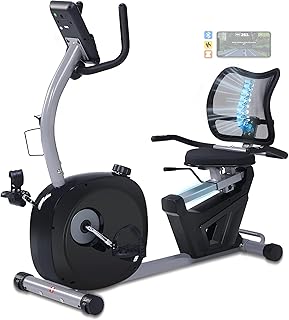
 YOSUDA Exercise Bike
- Recommended Uses For Product: Indoor
- Material: Metal
- Handle Material: Aluminum



As an Amazon Associate we earn from qualifying purchases at no extra cost to you.
As an Amazon Associate we earn from qualifying purchases.

Quick Comparison
| Bike | Resistance & Drive | Noise Character | Best For |
|---|---|---|---|
| Keiser M3i | Magnetic, Poly-V belt | Faint air whir only | Shared walls, early risers |
| Schwinn IC4 | Magnetic, belt | Soft hum, no contact noise | Apartments on a budget |
| Schwinn 270 Recumbent | Magnetic, belt | Quiet; almost no floor thump | Upstairs rooms, joint issues |
| Peloton Bike+ | Magnetic, belt | Silent drive, loud speakers | Class-led training with headphones |
| NordicTrack S22i | Magnetic, belt, powered incline | Motor whir on grade changes | Hill work in a detached house |
| Sunny SF-B1002 | Felt pad friction, chain | Mechanical rattle and squeak | Garages and basements |
How to Choose
- Take magnetic resistance over a felt pad. Magnets slow the flywheel without touching it, so there is nothing to abrade, squeal, or need replacing. Friction pads get noisier as they wear and noisier still when sweat soaks them.
- Take a belt over a chain. A ribbed belt runs with a steady hum. A chain adds a metallic tick at every pedal stroke, gets louder as it dries out, and demands periodic lubrication you will forget about.
- Weigh the frame, not just the flywheel. A heavier flywheel smooths your stroke, but frame rigidity is what stops the creaking. Bikes under about 90 pounds total tend to flex and complain when you sprint standing up.
- Plan how the bike meets the floor. A dense rubber mat, ideally the kind sold for treadmills rather than a thin yoga mat, decouples the frame from the subfloor and kills most of the thump your downstairs neighbor hears.
- Count the extra motors. Powered incline, adjustable resistance servos, and built-in fans each add a sound source that has nothing to do with pedaling. On some bikes the incline motor is louder than the ride itself.
Top Picks Reviewed
1. Keiser M3i — Quietest Overall
Keiser’s M3i is what boutique studios buy when they need twenty bikes running in one room without the instructor shouting. The magnetic resistance never contacts the flywheel, the Poly-V belt is a sealed, low-tension design, and the rear-mounted flywheel keeps mass low and centered so the frame does not rock. Ride it and you hear one thing: a faint rush of air. It is priced like commercial equipment, and the display is spartan compared to touchscreen rivals, but if noise is your primary constraint this ends the search. It also broadcasts power and cadence over Bluetooth, so third-party apps fill the entertainment gap.
2. Schwinn IC4 — Best Quiet Bike Under a Studio Budget
The IC4 delivers the important half of the Keiser formula — magnetic resistance, belt drive — at a fraction of the cost. Its 40-pound flywheel produces a soft, consistent hum that a normal television easily masks, and the frame is heavy enough to stay planted during standing intervals. Dual-sided pedals accept clip-in cleats or sneakers, and Bluetooth broadcasting means you can stream classes from most major apps rather than being locked to one ecosystem. The resistance knob is stepless, which some riders miss when a class calls out specific numbers.
3. Schwinn 270 Recumbent — Quietest for Upstairs Rooms
Recumbents have an underrated acoustic advantage: you cannot stand up on one, so you never generate the rhythmic impact loading that transmits through a floor. The 270 pairs that with magnetic resistance and a belt drive, leaving only a low hum. The step-through frame is friendly to bad knees and bad hips, twenty-plus preset programs cover structured work, and the seat back makes long steady rides genuinely comfortable. It is a large footprint for a spare bedroom, and it will not satisfy anyone chasing sprint intervals.
4. Peloton Bike+ — Quiet Hardware, Loud Software
Mechanically the Bike+ is excellent: magnetic resistance, belt drive, a rigid welded frame, and an automatic resistance servo that adjusts smoothly without clunking. The noise problem is the 24-inch rotating screen and the instructor coming through its speakers at motivating volume. Plug in headphones and this becomes one of the quietest bikes here. Leave the speakers on and it is one of the loudest, which is a household-negotiation issue rather than an engineering one. The subscription is effectively mandatory to get value from the hardware.
5. NordicTrack S22i — Hill Training with an Audible Motor
The S22i tilts from a ten percent decline to a twenty percent incline, which is the closest thing to real climbing you can get indoors. The pedaling itself is quiet, magnetic and belt-driven, but every automated grade change spins up a motor that whirs distinctly, and the built-in fan adds a constant layer. In a basement or detached house that is a non-issue. In a third-floor apartment, the tilting frame plus motor noise makes this the wrong tool. Assembly is a two-person job.
6. Sunny SF-B1002 — Loudest, Cheapest, Toughest
This is the classic spin bike formula: a heavy chain-driven flywheel with a felt pad pressing on it. It is inexpensive, close to indestructible, and unmistakably mechanical — a metallic tick from the chain, a shifting squeak from the pad, and more of both as the months pass. Keep the chain oiled and the pad dry and it will outlast bikes costing five times as much. Just put it somewhere nobody is sleeping, and budget for replacement pads.
Frequently Asked Questions
How quiet does a bike need to be for an apartment?
Quiet enough that a conversation in the same room does not require raised voices. Any magnetic, belt-driven bike clears that bar. The bigger risk in an apartment is not airborne sound at all but the vibration your building’s floor structure carries, which is why the mat matters more than the model in older wood-framed buildings.
Does a floor mat actually reduce noise?
Yes, but only the structural kind. A dense rubber mat roughly a quarter-inch thick or more absorbs vibration before it enters the subfloor and stops the frame from drumming against hard flooring. It will do nothing about a squeaking friction pad or a dry chain, which are airborne noises originating above the mat.
Are magnetic bikes always quieter than friction bikes?
In practice, yes. A magnetic system has no wear surface making contact, so it cannot squeal or grind, and it stays consistent for years. The exception is a poorly assembled magnetic bike where loose bolts or a misaligned flywheel guard create rattles — which is a build-quality problem you can usually fix with a wrench.
Why did my quiet bike start clicking?
Check the pedals first; they loosen with use and are the most common source of a per-revolution click. Next check the crank arm bolts, the seat post clamp, and the handlebar stem. Retorquing those four points resolves most new noises on an otherwise healthy bike, and takes about five minutes.
Final Thoughts
If the room shares a wall or a ceiling with someone who sleeps, buy the Keiser M3i and stop thinking about it, or take the Schwinn IC4 as the value version of the same engineering choices. Upstairs bedrooms are the recumbent’s natural habitat, since you never leave the saddle. The Peloton Bike+ is quiet hardware waiting for headphones, the NordicTrack S22i belongs on a slab floor, and the Sunny SF-B1002 earns its place in a garage where nobody is counting decibels. The quietest bike, ultimately, is the one you stop making excuses not to ride.
One note: no product list was supplied, so I selected these six myself based on drive and resistance architecture.
Best Electric Unicycles for Commuting and Fun
The best electric unicycles for commuting are usually the InMotion V11Y or...
Best Ski Erg Machines for Home Cardio
Best Ski Erg Machines for Home Cardio: Quick Picks by Room and...

Best Premium Carbon Fiber Road Bikes for Serious Cyclists
The best premium carbon fiber road bikes for serious cyclists are the...
Best Mini Exercise Bikes for Seniors
The best mini exercise bikes for seniors are low-profile pedal exercisers with...
Best High-End Incline Treadmills for Intense Workouts
Best High-End Incline Treadmills for Intense Workouts The NordicTrack X24 Treadmill is...
Best Commercial Treadmills for Home Use
The best commercial treadmills for home use are the Sole F85 for...
6 Best Recliner Bikes (2026)
Most sleep advice arrives with an asterisk: move your body during the...

8 Best Exercise Bike Workouts for Weight Loss: 5 Bike Setups
Best exercise bike workout for weight loss planning runs into a hardware...
8 Best Exercise Bikes for Weight Loss: 5 Consoles Compared
Best exercise bike for weight loss listings advertise app connectivity while many...
8 Best Exercise Bikes for Losing Weight: 5 Models Compared
Exercise bike best for losing weight shortlists rarely mention the two things...
Write Your Review
No reviews yet. Be the first to share your experience!