Key takeaways
- Fan acoustics over raw wattage: Every insert here tops out near 1500W, so the real differentiator is how the blower sounds at low speed. A steady, broadband hum sits below your waking threshold; a rattling or cycling fan does not. If a unit will live in a bedroom, favor models described as low-noise and plan to run them on the 750W setting overnight.
- Thermostat behavior, not just a temperature dial: Look for a thermostat that cycles the element while keeping airflow consistent. Wide swings between hot and cold are what wake people at 3 a.m., and a blower that shuts off entirely between cycles creates exactly that sawtooth pattern.
- Measure the opening in three dimensions: Width gets all the attention, but depth decides whether the insert seats flush and whether the blower has room to breathe. Record width, height, and depth at both the front and rear of your firebox before ordering, since masonry openings taper.
- Independent flame, sound, and heat controls: The most useful feature for evening wind-down is being able to run the flame effect with the heater off. Separate switching also lets you kill the crackling audio, which is pleasant for an hour and genuinely disruptive for eight.
- Dimmable flame brightness and a real timer: Bright, cool-toned flicker near the bed suppresses melatonin more than people expect. Multi-level brightness plus an automatic shutoff timer lets the unit fade out of your evening instead of glowing until morning.
What's inside
Most people shop for an electric fireplace insert thinking about aesthetics, and then discover something unexpected a few weeks later: the room they sleep in feels different. As someone who spends most of my working hours on sleep environments, I can tell you the two variables that decide whether a heater helps or hurts your rest are noise and thermal drift. A blower-equipped insert moves warm air outward instead of letting it stack against the ceiling, which keeps temperatures steadier through the night — but only if the fan itself is quiet enough to disappear into the background. The trouble is that listings rarely tell you which of those two things you’re actually getting.
This guide approaches electric fireplace inserts with a blower through that lens. Below you’ll find the models worth considering in 2026, a short checklist of specifications that genuinely affect comfort and sleep quality, plus honest notes on where each unit fits — bedroom, living room, or a converted fireplace opening that has sat cold for years. I’ve prioritized units with dual wattage, real thermostatic control, and crackling audio that can be silenced, because a heater you can’t turn down to “quiet warmth” isn’t a bedroom heater at all.
As an Amazon Associate we earn from qualifying purchases.


🛒 Best Price Today on Amazon
Prime members get fast, free shipping on everything above, plus member-only deals. New members get a 30-day free trial — cancel anytime.
How to Choose a/an Electric Fireplace Insert With Blower (2026)
- Fan acoustics over raw wattage: Every insert here tops out near 1500W, so the real differentiator is how the blower sounds at low speed. A steady, broadband hum sits below your waking threshold; a rattling or cycling fan does not. If a unit will live in a bedroom, favor models described as low-noise and plan to run them on the 750W setting overnight.
- Thermostat behavior, not just a temperature dial: Look for a thermostat that cycles the element while keeping airflow consistent. Wide swings between hot and cold are what wake people at 3 a.m., and a blower that shuts off entirely between cycles creates exactly that sawtooth pattern.
- Measure the opening in three dimensions: Width gets all the attention, but depth decides whether the insert seats flush and whether the blower has room to breathe. Record width, height, and depth at both the front and rear of your firebox before ordering, since masonry openings taper.
- Independent flame, sound, and heat controls: The most useful feature for evening wind-down is being able to run the flame effect with the heater off. Separate switching also lets you kill the crackling audio, which is pleasant for an hour and genuinely disruptive for eight.
- Dimmable flame brightness and a real timer: Bright, cool-toned flicker near the bed suppresses melatonin more than people expect. Multi-level brightness plus an automatic shutoff timer lets the unit fade out of your evening instead of glowing until morning.
The Best Electric Fireplace Insert With Blower (2026)s Reviewed
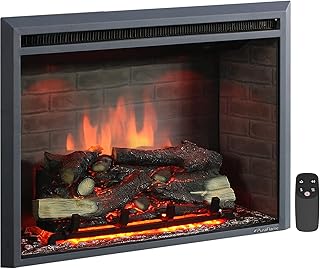
PuraFlame Western 33″ Insert
The Western is the most complete package for an existing masonry opening: 33 inches wide, dual 750/1500W output, remote control, and crackling audio you can switch off independently. Its blower distributes heat evenly across a mid-sized room without the high-pitched whine that plagues cheaper fans, making it my default recommendation for bedrooms above 150 square feet.
LegendFlame Carl 39″ (EF265)
At 39 inches, the Carl covers wider fireboxes where a 33-inch unit would leave awkward gaps, and the flame presentation reads convincingly from across a large room. Dual wattage and remote operation are standard here, and the heater side is powerful enough to serve as a primary source in a well-insulated living room.
PuraFlame Klaus 33″ Insert
Mechanically similar to the Western but fronted by a glass door and mesh screen, the Klaus is the pick when you want the visual language of a real firebox rather than an obvious appliance. The screen slightly softens the flame effect, which is a genuine advantage in a bedroom where you’d rather not stare into a bright rectangle.
Real Flame Harlan 55″ with Mantel
For rooms with no existing fireplace, the Harlan pairs a replaceable insert heater with a white mantel surround, so you get a finished architectural feature instead of a box on the floor. The replaceable-insert design is the quiet selling point: the heater is the part that eventually fails, and here you can swap it without discarding the furniture.
LegendFlame 25″ Free Standing Log Set (EF484)
This log set drops into an oversized or irregular opening where a framed insert won’t sit properly, and at 25 inches it also works as a standalone unit in a small bedroom or study. Dual wattage, crackling sound, and remote control are all present despite the compact footprint.
Frequently Asked Questions
Is it safe to sleep with an electric fireplace insert running?
Generally yes, provided the unit has overheat protection, is plugged directly into a wall outlet rather than an extension cord, and has clear space around the air intake. Running the lower 750W setting overnight is both safer and more comfortable than cycling 1500W against a thermostat.
Will the blower keep me awake?
A well-built blower on low produces steady, low-frequency sound that most sleepers habituate to within a night or two — some find it actively helpful, similar to a fan. Intermittent noise is the real problem, so choose a unit whose fan runs continuously rather than one that starts and stops with every thermostat cycle.
What room temperature should I target overnight?
Most adults sleep best somewhere in the mid-60s Fahrenheit. Because inserts with blowers heat quickly, set the thermostat a degree or two below where you’d set it during the day and let the flame effect handle the perception of warmth.
Do I need an electrician to install one?
Not usually. These units run on standard 120V household power, though a 1500W heater draws roughly 12.5 amps and should not share a circuit with other high-draw appliances. Hardwiring is optional on some models and worth discussing with an electrician if you want a cord-free look.
Final Thoughts
If your priority is a quiet, thermostatically stable bedroom heater that disappears into an existing firebox, the PuraFlame Western is the strongest all-around choice, with the PuraFlame Klaus edging ahead when you want the softer, screened flame view near a bed. For larger living rooms, the LegendFlame Carl 39″ delivers the output and visual scale that smaller inserts can’t, while the Real Flame Harlan remains the answer for anyone building the fireplace from scratch.