Key takeaways
- Dimming range, not just color count: Twelve flame colors mean little if the lowest brightness setting still lights the room like a nightstand lamp. Look for multiple discrete brightness levels and favor warm amber tones over blue-white embers in any room used for sleeping — short-wavelength light is the most disruptive to melatonin onset.
- A real thermostat plus a timer you’ll actually use: Core body temperature needs to drop roughly a degree to initiate and hold sleep. A unit with genuine thermostatic control and a multi-hour countdown timer lets you warm the room at 9 p.m. and coast into a cooler bedroom by midnight, rather than baking all night at 1500W.
- Fan noise character: Blower-driven heat always makes sound. What matters is whether it’s smooth broadband air movement — which many sleepers find masking and pleasant — or an intermittent rattle or high-pitched whine that your auditory system keeps flagging. Manufacturers advertising “low noise” designs are usually worth the premium here.
- Recess depth and wall type: Ultra-thin models fitting standard 2×4 framing save considerable renovation grief. Confirm the required cavity depth, whether the trim allows flush or surface mounting, and that you have a dedicated circuit — 1500W on a shared bedroom circuit invites nuisance breaker trips.
- Ambience without heat: The best year-round feature on any of these is the ability to run flames with the heater off. That’s what makes an insert usable as a warm, low-level evening light source in July, and it should be a one-button operation on the remote.
What's inside
Most people shop for a fireplace insert with their eyes — flame realism, bezel thickness, how the glass looks against a dark accent wall. As someone who spends their working life studying what happens to the human body between lights-out and sunrise, I’d argue the more consequential questions are quieter ones: how much light does this thing throw at 11 p.m., does the fan hum at a frequency your brain can ignore, and can you set the heat to shut off before your core temperature needs to fall? A bedroom or den fireplace is a sleep-adjacent appliance whether the manufacturer markets it that way or not.
This guide looks at the strongest 36-inch recessed and wall-mounted electric inserts available in 2026 through that lens as well as the conventional ones. I’ve weighed dimming range, thermostat behavior, timer granularity, fan noise, and installation depth alongside the usual build-quality and flame-effect criteria — because the model that photographs best is not always the model you want glowing thirty inches from a pillow.
As an Amazon Associate we earn from qualifying purchases.



🛒 Best Price Today on Amazon
Prime members get fast, free shipping on everything above, plus member-only deals. New members get a 30-day free trial — cancel anytime.
How to Choose a/an 36 Inch Electric Fireplace Insert (2026)
- Dimming range, not just color count: Twelve flame colors mean little if the lowest brightness setting still lights the room like a nightstand lamp. Look for multiple discrete brightness levels and favor warm amber tones over blue-white embers in any room used for sleeping — short-wavelength light is the most disruptive to melatonin onset.
- A real thermostat plus a timer you’ll actually use: Core body temperature needs to drop roughly a degree to initiate and hold sleep. A unit with genuine thermostatic control and a multi-hour countdown timer lets you warm the room at 9 p.m. and coast into a cooler bedroom by midnight, rather than baking all night at 1500W.
- Fan noise character: Blower-driven heat always makes sound. What matters is whether it’s smooth broadband air movement — which many sleepers find masking and pleasant — or an intermittent rattle or high-pitched whine that your auditory system keeps flagging. Manufacturers advertising “low noise” designs are usually worth the premium here.
- Recess depth and wall type: Ultra-thin models fitting standard 2×4 framing save considerable renovation grief. Confirm the required cavity depth, whether the trim allows flush or surface mounting, and that you have a dedicated circuit — 1500W on a shared bedroom circuit invites nuisance breaker trips.
- Ambience without heat: The best year-round feature on any of these is the ability to run flames with the heater off. That’s what makes an insert usable as a warm, low-level evening light source in July, and it should be a one-button operation on the remote.
The Best 36 Inch Electric Fireplace Insert (2026)s Reviewed
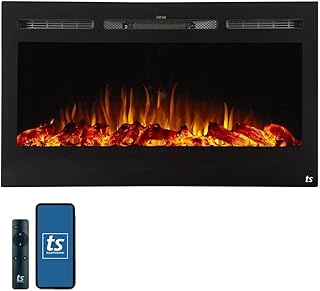
Touchstone Sideline 36″
The most thoughtfully engineered option here, with thirty ember and flame combinations, WiFi and Alexa control, and a choice of log or crystal hearth media. Voice-scheduled shutoff is genuinely useful for an evening wind-down routine you don’t have to remember to end.
Electactic 36″ Ultra-Thin
An unusually shallow profile makes this the pragmatic pick for retrofits into existing stud bays, and it pairs a proper thermostat with adjustable flame and timer control on a clean touchscreen. Dual 750/1500W wattage gives you a low setting that takes the chill off without overheating a bedroom.
R.W.FLAME 36″ Recessed
Five brightness settings and an eight-hour timer give this model the most granular control over light output of anything in the group — the specification I’d prioritize for a room where someone sleeps. The 36″ x 27″ footprint reads as a substantial architectural feature rather than a slim panel.
Realsmart 36″ Slim Black
Twelve flame colors and an explicitly low-noise blower design make this a strong value choice for open-plan living areas and media rooms. The slim black bezel disappears against dark walls, which helps at night when you want the flames visible and the hardware invisible.
Valuxhome 36″ Insert
Overheating protection and a crackling audio track are the headline features, and the crackle is worth auditing before you commit — some sleepers find it a soothing masking sound, others find its irregularity keeps them alert. Fortunately it’s independently switchable.
Frequently Asked Questions
Is it safe to run an electric fireplace overnight in a bedroom?
Electrically, these units are designed for extended operation and include tip-over and overheat cutoffs. Physiologically, running heat all night is counterproductive — a warm room blunts the nocturnal temperature drop that consolidates deep sleep. Use the timer.
What room temperature should I be targeting?
Most sleep research converges on roughly 60–68°F for the sleeping hours. Set the thermostat toward the lower end of comfortable and let the fireplace do pre-bed warming rather than all-night maintenance.
Can I leave the flames on with the heater off?
Yes, on every model reviewed here. Dimmed amber flames make a reasonable substitute for overhead lighting in the last hour before bed, when reducing overall light intensity matters more than any single bulb choice.
Do I need an electrician?
For a recessed installation, generally yes — framing modifications and a dedicated 15-amp circuit for 1500W operation are best handled professionally. Surface-mounted installations plugged into an existing outlet are more DIY-friendly.
Final Thoughts
If you want the most control over light, heat, and timing — the three variables that determine whether an insert helps or hinders your sleep — the Touchstone Sideline 36″ is the clear recommendation, with the R.W.FLAME 36″ close behind for its five-stage dimming and eight-hour timer. For retrofits where wall depth is the binding constraint, the Electactic Ultra-Thin delivers nearly the same functional control in a package that fits where the others won’t.