Key takeaways
- Measure the firebox first, not last: Masonry openings taper toward the back, so record width at the front face, width at the rear, height, and usable depth. Most retrofit units need roughly 20 inches of front width clearance and 8 to 12 inches of depth; a unit listed at 33 inches wide will not slide into a 32-inch opening no matter how carefully you angle it.
- Two-stage heat beats one-stage: Look for 750W/1500W switching. The low setting is the one you’ll actually live with in the evening, because 1500W in a small bedroom overshoots quickly and warm rooms are the single most common reason people wake at 3 a.m.
- Insist on dimmable flame: Bright, fixed-brightness flames put unnecessary light into the room after dark. Multiple brightness levels let you drop the visual output low enough that it becomes ambient glow rather than a light source competing with your melatonin.
- Decide whether you want crackle: Simulated crackling is genuinely useful as low-level masking sound for light sleepers, but it should be independently switchable from the heater and flame. Avoid units where the audio is tied to the heat setting.
- Trim insert versus freestanding log set: A framed insert with a glass front gives a finished, built-in appearance but demands precise measurements. A freestanding log set simply sits inside the existing opening, which is far more forgiving on odd or sloped fireboxes and much easier to remove later.
What's inside
A masonry firebox that no longer earns its keep is one of the most common frustrations I hear about from clients working on their sleep environments. The chimney pulls warm air out of the room all winter, the damper rattles, and the whole cavity becomes a decorative hole rather than a source of comfort. Meanwhile, the bedroom or living room sits two or three degrees cooler than the rest of the house — and since your body needs a gentle, steady thermal glide-path to fall asleep, that draft is doing real damage to your evenings.
An electric insert solves the problem from both directions: it seals off the cold-air pathway and gives you controllable radiant warmth with a visual flame that reads as restful rather than stimulating. This guide covers what actually matters when you’re dropping a unit into an existing firebox — dimensions, heater staging, dimmable flame, sound options, and the difference between a built-in trim insert and a freestanding log set you simply slide in. Below are the models I’ve found most reliable for retrofit installations in 2026.
As an Amazon Associate we earn from qualifying purchases.


🛒 Best Price Today on Amazon
Prime members get fast, free shipping on everything above, plus member-only deals. New members get a 30-day free trial — cancel anytime.
How to Choose a/an Electric Fireplace Insert For Existing Fireplace (2026)
- Measure the firebox first, not last: Masonry openings taper toward the back, so record width at the front face, width at the rear, height, and usable depth. Most retrofit units need roughly 20 inches of front width clearance and 8 to 12 inches of depth; a unit listed at 33 inches wide will not slide into a 32-inch opening no matter how carefully you angle it.
- Two-stage heat beats one-stage: Look for 750W/1500W switching. The low setting is the one you’ll actually live with in the evening, because 1500W in a small bedroom overshoots quickly and warm rooms are the single most common reason people wake at 3 a.m.
- Insist on dimmable flame: Bright, fixed-brightness flames put unnecessary light into the room after dark. Multiple brightness levels let you drop the visual output low enough that it becomes ambient glow rather than a light source competing with your melatonin.
- Decide whether you want crackle: Simulated crackling is genuinely useful as low-level masking sound for light sleepers, but it should be independently switchable from the heater and flame. Avoid units where the audio is tied to the heat setting.
- Trim insert versus freestanding log set: A framed insert with a glass front gives a finished, built-in appearance but demands precise measurements. A freestanding log set simply sits inside the existing opening, which is far more forgiving on odd or sloped fireboxes and much easier to remove later.
The Best Electric Fireplace Insert For Existing Fireplace (2026)s Reviewed
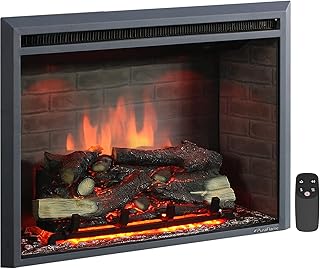
PuraFlame Western 33″
The Western is my default recommendation for standard-size masonry openings: solid build, a convincing ember bed, and a remote that lets you adjust flame and heat without leaving the sofa. Two-stage 750/1500W output plus switchable crackling sound makes it one of the few units that works equally well as a heat source and as a quiet evening backdrop.
PuraFlame Klaus 33″
Identical footprint to the Western but finished with a glass door and mesh screen, which gives it a much more authentic, semi-open hearth look once installed. Choose this one if the fireplace is a focal point in the room and you want the retrofit to read as original rather than obviously electric.
Valuxhome 36″ Insert
The pick for wider fireboxes, and a genuinely thoughtful unit — overheating protection, remote operation, crackling audio, and the same 750/1500W staging in a broader chassis. At 36 inches it fills a large opening properly instead of leaving awkward gaps at the sides.
23″ Insert with 4 Flame Brightness Levels
Small fireboxes are the hardest to shop for, and this 23-inch unit handles them well with four flame brightness levels, an 8-hour timer, and notably low fan noise. The timer is the standout feature for bedroom use: set it to shut down an hour after you turn in and the room cools naturally as your body temperature drops.
LegendFlame EF290 23″ Log Set
A freestanding log set rather than a framed insert, which makes it the path of least resistance for irregular or shallow fireboxes — no trim fitting, no shimming, just place it and plug it in. You still get 750/1500W heat, crackling sound, and remote control.
Frequently Asked Questions
Do I need to seal the chimney before installing an electric insert?
Yes, and it’s the step most people skip. An unblocked flue will keep siphoning conditioned air out of the room and undercut the heater’s output. Fit a chimney balloon or an insulated top-sealing damper before the insert goes in.
Can these run on a standard household outlet?
All the units here run on standard 120V power, but 1500W draws roughly 12.5 amps. Give the insert its own circuit where possible, and never run one on an extension cord or power strip.
Is it safe to sleep with an electric fireplace running?
These units have no combustion, no emissions, and overheating cutoffs, so the safety picture is straightforward. The better question is whether you should — a heater running all night tends to hold the room too warm for quality sleep, so a timer or low setting is the smarter approach.
Will the flame effect keep me awake?
Only if you leave it on full brightness. Dimmed to its lowest level, the flame sits well below the intensity that meaningfully suppresses melatonin, and many light sleepers find the slow, predictable motion actively settling.
Final Thoughts
For most existing masonry fireplaces, the PuraFlame Western 33″ is the best balance of build quality, heat control, and evening-friendly flame dimming, while the PuraFlame Klaus 33″ is worth the swap if you want the glass-and-mesh look of a real hearth. Wider openings should go to the Valuxhome 36″, and anyone dealing with a shallow or awkwardly shaped firebox will save themselves considerable trouble with the LegendFlame EF290 log set.