Key takeaways
- Seat depth versus your inseam: Measure from the back of your knee to your heel. If seat depth exceeds that number by more than a few inches, your feet dangle when sitting upright — fine for lounging, tiring for conversation. Deep sectionals reward households that actually recline; they punish those who sit formally.
- Cushion fill and firmness: Look for high-resilience foam cores with a fiber or down-blend wrap. Pure fiberfill feels luxurious for a month, then compresses into a hammock that misaligns the lumbar spine. Firmer cores hold a neutral spine over a long nap.
- Flat sleeping footprint: Push the ottomans into the chaise and check for a level, seam-free stretch of at least 68 inches. Ridges between modules land under the shoulder blade or hip and cause the micro-arousals that fragment sleep without waking you fully.
- Cover removability and fabric breathability: Chenille is soft but traps heat, and thermoregulation is the single most underrated factor in couch sleep. Removable, washable covers let you swap to a lighter weave in summer and keep allergens down for congested sleepers.
- Module stability: Interlocking clips or hook-and-loop connectors matter more than they sound. Modules that slide apart under shifting weight create a gap you’ll subconsciously brace against all night.
What's inside
Most people shop for a sectional the way they shop for a rug: they think about the room. But if you’re drawn to deep seating specifically, chances are you’re really shopping for rest. In my work with clients on sleep hygiene, the living room comes up constantly — the 20-minute wind-down that turns into a 3 a.m. wake-up with a stiff neck, the partner who “sleeps better on the couch,” the teenager who does homework horizontally. A shallow 21-inch seat forces your spine into a C-curve and your hips into a shallow, unsupported angle. A genuinely deep seat, roughly 40 inches or more front-to-back on these oversized modular models, lets you lie fully supine with your legs extended. That’s the difference between dozing and actually restoring.
This guide looks at six oversized, deep-seat modular sectionals through a sleep-quality lens: seat depth and firmness, how well the cushion resists sagging under a full-body load, whether the arms and ottomans create a usable flat sleeping surface, and how easily the covers come off when someone inevitably naps there and drools. I’ve also flagged the practical issues that matter for a piece of furniture doubling as a bed — foam density, seam placement under the shoulder, and whether the modules drift apart overnight.
As an Amazon Associate we earn from qualifying purchases.


🛒 Best Price Today on Amazon
Prime members get fast, free shipping on everything above, plus member-only deals. New members get a 30-day free trial — cancel anytime.
How to Choose a Deep Sectional Sofa (2026)
- Seat depth versus your inseam: Measure from the back of your knee to your heel. If seat depth exceeds that number by more than a few inches, your feet dangle when sitting upright — fine for lounging, tiring for conversation. Deep sectionals reward households that actually recline; they punish those who sit formally.
- Cushion fill and firmness: Look for high-resilience foam cores with a fiber or down-blend wrap. Pure fiberfill feels luxurious for a month, then compresses into a hammock that misaligns the lumbar spine. Firmer cores hold a neutral spine over a long nap.
- Flat sleeping footprint: Push the ottomans into the chaise and check for a level, seam-free stretch of at least 68 inches. Ridges between modules land under the shoulder blade or hip and cause the micro-arousals that fragment sleep without waking you fully.
- Cover removability and fabric breathability: Chenille is soft but traps heat, and thermoregulation is the single most underrated factor in couch sleep. Removable, washable covers let you swap to a lighter weave in summer and keep allergens down for congested sleepers.
- Module stability: Interlocking clips or hook-and-loop connectors matter more than they sound. Modules that slide apart under shifting weight create a gap you’ll subconsciously brace against all night.
The Best Deep Sectional Sofas of 2026, Reviewed
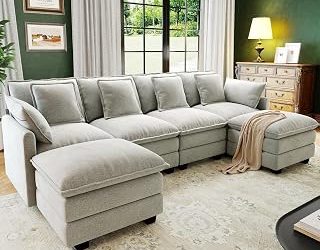
120″ Modular Cloud Sectional with Ottoman (Green)
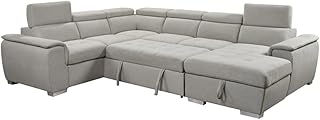
The standout here is the sleeper configuration: pull the ottoman flush and you get a continuous, genuinely flat surface long enough for most adults to stretch out without curling. The chenille runs warm, so I’d pair it with a breathable cotton throw rather than the included pillows if you’re a hot sleeper.
117″ V-Shaped Sectional with Corner and 2 Ottomans (Terracotta)
The V-shape geometry is the smart choice for households where two people nap simultaneously — each arm gives an independent, supported position instead of forcing one person into the corner well. Deep seats hold their loft well, though the corner module needs a firmer support pillow if you read upright before bed.
Legend Vansen Reversible U/L-Shaped Sectional (Dark Grey)
The reversible layout is the most adaptable option on this list, which matters if your wind-down spot needs to move away from a window or a light source. Plush polyester breathes noticeably better than chenille, a real advantage for anyone who wakes up overheated.
7-Seater Chenille Corner Sectional with 2 Movable Ottomans (Camel)
Built for full households, with enough surface area that a napping adult doesn’t monopolize the room. The two movable ottomans are the functional core — position them end-to-end to extend the chaise for a taller sleeper.
EASE MOOSE L-Shaped Sectional with Removable Cover (Blue)
My pick for allergy-prone or congested sleepers, purely because the covers come off and go in the wash without a fight. The seat is wide and deep with a slightly firmer feel, which I generally prefer for sustained lying-down time.
Frequently Asked Questions
Is sleeping on a deep sectional bad for you?
Occasionally, no — a supportive deep seat can be perfectly fine for a nap or an unplanned overnight. The problem is habitual couch sleeping, which tends to involve a less consistent schedule, more ambient light, and more noise. Those environmental factors do more damage to sleep architecture than the cushion itself.
How firm should the cushions be for napping?
Medium-firm. You want enough give to relieve pressure at the shoulder and hip, but enough resistance that your lumbar spine doesn’t sink below your ribs and pelvis. If your hand sinks past the wrist with light pressure, it’s too soft for regular sleep.
Will chenille make me overheat?
It can. Chenille’s looped pile traps a warm air layer, which feels wonderful in a cool room and stifling in a warm one. If your home runs above about 70°F at night, choose a polyester or linen-blend cover, or keep a lightweight blanket nearby instead of using a heavy throw.
Do modular sections stay together?
With good connectors, mostly. Check the hardware before assuming — if the modules only butt against each other, add non-slip pads or a low-profile connector bracket. A gap that opens under your hip mid-nap is a genuine sleep disruptor.
Final Thoughts
If restorative lounging is the priority, the 120″ Modular Cloud Sectional with Ottoman offers the best flat sleeping surface for the money, while the Legend Vansen Reversible U/L-Shaped Sectional is the smarter buy for hot sleepers and rooms that need reconfiguring. Households with multiple loungers should look hard at the 117″ V-Shaped Sectional, which gives everyone a properly supported spot without anyone claiming the corner.