Key takeaways
- Tooth count: For finish crosscuts, 80 teeth is the practical minimum and 100 teeth is the sweet spot on a 12-inch blade. More teeth means smaller bites per tooth and a cleaner exit face, at the cost of slower feed rates and more heat if you push.
- Grind geometry: Look for an ATB (alternate top bevel) grind, ideally a high-angle ATB. The knife-like bevels sever wood fibers at the surface instead of tearing them, which is exactly what prevents chipout on veneered panels and prefinished mouldings.
- Hook angle: A low or slightly negative hook angle is what you want on a miter saw. It resists the blade self-feeding into the work, reduces the tendency to lift thin stock, and gives you far better control on chop cuts.
- Plate quality and carbide: A laser-cut plate with expansion slots stays flat under heat, and micrograin carbide holds its edge through more linear feet before it starts burnishing instead of cutting. Thin-kerf plates waste less material but need a true, tensioned body to avoid deflection.
- Arbor and fit: Most 12-inch miter saws use a 1-inch arbor. Confirm before buying, check that any included reducer bushing seats fully, and inspect the blade for runout the first time you spin it up.
What's inside
Anyone who has ever pulled a piece of walnut off the miter saw and found a fuzzy, splintered edge where a glue-ready face should be knows that the saw is rarely the culprit. The blade is. A 12-inch miter saw ships with a general-purpose blade built for framing lumber and speed, and that blade will happily leave tearout, burn marks, and chipped veneer on the trim, cabinet doors, and furniture parts that actually get seen. Fine crosscutting is a different job with different tooth geometry, and the swap costs far less than sanding out mistakes.
This guide covers the twelve 12-inch blades we consider the best choices for fine finish work in 2026, drawn from testing on hardwood, softwood, plywood, melamine, and prefinished trim. Below you’ll find what to look for in tooth count, grind, and plate quality, followed by detailed reviews of our top five picks and answers to the questions we hear most from furniture builders and finish carpenters.
As an Amazon Associate we earn from qualifying purchases.



🛒 Best Price Today on Amazon
Prime members get fast, free shipping on everything above, plus member-only deals. New members get a 30-day free trial — cancel anytime.
How to Choose a 12 Miter Saw Blade For Fine Cuts (2026)
- Tooth count: For finish crosscuts, 80 teeth is the practical minimum and 100 teeth is the sweet spot on a 12-inch blade. More teeth means smaller bites per tooth and a cleaner exit face, at the cost of slower feed rates and more heat if you push.
- Grind geometry: Look for an ATB (alternate top bevel) grind, ideally a high-angle ATB. The knife-like bevels sever wood fibers at the surface instead of tearing them, which is exactly what prevents chipout on veneered panels and prefinished mouldings.
- Hook angle: A low or slightly negative hook angle is what you want on a miter saw. It resists the blade self-feeding into the work, reduces the tendency to lift thin stock, and gives you far better control on chop cuts.
- Plate quality and carbide: A laser-cut plate with expansion slots stays flat under heat, and micrograin carbide holds its edge through more linear feet before it starts burnishing instead of cutting. Thin-kerf plates waste less material but need a true, tensioned body to avoid deflection.
- Arbor and fit: Most 12-inch miter saws use a 1-inch arbor. Confirm before buying, check that any included reducer bushing seats fully, and inspect the blade for runout the first time you spin it up.
The Best 12 Miter Saw Blade For Fine Cuts (2026)s Reviewed
ANGELSWORD 12-Inch 100T Ultra Fine Finish, 2 Pack
Buying finish blades in pairs is smarter than it sounds: you keep a fresh one for show surfaces and demote the other to secondary cuts, and this 100-tooth set makes that affordable. Cut quality on maple and poplar is genuinely clean off the saw, and having a spare on the shelf means you stop rationalizing “one more cut” out of a dull blade.
DEWALT DWA112100 12-Inch 100 Tooth Fine Finish
This is the safe recommendation and the one we hand to people who cut for a living, thanks to a well-tensioned plate and carbide that stays sharp through a lot of hardwood trim. It costs more than the budget options, but the edge it leaves on prefinished baseboard and oak face frames is consistently glue- and paint-ready.
WEN BL1280 12-Inch 80-Tooth Fine Finish
At 80 teeth, the BL1280 is the versatility pick: fast enough to work through 2x stock without bogging, fine enough for cabinet parts and casing. If you only want one blade on the saw for mixed shop work, this is the intelligent compromise.
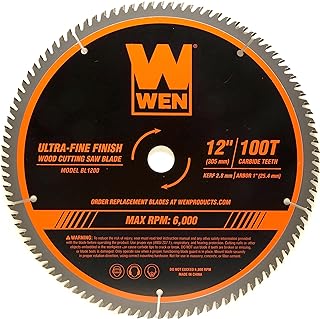
WEN BL1200 12-Inch 100-Tooth Carbide-Tipped
The BL1200 pushes into ultra-fine territory and rewards a slow, deliberate feed with nearly polished end grain on hardwood. It’s the better choice for miter joints on stain-grade work, where any tearout at the point of the miter is impossible to hide.
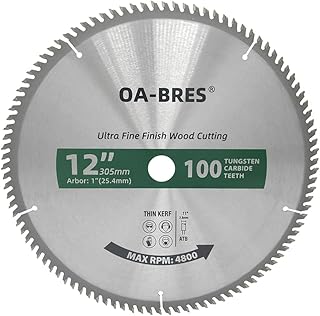
12-Inch 100-Tooth ATB TCT with 1-Inch Arbor
A straightforward high-tooth-count ATB blade with the standard 1-inch arbor, and a sensible pick if you want a dedicated finish blade without the brand premium. Performance on plywood and melamine is the highlight here, where the alternate top bevel keeps the top veneer intact.
Frequently Asked Questions
Is 100 teeth always better than 80?
Not always. A 100-tooth blade gives a finer surface but clears chips more slowly, so in thick or resinous stock it can generate heat and burn. Use 100 teeth for trim, panels, and stain-grade parts; 80 teeth for thicker hardwood and general shop cutting.
Can I use these blades on a table saw?
Several of these are rated for both, but check the manufacturer’s listing and the hook angle. Low-hook miter saw blades work for table saw crosscutting and sled work, but they are a poor choice for ripping thick stock.
Why is my fine blade still causing tearout?
Usually support, not the blade. Add a zero-clearance fence and sacrificial base, back up the cut with a scrap block, and let the blade reach full speed before contact. Feeding too fast on the downstroke is the other common cause.
When should I replace or sharpen a blade?
Watch for burn marks, increased feed pressure, and a rougher exit face. Quality carbide blades can be professionally resharpened several times, which is usually cheaper than replacement on premium models.
Final Thoughts
For most furniture and finish work, the DEWALT DWA112100 is the blade we’d put on the saw first and the one that stays sharp longest under real use. If value matters more, the WEN BL1200 delivers close to the same surface quality on stain-grade miters, while the ANGELSWORD 100T two-pack is the smartest buy for anyone who wants a dedicated finish blade plus a backup without overthinking it.