Key takeaways
- Tooth count and job matching: Roughly 24–40 teeth clear sawdust efficiently for ripping thick stock, 40–50 teeth handle mixed general work, and 60–80 teeth deliver the glass-smooth crosscuts and chip-free plywood edges furniture work demands. Higher isn’t better — it’s slower and hotter in solid ripping.
- Grind geometry: ATB (alternate top bevel) teeth slice wood fibers cleanly for crosscutting; flat-top or FTG grinds shear efficiently along the grain; TCG (triple chip) resists chipping in laminate and MDF. Check the grind before assuming a tooth count tells the whole story.
- Plate quality and kerf: A flat, tensioned steel plate stays true under heat and keeps the cut straight. Thin-kerf blades (about 3/32″) reduce strain on underpowered contractor saws and waste less material; full kerf resists deflection on cabinet saws with 3 HP or more.
- Carbide grade and arbor fit: Micro-grain carbide holds an edge through far more board feet and survives resharpening. Confirm a 5/8-inch arbor — standard on nearly every 10-inch North American saw — and verify the plate is properly balanced to limit vibration.
- Cost per usable cut: A single premium blade often outlasts several bargain ones, but two-blade sets make sense if you frequently switch between rough breakdown and finish work. Factor in whether local sharpening service is available for the blade you’re buying.
What's inside
Few upgrades change the character of a workshop as quickly as swapping the blade that came bundled with your table saw. Stock blades are shipped to be adequate at everything, which in practice means they leave burn marks on maple, tear out the veneer on plywood, and force you to sand edges that should have come off the saw ready for glue. The frustration compounds when you’re building furniture, where a single ragged crosscut on a visible apron or drawer front undoes an afternoon of careful layout.
This guide looks at the 10-inch blades worth putting on a home furniture builder’s saw in 2026 — general-purpose 40-tooth options, high-count finish blades for melamine and hardwood, and value two-packs that let you keep a ripping blade and a finish blade in rotation. Below you’ll find the shortlist, followed by the specifications that actually predict cut quality and honest notes on where each blade earns its keep.
As an Amazon Associate we earn from qualifying purchases.


🛒 Best Price Today on Amazon
Prime members get fast, free shipping on everything above, plus member-only deals. New members get a 30-day free trial — cancel anytime.
How to Choose a 10 Inch Table Saw Blades (2026)
- Tooth count and job matching: Roughly 24–40 teeth clear sawdust efficiently for ripping thick stock, 40–50 teeth handle mixed general work, and 60–80 teeth deliver the glass-smooth crosscuts and chip-free plywood edges furniture work demands. Higher isn’t better — it’s slower and hotter in solid ripping.
- Grind geometry: ATB (alternate top bevel) teeth slice wood fibers cleanly for crosscutting; flat-top or FTG grinds shear efficiently along the grain; TCG (triple chip) resists chipping in laminate and MDF. Check the grind before assuming a tooth count tells the whole story.
- Plate quality and kerf: A flat, tensioned steel plate stays true under heat and keeps the cut straight. Thin-kerf blades (about 3/32″) reduce strain on underpowered contractor saws and waste less material; full kerf resists deflection on cabinet saws with 3 HP or more.
- Carbide grade and arbor fit: Micro-grain carbide holds an edge through far more board feet and survives resharpening. Confirm a 5/8-inch arbor — standard on nearly every 10-inch North American saw — and verify the plate is properly balanced to limit vibration.
- Cost per usable cut: A single premium blade often outlasts several bargain ones, but two-blade sets make sense if you frequently switch between rough breakdown and finish work. Factor in whether local sharpening service is available for the blade you’re buying.
The Best 10 Inch Table Saw Blades (2026)s Reviewed
DEWALT DWA11040 40-Tooth Fine Finish
This is the blade most home shops should reach for first: 40 ATB teeth on ultra-sharp carbide split the difference between clean crosscuts and reasonable ripping speed, so you can build an entire case piece without stopping to swap. The thin kerf plays well with 1.75 HP saws that bog down under a full-kerf blade.
FOXBC 80-Tooth Ultra Finish
With 80 teeth and a 5/8-inch arbor, this one is purpose-built for the cuts you don’t want to sand — hardwood face frames, mitered trim, and prefinished plywood. Feed it slowly and keep it out of thick ripping duty, and it rewards you with edges close to jointer-ready.
WEN BL1080 80-Tooth Ultra-Fine Finish
A strong budget entry into high-tooth-count territory, the BL1080 handles melamine and veneered sheet goods with minimal top-surface chipping when paired with a zero-clearance insert. Carbide life is respectable for the price, though it benefits from being reserved strictly for finish cuts.
WEN BL1060 60-Tooth Fine Finish
The 60-tooth BL1060 is arguably the smarter buy for furniture makers who want finish quality without the heat buildup and slow feed rate of an 80-tooth blade. It moves confidently through 3/4-inch oak and poplar crosscuts and doubles well on a miter saw.
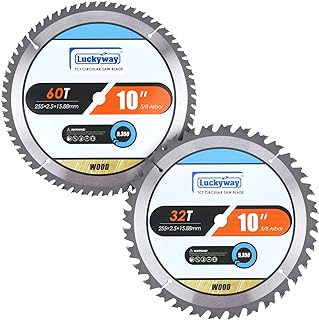
Luckyway 60T + 32T Two-Pack
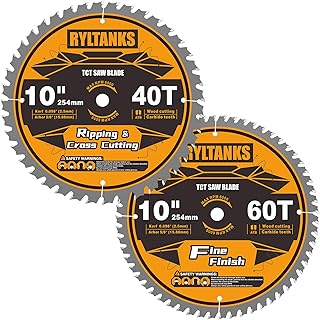
Getting a 32-tooth ripping blade and a 60-tooth finish blade together is the fastest way to a properly equipped saw on a modest budget. The 32-tooth clears chips well when dimensioning stock, and the 60-tooth takes over for joinery and visible edges.
Frequently Asked Questions
How many teeth do I need for plywood?
Aim for 60 to 80 teeth with an ATB grind, and pair the blade with a zero-clearance insert. The insert supports the veneer fibers at the cut line and often does more to eliminate tearout than the blade itself.
Why does my blade burn the wood?
Burning usually points to a dull blade, a fence out of parallel with the blade, resin buildup on the carbide, or feeding too slowly. Clean the blade with a dedicated pitch remover and check your fence alignment before replacing anything.
Thin kerf or full kerf?
Choose thin kerf if your saw is under roughly 2 HP or you’re a portable jobsite saw — less material removed means less power required. Full kerf resists flexing and is the better choice on heavier cabinet saws.
Can I use a table saw blade on my miter saw?
Often yes, provided the diameter, arbor size, and maximum RPM rating match, which is why several blades here list both uses. Confirm the tooth hook angle is neutral or negative for miter saw use, since aggressive positive hook can grab the workpiece.
Final Thoughts
For most home furniture builders, the DEWALT DWA11040 is the blade that stays mounted on the saw and the WEN BL1060 is the one you swap in when the cut will be seen. If you’re outfitting a saw from scratch on a tight budget, the Luckyway 60T and 32T two-pack covers both roles for less than the price of a single premium blade.