Key takeaways
- Tooth count matched to the cut: 24–32 teeth clear chips fast for ripping thick stock, 40 teeth is the honest all-rounder, and 60–80 teeth deliver the glassy crosscuts you want on visible furniture edges and plywood veneer.
- Arbor and plate accuracy: Confirm the 5/8-inch arbor fits your saw, then prioritize a flat, laser-cut plate. Plate runout causes more finish problems than dull carbide ever will.
- Grind geometry: ATB (alternate top bevel) slices cross-grain fibers cleanly; combination and Hi-ATB grinds add versatility and reduce tearout on melamine and prefinished panels.
- Kerf width and saw power: Thin-kerf blades waste less wood and suit lower-horsepower contractor saws; full-kerf blades resist deflection on cabinet saws with 3 HP or more.
- Noise, vibration, and dust: Look for expansion slots, anti-vibration cuts, and copper-filled slots. Quieter blades are not a gimmick — they mean less fatigue, better control, and a shop you can use without waking the house.
What's inside
Every woodworker who has built a headboard, a nightstand, or a slat bed frame knows the moment: the cut looks fine on the saw, but under a lamp the edge tells the truth. Fuzzed grain along the crosscut. A faint scallop where the blade wandered. Burn marks on maple that no amount of sanding fully erases. Nine times out of ten the saw is not the problem — the blade is. A tired or badly matched blade forces you to feed slower, push harder, and sand longer, and the piece that was supposed to feel calm and quiet in a bedroom ends up looking rushed.
There is a practical wellness argument here too. Bedroom furniture is furniture you touch in the dark and lie inches away from all night, so smooth edges, tight joints, and low-vibration cuts genuinely matter — and a sharp blade means fewer screaming passes through hardwood, less dust in the air, and shorter sessions in the shop. This guide covers ten table saw blades worth buying in 2026, how tooth count and grind geometry translate into real-world finish quality, and which blades to reach for depending on whether you are ripping frame stock, crosscutting panels, or sneaking up on a final show edge.
As an Amazon Associate we earn from qualifying purchases.



🛒 Best Price Today on Amazon
Prime members get fast, free shipping on everything above, plus member-only deals. New members get a 30-day free trial — cancel anytime.
How to Choose a 10 Table Saw Blades (2026)
- Tooth count matched to the cut: 24–32 teeth clear chips fast for ripping thick stock, 40 teeth is the honest all-rounder, and 60–80 teeth deliver the glassy crosscuts you want on visible furniture edges and plywood veneer.
- Arbor and plate accuracy: Confirm the 5/8-inch arbor fits your saw, then prioritize a flat, laser-cut plate. Plate runout causes more finish problems than dull carbide ever will.
- Grind geometry: ATB (alternate top bevel) slices cross-grain fibers cleanly; combination and Hi-ATB grinds add versatility and reduce tearout on melamine and prefinished panels.
- Kerf width and saw power: Thin-kerf blades waste less wood and suit lower-horsepower contractor saws; full-kerf blades resist deflection on cabinet saws with 3 HP or more.
- Noise, vibration, and dust: Look for expansion slots, anti-vibration cuts, and copper-filled slots. Quieter blades are not a gimmick — they mean less fatigue, better control, and a shop you can use without waking the house.
The Best 10 Table Saw Blades (2026)s Reviewed
FOXBC 10-Inch 80-Tooth Ultra Finish Blade
With 80 teeth and a fine-finish grind, this is a dedicated show-surface blade — ideal for crosscutting hardwood rails, cutting veneered ply, and trimming drawer fronts where sanding would ruin a crisp edge. Feed slowly and let the tooth count do the work; pushing it through thick ripping cuts will only load up the gullets.
DEWALT DWA11040 10-Inch 40-Tooth Fine Finish
If you keep one blade on the saw and refuse to think about it again, this is the pick: 40 teeth of ultra-sharp carbide that rips 3/4-inch hardwood without complaint and crosscuts cleanly enough for most joinery. It is the blade I recommend to anyone building their first bed frame or dresser.
WEN BL1080 10-Inch 80-Tooth Carbide-Tipped
A genuinely strong value in the ultra-fine category, the BL1080 leaves a near-planed surface on poplar, pine, and hardwood plywood, and it moves easily between table saw and miter saw duty. Expect to swap it out for ripping — this is a finishing tool, not a workhorse.
WEN BL1060 10-Inch 60-Tooth Fine-Finish
Sixty teeth is the sweet spot many woodworkers overlook: cleaner than a 40-tooth on crosscuts, but far less prone to burning and bogging than an 80-tooth when the stock gets thicker. For mixed furniture work in a one-blade shop, this is arguably the smartest single choice on the list.
10-Inch 40T + 60T Table Saw Blade 2-Pack
This pairing covers the two cuts that make up most furniture projects — ripping and cross-cutting with the 40-tooth, fine finishing with the 60-tooth — at a price that makes blade swapping feel painless instead of precious. A sensible starting kit for a new saw.
Frequently Asked Questions
How many teeth do I actually need for furniture work?
For most bedroom and case furniture, a 40-tooth blade handles the bulk of the job and a 60- or 80-tooth blade handles final visible cuts. Dedicated ripping blades in the 24–32 tooth range only pay off if you are milling a lot of thick rough lumber.
Why does my blade burn the wood?
Burning usually means dull carbide, misalignment between blade and fence, too high a tooth count for the cut, or feeding too slowly. Check alignment first — it is free, and it fixes more burning than a new blade does.
Can I use these blades on a miter saw too?
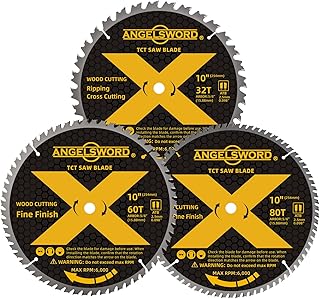
Several here, including the WEN and ANGELSWORD blades, are rated for both. Just confirm arbor size, maximum RPM, and that the blade’s hook angle is appropriate; aggressive positive-hook blades can grab on a sliding miter saw.
When should I replace rather than sharpen?
Quality carbide blades can be professionally resharpened two or three times before the teeth get too thin. Replace immediately if you find chipped carbide, a warped plate, or visible cracks in the gullets.
Final Thoughts
If you want one blade that quietly disappears into your workflow, the DEWALT DWA11040 is the safest bet in this lineup, with the WEN BL1060 running a close second for anyone doing more crosscutting than ripping. Add the FOXBC 80-tooth for final show cuts, and you have a three-blade setup that will carry you through beds, nightstands, and cabinets without a single fuzzy edge.