Key takeaways
- Headrest angle above all: The single most common complaint I hear is neck strain, not back strain. Look for a high back or adjustable headrest that supports your skull in a slight forward tilt rather than pushing your chin toward your chest — that pushed-forward position narrows the airway and encourages snoring if you drift off.
- Recline depth, deliberately chosen: A shallow recline (around 110–120°) keeps you alert for reading or feeding. A deep recline invites genuine sleep. Decide which behavior you want from the chair before you buy, because you will get the one the chair is built for.
- Heat and massage as wind-down tools: Lumbar heat is genuinely useful for pre-bed muscle release. Vibration massage is more variable — helpful for some, stimulating for others. Prioritize independent controls and an auto-off timer so the chair can’t wake you mid-cycle.
- Footprint and wall clearance: Swivel bases need rotational space, and manual recliners need rear clearance. Measure the arc, not just the chair. Small-space models trade a few inches of seat depth for the ability to actually rotate without hitting a bookshelf.
- Upholstery and thermal comfort: Sleep-onset requires a falling core temperature. Dense chenille and heavy microfiber trap heat beautifully in winter and work against you in a warm room. Breathable woven fabric is the safer year-round choice.
What's inside
Most people shop for a recliner the way they shop for a sofa — by looks, by footprint, by whether it matches the rug. But if you spend evenings in that chair, you’re not buying furniture so much as buying the last two hours before bed. As a sleep-wellness practitioner, I see the consequences of that choice constantly: the client who dozes off at 8:40 p.m. in an unsupportive chair and then lies awake at midnight, the new parent whose nursery glider forces a hunched neck angle through every 3 a.m. feed, the retiree whose chair is so comfortable it has quietly replaced the bed entirely. A swivel recliner sits at an unusual intersection of comfort and circadian consequence, and the wrong one costs you sleep quality without ever announcing itself as the culprit.
This guide evaluates the swivel recliners worth considering in 2026 through that lens — headrest geometry, recline depth, lumbar behavior over long sessions, heat and massage features that actually help downshift the nervous system, and the practical stuff like footprint, swivel smoothness, and nursery suitability. Below you’ll find our picks, followed by a buying framework, individual reviews, and answers to the questions that come up most often.
As an Amazon Associate we earn from qualifying purchases.


How to Choose a Swivel Recliner (2026)
- Headrest angle above all: The single most common complaint I hear is neck strain, not back strain. Look for a high back or adjustable headrest that supports your skull in a slight forward tilt rather than pushing your chin toward your chest — that pushed-forward position narrows the airway and encourages snoring if you drift off.
- Recline depth, deliberately chosen: A shallow recline (around 110–120°) keeps you alert for reading or feeding. A deep recline invites genuine sleep. Decide which behavior you want from the chair before you buy, because you will get the one the chair is built for.
- Heat and massage as wind-down tools: Lumbar heat is genuinely useful for pre-bed muscle release. Vibration massage is more variable — helpful for some, stimulating for others. Prioritize independent controls and an auto-off timer so the chair can’t wake you mid-cycle.
- Footprint and wall clearance: Swivel bases need rotational space, and manual recliners need rear clearance. Measure the arc, not just the chair. Small-space models trade a few inches of seat depth for the ability to actually rotate without hitting a bookshelf.
- Upholstery and thermal comfort: Sleep-onset requires a falling core temperature. Dense chenille and heavy microfiber trap heat beautifully in winter and work against you in a warm room. Breathable woven fabric is the safer year-round choice.
The Best Swivel Recliners of 2026, Reviewed
Korser 360° Swivel Rocker Recliner with Massage and Heat
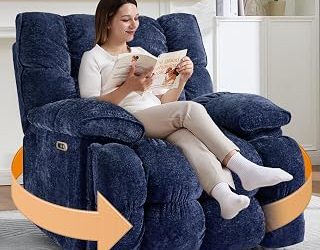
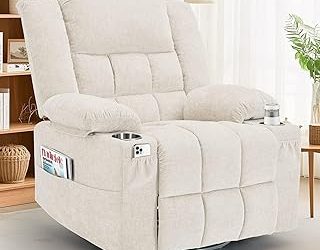
The strongest all-rounder here: a genuine 360° swivel, smooth rocking motion, and lumbar heat that makes it a legitimate wind-down station rather than just a comfortable seat. The cup holder and manual recline mechanism keep it simple, which matters when you’re operating it half-asleep.
Harkawon Swivel Rocker Recliner
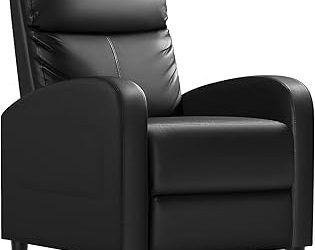
The high back and deep seat make this the best pick for taller users, whose necks are usually the first casualty of a standard-height recliner. No powered extras, but the support geometry is sound and the glider motion is quiet enough for a nursery.
Oversized Swivel Rocker Recliner with Adjustable Headrest
The adjustable headrest is the headline feature and the reason it earns a place here — it’s the only chair on this list that lets you tune head position independently of recline angle. The two removable pillows are a nice touch for side-leaning feeds; the barrel silhouette does run warm.
Davinci Suzy Electronic Swivel Recliner
Powered recline plus a USB port makes this the most nursery-literate design of the group, letting you adjust position without disturbing a sleeping infant. GREENGUARD Gold and CertiPUR-US certification also mean lower VOC off-gassing — a real consideration in a small bedroom where you’re breathing that air all night.
Korser Small-Space Swivel Rocker Recliner (Chenille)
Well-judged for apartments and compact bedrooms: it swivels and reclines without demanding a large clearance arc, and the side pockets keep books and a water glass off the floor. Chenille is cozy but heat-retentive, so pair it with a cooler room.
Frequently Asked Questions
Is sleeping in a recliner bad for you?
Not inherently — some people with reflux or sleep apnea sleep better slightly upright. The problem is unintentional recliner sleep: a fragmented 40-minute evening nap in a chair discharges sleep pressure and delays your actual sleep onset. Set a limit if you’re prone to drifting off.
Do the heat and massage functions actually help sleep?
Lumbar heat does, indirectly. Warming the periphery encourages heat loss and the core-temperature drop that precedes sleep. Vibration massage relaxes some people and alerts others — use it 60 to 90 minutes before bed rather than immediately beforehand.
Manual or powered recline?
Powered is worth it if you’ll adjust position frequently, have limited upper-body strength, or need silence around a sleeping baby. Manual mechanisms are cheaper, need no outlet, and have fewer failure points over a decade of use.
Are swivel recliners suitable for nurseries?
Yes, and often better than fixed gliders, since rotating toward a crib or changing table beats standing up. Look for a locking or resistance-damped swivel so the chair doesn’t drift while you’re holding an infant.
Final Thoughts
For most households, the Korser 360° Swivel Rocker with massage and heat delivers the best balance of support, motion quality, and genuine wind-down utility. Taller users should look first at the Harkawon high-back for its superior neck geometry, while parents furnishing a nursery will get the most from the Davinci Suzy — powered adjustment and certified low-emission materials are worth the premium in a room where someone very small sleeps every night.