Key takeaways
- Recline geometry: A 15-degree tilt is a TV chair; roughly 40 degrees or more, with the legs elevated near heart height, is where blood pooling eases and heart rate genuinely drops. If drifting off in the chair is part of your routine, prioritize maximum open angle over cosmetic details.
- Lumbar and cervical support: Your lower back needs a firm convex swell that meets the natural inward curve of the spine, and your head needs support that doesn’t push your chin toward your chest — forward head flexion narrows the airway and encourages snoring. Adjustable headrests are worth the premium.
- Thermal behavior of the upholstery: Core temperature has to fall for sleep pressure to build. Bonded and PU leathers trap heat against the skin; chenille and woven fabrics breathe; genuine leather sits in the middle and improves as it ages. Match the material to your room, not the showroom.
- Effort to operate: Push-back manuals ask you to brace and shove — fine at 30, a real barrier with hip, shoulder, or knee pain. Power mechanisms let you adjust in increments without leaving the relaxed state you just built, which matters more than the spec sheet suggests.
- Frame, footprint, and fit: Confirm seat width and depth against your own hips and thigh length, check the stated weight capacity, and measure the wall clearance the mechanism needs. A chair that’s an inch too deep will cut circulation behind your knees every single night.
What's inside
Most people shop for a recliner the way they shop for a lamp — by looking at it. But a recliner is one of the few pieces of furniture your body will spend hundreds of semi-conscious hours in, and from a sleep-wellness standpoint, that changes the calculus entirely. The evening hours you spend reclined are your nervous system’s runway into sleep. A chair that pins your neck forward, pools pressure under your thighs, or forces a hard shove to recline will quietly work against the wind-down process you’re trying to protect — and many buyers only notice months later, when the 9 p.m. slump has become a 9 p.m. backache.
This guide evaluates recliners through that lens: how well each one supports the lumbar curve, whether it can reach a genuinely restorative angle, how the upholstery handles overnight heat and humidity, and how much physical effort the mechanism demands from a body that’s already tired. Below you’ll find our picks for 2026 across manual and power designs, plus a short framework for matching a chair to your body and your evening routine rather than to your rug.
As an Amazon Associate we earn from qualifying purchases.




How to Choose a Home Furniture Recliner (2026)
- Recline geometry: A 15-degree tilt is a TV chair; roughly 40 degrees or more, with the legs elevated near heart height, is where blood pooling eases and heart rate genuinely drops. If drifting off in the chair is part of your routine, prioritize maximum open angle over cosmetic details.
- Lumbar and cervical support: Your lower back needs a firm convex swell that meets the natural inward curve of the spine, and your head needs support that doesn’t push your chin toward your chest — forward head flexion narrows the airway and encourages snoring. Adjustable headrests are worth the premium.
- Thermal behavior of the upholstery: Core temperature has to fall for sleep pressure to build. Bonded and PU leathers trap heat against the skin; chenille and woven fabrics breathe; genuine leather sits in the middle and improves as it ages. Match the material to your room, not the showroom.
- Effort to operate: Push-back manuals ask you to brace and shove — fine at 30, a real barrier with hip, shoulder, or knee pain. Power mechanisms let you adjust in increments without leaving the relaxed state you just built, which matters more than the spec sheet suggests.
- Frame, footprint, and fit: Confirm seat width and depth against your own hips and thigh length, check the stated weight capacity, and measure the wall clearance the mechanism needs. A chair that’s an inch too deep will cut circulation behind your knees every single night.
The Best Home Furniture Recliners (2026) Reviewed
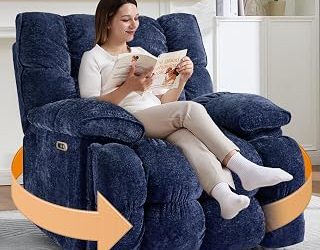
FLEXISPOT Mochi Oversized 54″ Power Recliner
Our overall pick, and the strongest choice for anyone who reliably dozes in their chair: the 54-inch seat removes the shoulder pinch taller and broader bodies deal with, and the breathable chenille avoids the clammy heat buildup that wakes people at the two-hour mark. Incremental power adjustment plus USB and Type-C ports mean you can settle in once and stay settled.
Signature Design by Ashley Boyington Power Recliner
The most therapeutically capable chair here — the zero-gravity position elevates the legs above the heart, which measurably reduces lower-limb swelling and takes compressive load off the lumbar discs. Gentle air massage and heat are useful pre-sleep parasympathetic cues, though the leather runs warm and the 250-pound capacity is worth verifying against your needs.
HULALA HOME Genuine Leather Manual Recliner
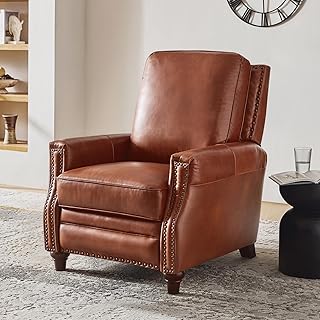
A rare case where design-led furniture doesn’t compromise the body: real leather over solid wood legs, with an independently adjustable backrest and footrest that let you dial in a supported posture instead of accepting one fixed position. Best for able-bodied users who want a chair that reads as a mid-century armchair, not medical equipment.
Homall Recliner Chair, PU Leather
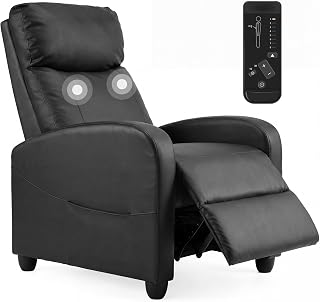
The value benchmark, and genuinely good on the fundamental that matters most — the built-in lumbar bolster sits at a sensible height and holds its shape. Expect PU leather to trap warmth in a room above roughly 72°F, so treat this as an evening-reading chair rather than an all-night one.
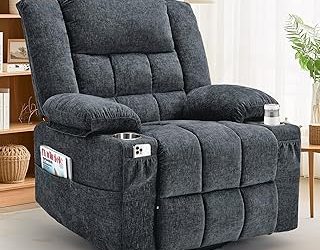
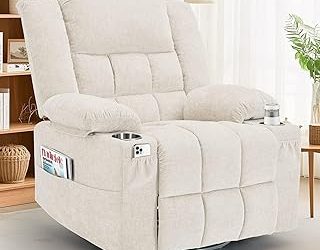
Massage Recliner Chair, Fabric, Ink
The smartest compromise for small living rooms: fabric upholstery that sheds heat, integrated massage for muscle downregulation, and lumbar support in a footprint that won’t dominate the space. Vibration massage isn’t the same as the air-cell system in the Ashley, but as a wind-down ritual it does the job.
Frequently Asked Questions
Is sleeping in a recliner actually bad for you?
Not inherently — and for people with acid reflux, sleep apnea, or post-surgical restrictions, an inclined position can be better than lying flat. The risks come from poor positioning: unsupported necks, dangling legs, and prolonged immobility that raises clot risk. Recline fully, support the head neutrally, and change position when you wake.
Manual or power for nightly use?
Power, in most cases. Manual mechanisms require a physical push that partially undoes the relaxation you’ve built, and they typically offer fewer usable positions. Manual chairs remain excellent for occasional reclining and cost meaningfully less.
Which upholstery is best if I run hot?
Woven fabrics like chenille first, genuine leather second, PU and bonded leather last. Synthetic leathers are effectively non-porous, so body heat and moisture accumulate at the contact points.
Does a recliner replace a proper bed?
No. Restorative sleep depends on the ability to shift position freely through the night, which no recliner permits. Use one as a wind-down station or a temporary medical accommodation, not a nightly substitute.
Final Thoughts
For most households, the FLEXISPOT Mochi is the best-balanced choice in 2026 — generous dimensions, breathable fabric, and effortless power adjustment cover the things that actually affect how you feel at bedtime. If circulation, swelling, or chronic lower-back pain are your main concerns, the Ashley Boyington’s zero-gravity recline and air massage justify the step up, while the HULALA HOME genuine leather recliner is the pick for anyone who wants real support without surrendering the look of their living room.